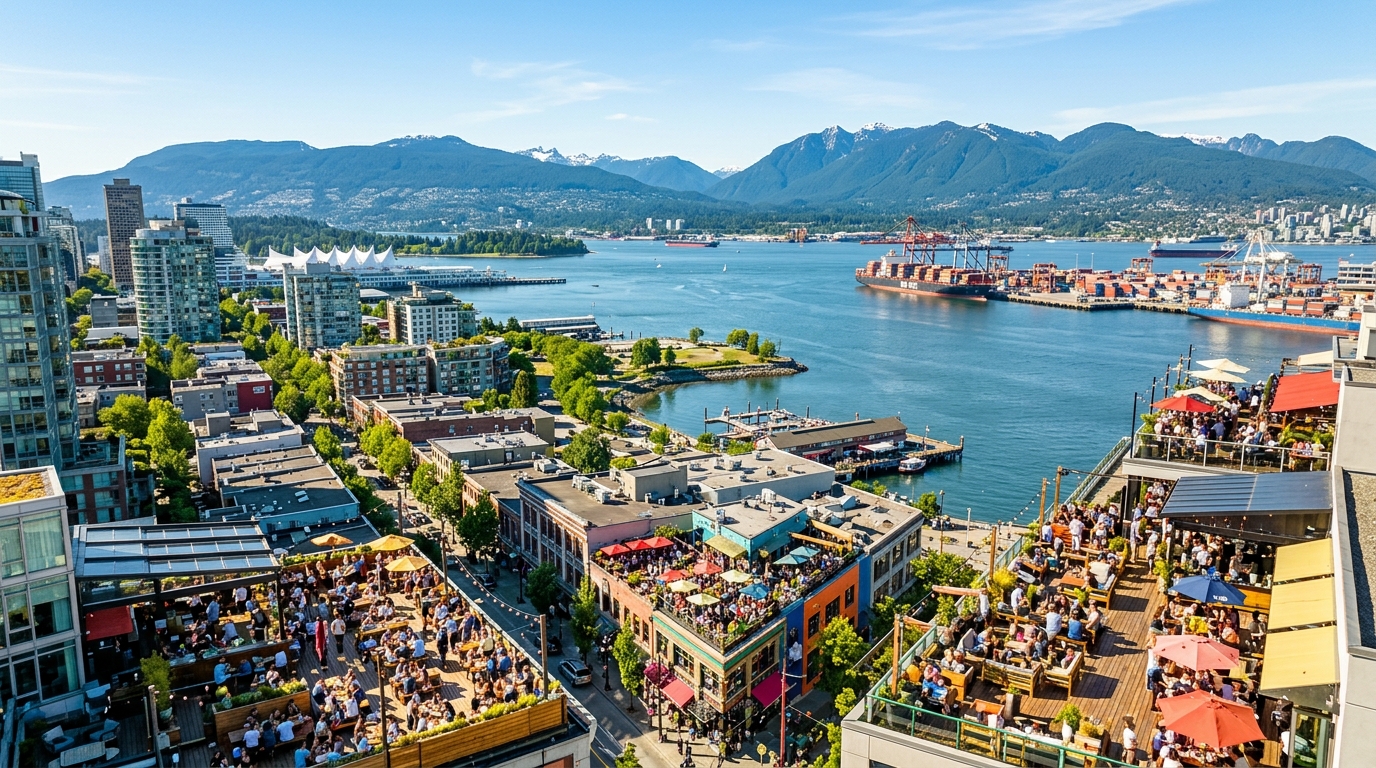
On a warm Friday evening in June, the patios along Robson Street and the Seawall fill faster than the dining rooms behind them. That is not a coincidence—it is a business model. For Metro Vancouver’s hospitality operators, it may be the most important economic variable of the summer.
BC’s Liquor and Cannabis Regulation Branch has expanded its temporary patio licensing program for the summer 2026 season, extending outdoor service hours and streamlining approvals for licensed premises across the province. For an industry still navigating elevated food costs and a minimum wage that rose to $17.85 per hour on June 1, 2026, the timing matters enormously. Outdoor seats are one of the few levers operators can pull without a capital renovation.
The foot traffic signal
Early summer data from the Downtown Vancouver Business Improvement Association (DVBIA) shows patio-anchored venues outperforming enclosed counterparts on foot traffic this season—a differential that is widening as temperatures hold above seasonal norms. The pattern is consistent with what economists call a revealed preference: when consumers have a choice, they are choosing the outdoor experience, and they are staying longer and spending more when they get it.
That dwell-time effect is critical. In hospitality economics, revenue per available seat hour—not just covers per night—determines whether a shift is profitable after labour and food costs. A table that lingers over a second round on a licensed patio generates meaningfully more gross margin than a quick-turn indoor table, particularly when the incremental cost of that second round is low.
The labour math underneath it all
The patio uplift is real, but it does not automatically translate to improved margins. At $17.85 an hour—up from $17.40 the prior year—BC’s food services and drinking places sector is absorbing significant labour cost increases. Operators who simply added patio seats without rethinking their staffing model have often found that the incremental revenue is consumed by the incremental wage bill.
The operators who are seeing real margin uplift this summer share a common characteristic: they restructured their labour model before patio season opened. Some have shifted to zone-based service, where a single server covers a larger outdoor section with the help of a runner or a digital ordering system—reducing the labour-to-cover ratio without degrading the guest experience. Others have reconfigured their kitchen prep schedules to front-load labour into lower-wage morning hours, keeping the high-traffic evening patio window as lean as possible on back-of-house headcount.
The BC Restaurant and Foodservices Association (BCRFA) has documented this shift in its operator guidance materials, noting that the wage floor increase has accelerated adoption of hybrid service models. The minimum wage increase is not only a cost; it is a forcing function that has pushed operators toward more efficient configurations they might otherwise have delayed.
The licence numbers tell the story
Applications for temporary patio licences in Metro Vancouver for the June–August 2026 window have increased year-over-year, with the LCRB processing a higher volume of approvals than the same period in 2025. That supply-side expansion makes the demand signal from DVBIA foot traffic data even more significant. Patios are multiplying, and they are still filling up.
The OpenTable view
Reservation data from OpenTable for Metro Vancouver reinforces the on-the-ground picture. Patio-specific reservation requests are running ahead of last year’s pace, and lead times for weekend patio bookings at well-reviewed venues have extended, suggesting demand is outpacing the new supply being licensed.
The kitchen table version
Strip away the jargon and the picture is this: BC raised the minimum wage, food costs remain high, and most of the usual margin levers have been pulled already. The patio licence expansion is a relatively low-cost way to grow revenue without growing headcount proportionally. But it only works if the labour model underneath it is already lean. Operators who restructured last fall are positioned to have their best summer in years. Those who did not are adding seats and adding wage costs in roughly equal measure.
The July peak—historically the highest-revenue weeks in Metro Vancouver’s hospitality calendar—opens in days. The playbook is not complicated: secure the licence, restructure the floor plan, right-size the service model, and let the city’s summer foot traffic do the rest.



