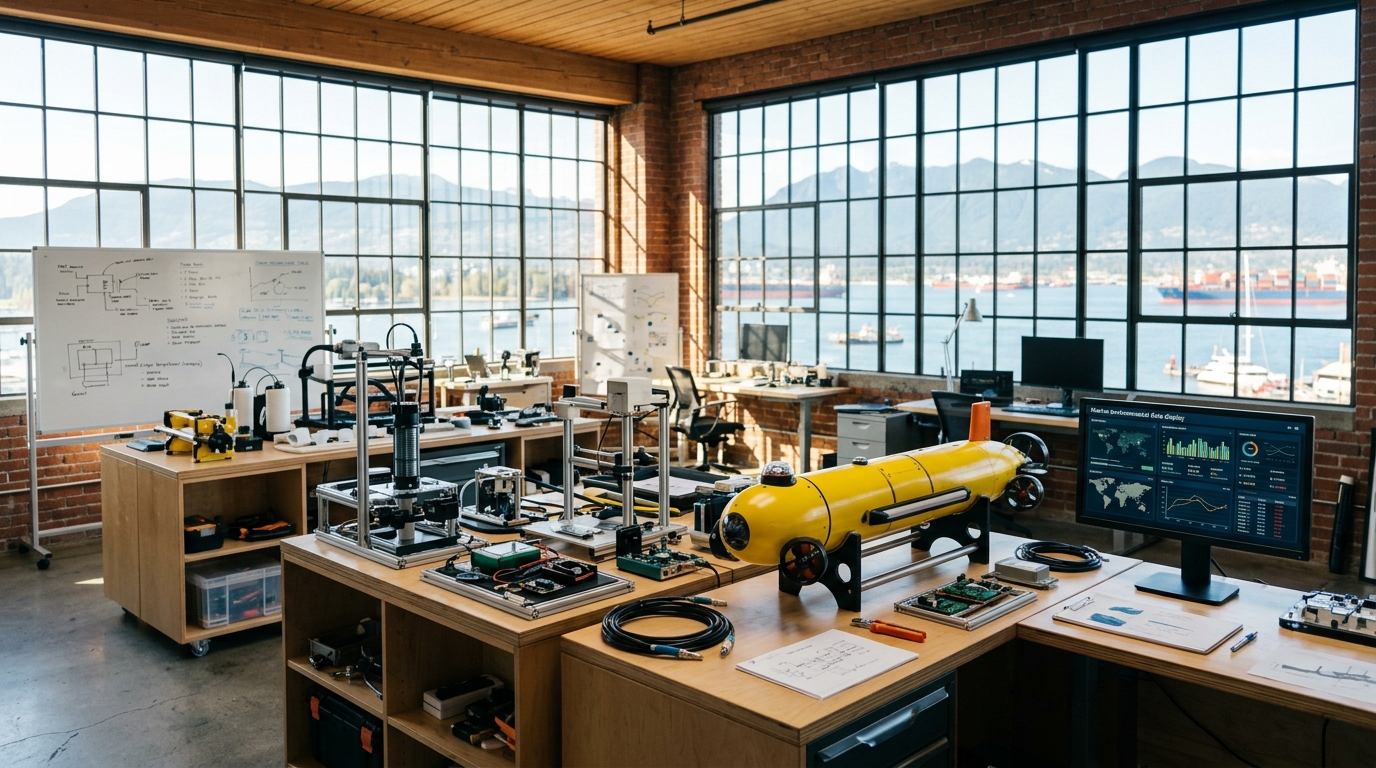
There is a sector generating defence contracts, federal procurement revenue, and export deals across the Pacific Rim—and most Vancouver investors have yet to take notice.
BC’s ocean technology cluster is not a concept. It is a functioning, revenue-generating industry built on the province’s deep-water access, world-class marine research institutions, and a geography that no other Canadian province can replicate. From underwater robotics to aquaculture monitoring platforms and marine environmental sensing networks, these companies are selling internationally, largely without the backing of domestic venture capital.
That is either a problem or an opportunity, depending on your perspective.
The Research Foundation
Ocean Networks Canada, operated out of the University of Victoria, runs one of the world’s most sophisticated ocean-observing systems. Its cabled underwater infrastructure across the Pacific and Arctic generates continuous environmental, seismic, and biological data. The commercialization pipeline flowing from that research base is robust, even if it has been slow to attract the attention of Bay Street or Vancouver’s own Howe Street venture community.
UBC’s ocean sciences programs and SFU’s marine research capacity further deepen the talent and intellectual property pool. NSERC-funded research across these institutions has seeded technologies now finding commercial applications in aquaculture, environmental compliance, and defence-adjacent sensing.
Federal Procurement as Anchor Revenue
For investors accustomed to software annual recurring revenue (ARR), ocean tech’s model looks different. The anchor customers are governments, not enterprises. Fisheries and Oceans Canada is a significant buyer of sensing, monitoring, and underwater systems—procurement that provides the kind of non-dilutive, recurring contract revenue that many startups spend years chasing.
Defence is the other anchor. NATO-allied contracts for marine surveillance and underwater acoustic systems are an emerging revenue stream for BC firms. Defence Research and Development Canada has been active in funding marine technology, and allied procurement—particularly from the United States, the United Kingdom, and Australia—is growing as undersea domain awareness becomes a strategic priority.
Why BC Has an Advantage
BC’s Pacific coastline provides direct access to deep water at a scale Ontario and Quebec cannot match. Testing underwater robotics or acoustic sensing equipment requires the ocean; having it at one’s doorstep compresses development cycles and reduces costs.
Innovate BC’s sector mapping has identified a meaningful cluster of marine technology companies in the province—a foundation most regions lack.
The Funding Gap
Deal flow data from NACO and CVCA shows ocean tech capturing a fraction of the capital flowing into cleantech, biotech, and software. The sector’s revenue model—government contracts and hardware-intensive products—does not fit the pattern-matching typical of Canadian venture capital.
However, this is an opportunity. Ocean tech companies with federal procurement relationships are not pre-revenue bets; they are businesses with defensible revenue and technical moats. There are no Sequoia-backed hyperscalers competing for Fisheries and Oceans Canada contracts.
What Comes Next
The sector’s invisibility is partly a marketing challenge. The National Research Council’s IRAP program has been a meaningful early-stage funder, signalling federal recognition of the sector.
The next step is a domestic investor cohort willing to underwrite Series A and B rounds for companies that have already de-risked their technology through government contracts. The exit paths are clear: strategic acquirers in defence, offshore energy, and environmental services are active buyers of proven marine assets.
BC has built this industry quietly over decades. For investors, the question is how long they will wait before the rest of the market catches on.