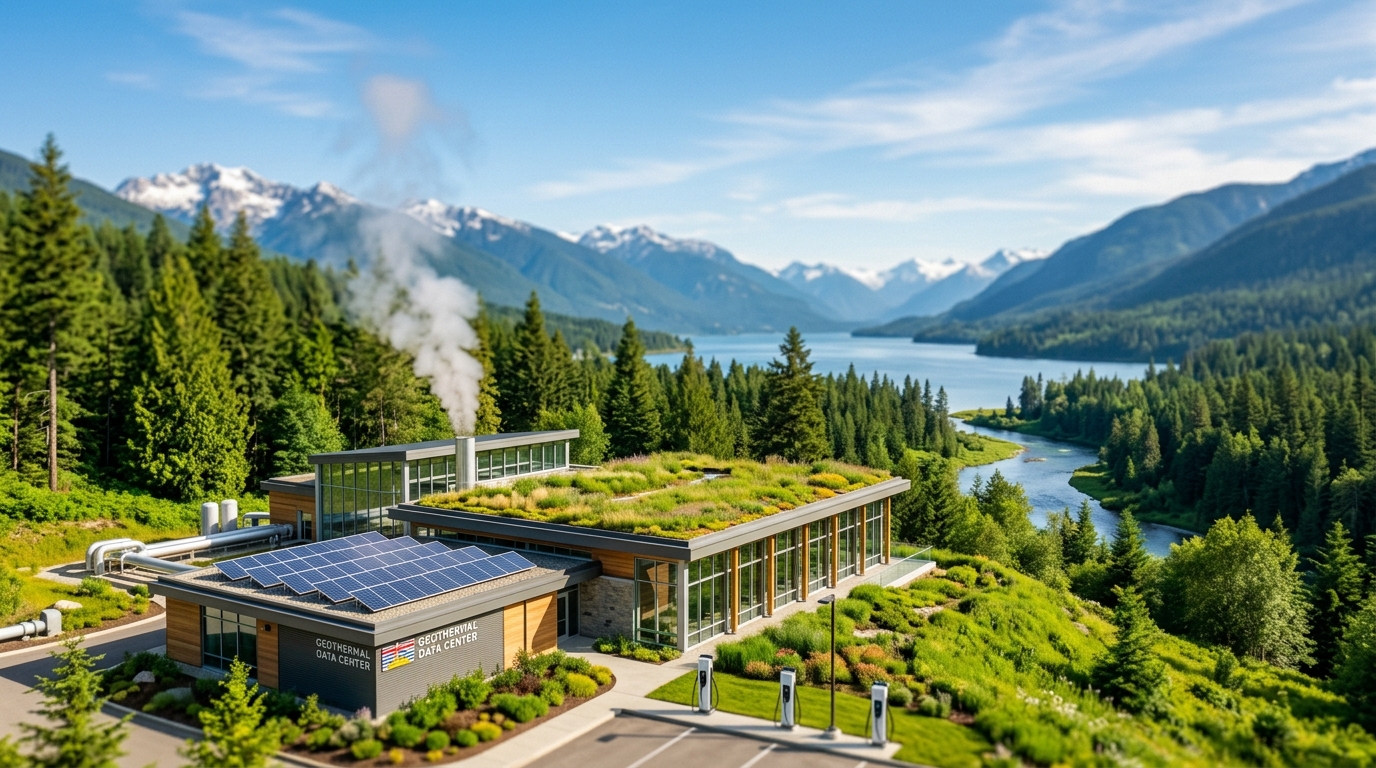
For two decades, geothermal energy in British Columbia occupied a familiar position in the clean energy conversation: promising in theory, perpetually stalled in practice. The geology was right, but the economics were not. That calculation is shifting, and for energy developers, data centre operators, and institutional investors, the window opening in 2026 looks meaningfully different from previous false starts.
Three conditions have converged. The BC Geological Survey has released updated geothermal resource mapping covering the Peace River and Stikine regions, providing the subsurface data that lenders require before committing capital. The federal government's Clean Electricity Investment Tax Credit now offers a 15% refundable credit on eligible capital costs for geothermal projects—a direct subsidy that shifts project economics. Furthermore, at least two advanced-stage projects in those northern regions are in active project finance discussions with institutional lenders, according to background information.
The core takeaway for investors: geothermal delivers baseload, dispatchable clean power—24 hours a day, regardless of weather—without touching BC Hydro's large-load interconnection queue, which currently runs approximately 48 months. For a data centre operator or industrial user that cannot wait four years for grid access, self-supply or direct industrial sale from a geothermal asset is a viable alternative.
Geothermal provides a structural answer to that constraint, not because it is cheap or fast to build, but because it produces firm power that can be sited near load and sold without grid intermediation.
The Resource Case
BC's geothermal potential has been understood for decades, but available mapping was previously insufficient for bankable development. The BC Geological Survey's updated assessments estimate geothermal gradients in the Peace River region at approximately 35–40°C per kilometre of depth—gradients that support commercial electricity generation at depths achievable with current drilling technology.
International precedent is well-established. Iceland generates approximately one-quarter of its electricity and nearly all of its heating from geothermal, operating at geological conditions comparable to BC's volcanic and tectonic zones. Kenya's Olkaria geothermal complex has demonstrated that emerging-market project finance can work at scale, a proof point that institutional lenders in Canada have begun to reference. While BC's resource is more diffuse than Iceland's and less surface-exposed than Kenya's, both demonstrate that commercial viability at these scales is not speculative.
The Finance Stack
The 2026 landscape differs from 2016 primarily in its capital structure. The federal Clean Economy ITC framework makes geothermal projects eligible for the 15% refundable Clean Electricity credit. Because it is refundable, the credit is paid out even if the project entity has no tax liability—a critical feature for special-purpose vehicles.
Layering the ITC against the Emerging Renewable Power Program helps close the capital stack. Institutional lenders—including pension funds and infrastructure debt funds—have shown appetite for long-duration, baseload renewable assets that carry federal credit support. Vancouver-based Borealis GeoPower has been among the most active developers working to advance BC geothermal, focusing on resource characterisation and regulatory navigation.
Reality Check: What Geothermal Cannot Do
Geothermal is not a near-term solution for Metro Vancouver's power needs. The resource is in the north, and transmission to population centres would require significant infrastructure investment. The opportunity lies in load that can move to the resource—such as remote data centres, industrial operations, or hydrogen production—or for northern communities currently reliant on diesel or natural gas.
Drilling risk remains. Geothermal exploration carries subsurface uncertainty higher than that of solar or wind. While the federal ITC helps absorb some of this risk, developers must structure exploration-phase capital separately from construction finance. Furthermore, permitting timelines in BC, particularly for projects intersecting with First Nations title and rights areas, require early and substantive engagement. The province's regulatory framework, administered in part through the BC Utilities Commission, has matured but remains more complex than wind and solar pathways.
The Operator's Calculation
For a developer facing a 48-month BC Hydro wait, a 20–50 MW northern geothermal project can potentially deliver firm power on a competitive timeline while qualifying for the federal ITC and avoiding ongoing transmission charges. Although the capital cost per megawatt exceeds that of solar, the capacity factor—typically above 90% for a well-characterised geothermal resource versus 15–25% for solar in BC—is significantly higher.
The projects currently advancing in the Peace River and Stikine regions will serve as the necessary proof-of-concept. If project finance closes, the resulting data on drilling costs, permitting, and generation performance will provide the track record required to underwrite the next wave of development.
That is how an also-ran becomes an asset class.