The electrification math for Metro Vancouver's commercial fleet operators looks straightforward: swap diesel for battery-electric, collect the incentives, and meet the targets. The engineering reality is considerably more complex. Across the region, logistics companies, transit authorities, and municipal fleet managers are discovering that the hardest constraint in fleet electrification is not the vehicles—it is the electrical infrastructure required to charge them, and the queue to get it built.
BC Hydro's commercial connections team currently quotes transformer lead times of 18 to 36 months for commercial service upgrades—the kind required when a depot needs to charge 20 or 40 heavy-duty vehicles overnight. That range is a strategic variable that will determine which operators remain compliant and competitive in 2028, and which continue to rely on diesel past the point of economic viability.
The policy clock is ticking. CleanBC's zero-emission vehicle targets require 100 per cent of light-duty vehicle sales to be zero-emission by 2035, with commercial fleet standards tightening progressively under Commercial Vehicle Safety and Enforcement (CVSE) regulations. For medium- and heavy-duty operators, the compliance runway is measurable. Those who treat infrastructure as a final step will find themselves stranded with capital tied up in depreciating diesel assets while grid connections remain months away.
The bottleneck, explained
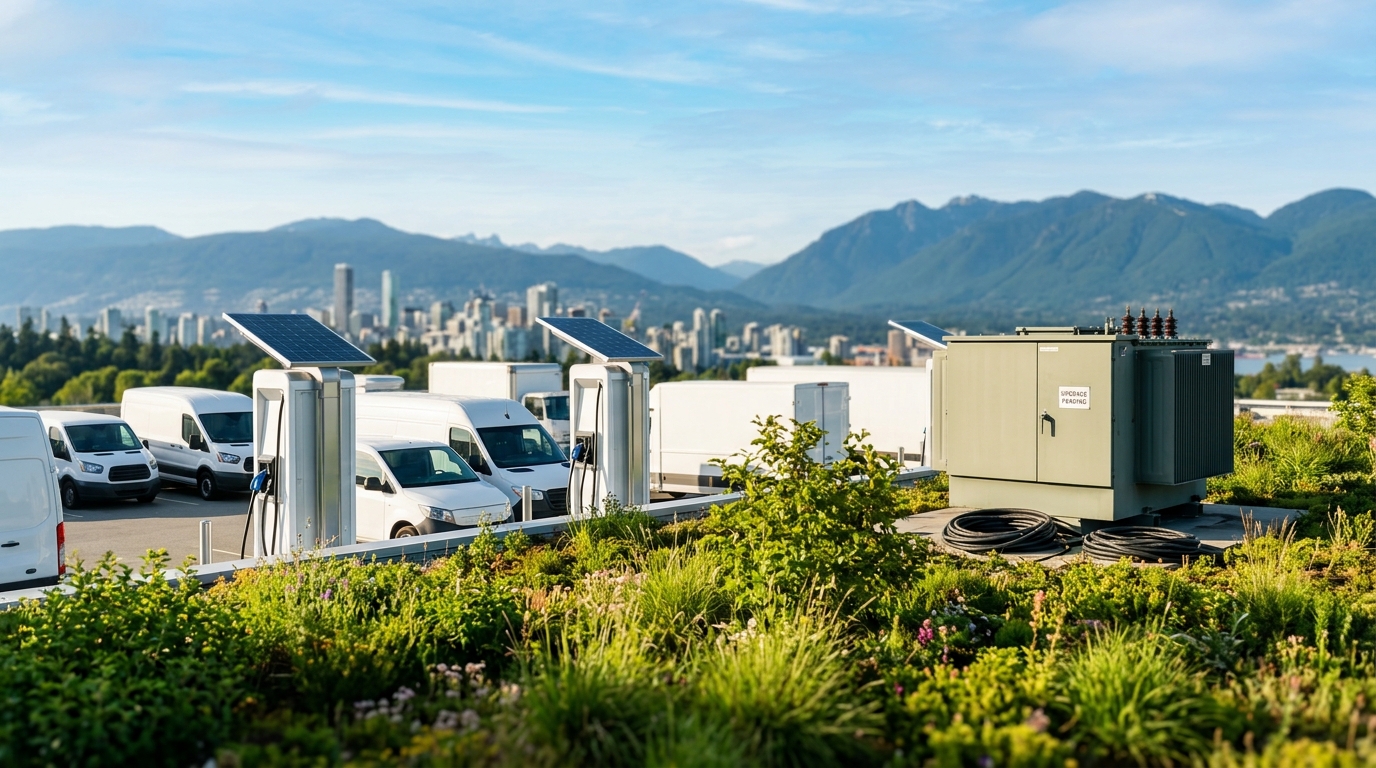
Commercial EV charging at scale requires more than plugging into an existing panel. A depot converting 30 Class 6 or Class 8 trucks may require a new pad-mounted transformer, upgraded service entrance equipment, dedicated metering, and, in some cases, distribution line extensions. Each step demands engineering assessments, permitting, and equipment procurement—and the transformer procurement step is where the timeline stretches.
The supply chain pressure on electrical transformers is not unique to British Columbia. Across North America, utilities compete for transformer capacity against data centre buildouts, industrial reshoring, and residential electrification programmes. BC Hydro draws from this same constrained global supply pool. The 18-to-36-month range reflects genuine manufacturing and logistics constraints.
In practice, an operator that submits a BC Hydro commercial connections application in the third quarter of 2026 and receives a transformer at the near end of the range could be energised by early 2028. An operator that waits until late 2027 is looking at 2029 at the earliest, and potentially 2030 if their project falls at the long end of the queue.
The winner-loser dynamic
This is a first-mover scenario with rigid timelines. Successful operators treat the infrastructure application as the first step in fleet conversion, not the last. They submit BC Hydro applications while still finalising vehicle procurement, accepting that planning assumptions will evolve once the connection timeline is confirmed.
Metro Vancouver's commercial vehicle fleet comprises more than 80,000 units across logistics, transit, construction, and municipal services. Even a modest conversion rate over the next three years represents a substantial queue of infrastructure applications. BC Hydro's pipeline is already under pressure, and that demand will intensify as CleanBC compliance deadlines approach.
The financial incentive to move early is substantial. The federal Incentives for Medium- and Heavy-Duty Zero-Emission Vehicles (iMHZEV) programme covers up to $200,000 per eligible vehicle. Provincial incentives through CleanBC Go Electric layer on top of federal support. Both programmes have budget ceilings and application windows; operators who delay infrastructure planning risk missing incentive cycles.
What the process looks like
The BC Hydro commercial connections process begins with a load inquiry—a formal submission outlining anticipated electrical demand, site location, and proposed service date. BC Hydro then conducts a system impact study to determine required infrastructure upgrades and cost allocation. For large loads, a facilities study follows before a service agreement is executed.
Each stage has its own timeline, and the clock does not start until the load inquiry is submitted. BC Hydro's commercial connections team can advise on requirements and current queue conditions. For complex sites, engaging an electrical engineer familiar with BC Hydro's interconnection standards before submitting the inquiry can reduce revision cycles and avoid unnecessary delays.
Reality check: Is there a workaround?
Some operators have explored interim strategies, such as mobile charging units or phased conversions. While these offer utility for managing the transition in stages, they do not resolve the underlying infrastructure constraint—they merely defer it. A fleet running 10 electric vehicles on existing service today will still require a transformer upgrade when it scales to 40.
Hydro-Québec's experience suggests that lead time pressures ease as utilities build procurement pipelines and standardise connection processes. BC Hydro is moving in that direction, but the near-term queue remains the binding constraint. Electric Mobility Canada has documented similar bottlenecks across multiple provinces, confirming that grid readiness is the primary hurdle for fleet electrification in most major Canadian markets.
For Metro Vancouver operators, the calculus is clear: submit the load inquiry now. The infrastructure timeline is the longest lead item in the conversion sequence and cannot be compressed. Operators who start the process in the second half of 2026 are competing for position with every other firm in the region. Those who are in the queue today will be the ones operating clean, compliant, and cost-efficient fleets in 2028.