The number concentrating minds in every restaurant back office from Gastown to Richmond is $18.25 per hour. That is BC’s minimum wage effective June 1, 2026—a figure that, when applied to a full front-of-house team, lands hard on an industry where labour costs for full-service operations typically consume 35 to 40 per cent of revenue. The math has changed, and so has the investment thesis.
What was an experiment in 2022—a delivery robot weaving between tables or an AI scheduling tool trimming overtime—is now an operational necessity. Metro Vancouver operators across restaurants, hotels, and event venues are deploying front-of-house automation at a pace that reflects a structural shift rather than a temporary trend. The question is no longer whether to automate, but how quickly and how to finance it.
BC Restaurant and Foodservices Association president and CEO Ian Tostenson has noted that the current trajectory of labour costs has effectively forced the hand of operators who were previously hesitant to automate. The association’s member data consistently identifies labour as the dominant variable cost—one now dictated by minimum wage schedules rather than operator discretion.
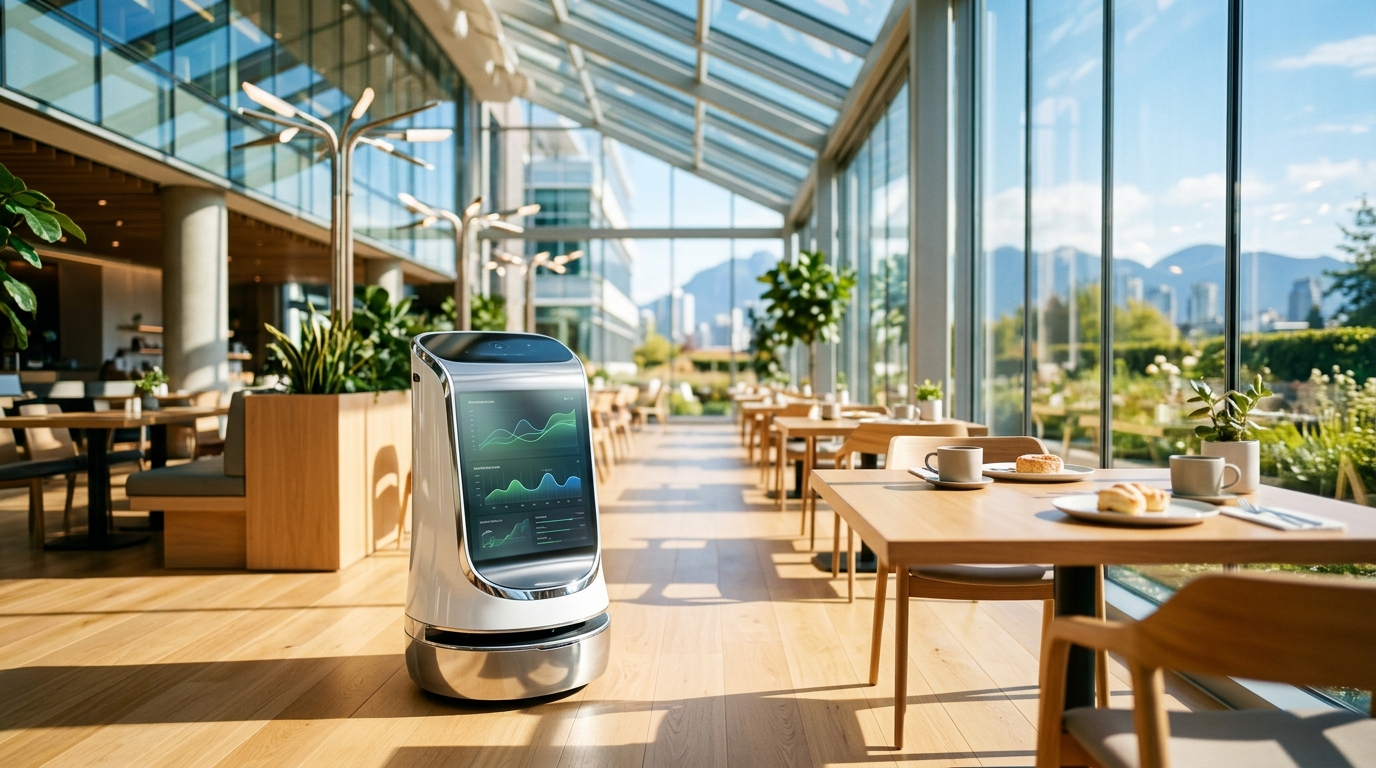
The payback arithmetic is becoming compelling. A front-of-house service robot—such as the autonomous food-delivery units now operating in a growing number of Lower Mainland restaurants—carries a capital cost that can be recovered in under two years when deployed across two daily shifts at the new wage floor. The Business Development Bank of Canada has flagged hospitality automation as an emerging financing category, with equipment loan structures increasingly tailored to the sector’s cash-flow seasonality. For commercial lenders, this is a new asset class with a clear collateral story.
The technology stack extends beyond robotics. AI-driven scheduling platforms—which optimize shift assignments against predicted covers, weather, and local events—are delivering measurable reductions in overtime and overstaffing. Statistics Canada’s accommodation and food services labour data shows the sector’s wage bill growing faster than revenue since 2021, a compression dynamic that makes even a 10 to 15 per cent scheduling efficiency gain material at the unit level. Automated ordering systems are also reducing front-of-house headcount requirements at quick-service and fast-casual operations across Metro Vancouver.
The opportunity for vendors is competitive. Global players including Bear Robotics and Keenon Robotics have established a Canadian presence, and Vancouver-area integrators are now offering turnkey deployment packages that bundle hardware, software, and maintenance. The market is moving from early adopter to early majority, a critical phase for securing distribution advantages.
Operators are not simply swapping humans for machines. Sophisticated deployments are restructuring roles, moving staff from repetitive transport and order-entry tasks toward guest experience and problem resolution. BC Hotel Association benchmarking data indicates that hotels are using AI-assisted concierge tools to extend service hours without proportional headcount increases, a model particularly relevant as the province’s hospitality sector absorbs tourism growth alongside rising wage floors.
The window for competitive advantage through early adoption is narrowing. Operators who act in the next 12 to 18 months will restructure their cost base before the next wage adjustment cycle. Those who wait are not avoiding capital outlay; they are deferring it while margins absorb the full cost of inaction. For vendors and financiers, that asymmetry is the pitch.