The pitch for British Columbia as a data centre hub is compelling: abundant hydroelectric power, a temperate climate that reduces cooling costs, and a stable regulatory environment. Metro Vancouver should be a prime destination for new infrastructure. Instead, the industry’s most urgent conversation is happening within BC Hydro’s interconnection queue, where the volume of requests is testing the limits of the province’s electrical grid.
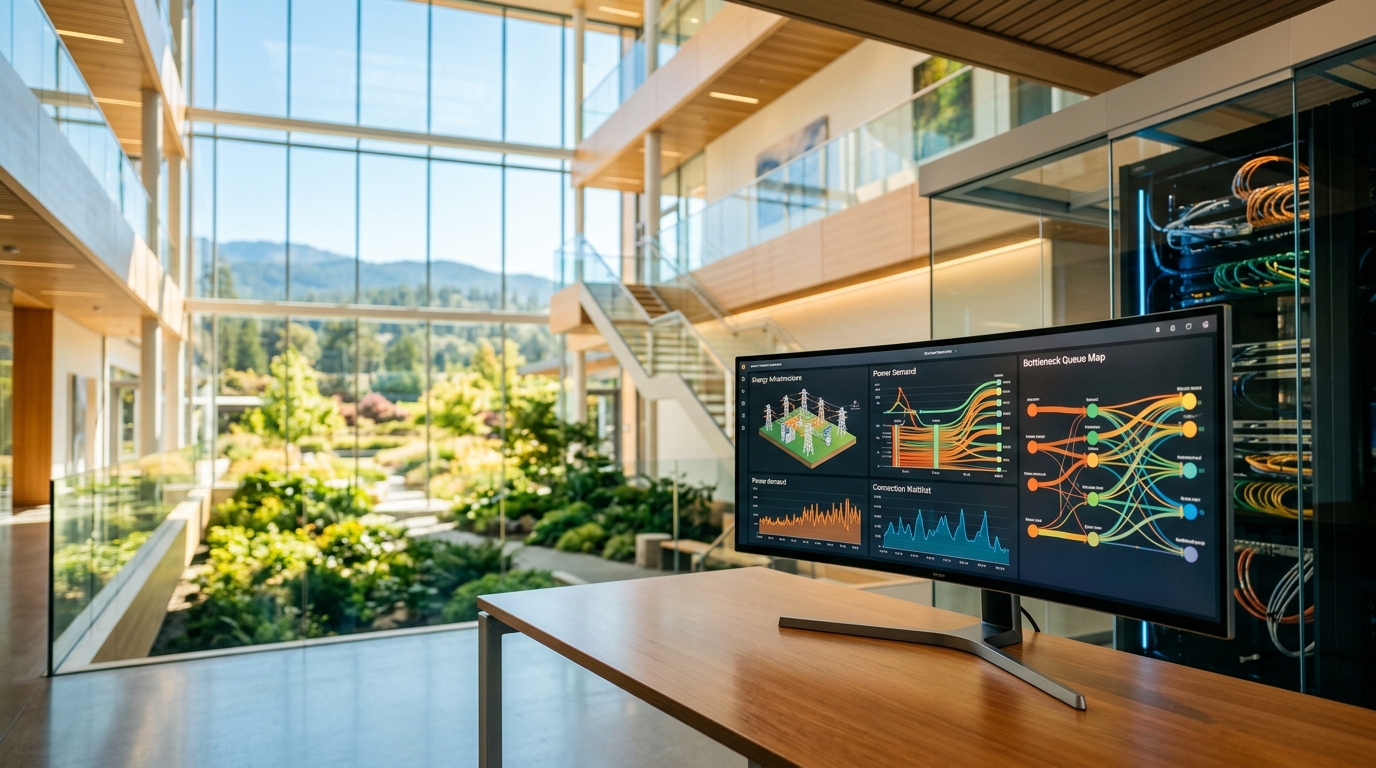
BC Hydro’s load interconnection queue has grown significantly over the past two years, driven by operators seeking large industrial power allocations. While the utility historically processed a steady stream of requests, it is now managing a surge of applications representing hundreds of megawatts of projected demand. Much of this is tied to AI model training and inference workloads, which consume power at a scale far exceeding conventional enterprise computing. It is important to note that BC Hydro actively filters this queue to prioritize serious projects over speculative inquiries, though the overall pressure on the grid remains high.
The cause is clear. A single rack of high-density AI accelerators can draw ten times the power of a standard server rack. Hyperscalers and co-location operators are seeking jurisdictions that can deliver large blocks of clean, affordable power. Natural Resources Canada projections identify data centre energy demand as one of the fastest-growing load categories in the country, with AI infrastructure as the primary driver.
BC’s competitive position remains strong. BC Hydro’s industrial electricity rates are among the most competitive in North America, though developers should note that new Tier 2 rates and the utility’s "Clean Power Call" may impact costs for exceptionally large new loads compared to historical averages. The province’s mild climate also provides a natural advantage in power usage effectiveness (PUE). Well-designed facilities in Metro Vancouver can achieve PUE ratios approaching 1.2, meaning most energy is directed toward computing rather than cooling.
Global co-location operators, including Digital Realty and Equinix, have identified Canada as a priority market. Digital Realty’s Canadian expansion commentary highlights clean-power access as a central site-selection criterion, while Equinix has identified Vancouver as a market where demand is outpacing available capacity.
The primary friction point is the interconnection process. Unlike a standard building permit, a large industrial power connection requires BC Hydro to assess transmission capacity, plan infrastructure upgrades, and sequence requests against existing commitments. This process often takes years. For operators facing 18-to-24-month delivery timelines for hyperscaler clients, this delay is a significant constraint.
Metro Vancouver’s industrial land market adds further complexity. Large-footprint sites with adequate power proximity are scarce, and the region’s industrial land squeeze limits available space for data centre development. The combination of constrained land and power creates a genuine capacity ceiling.
The policy stakes are high. Data centres represent significant capital investments with long operating lifespans and high-value employment. The Canada Green Building Council continues to advocate for tighter energy performance standards, which would further favour BC’s hydroelectric supply. If the province can streamline its interconnection processes, it is well-positioned to capture a significant share of the clean-data-centre capital flowing through North America.
The challenge remains whether BC Hydro’s planning and approval processes can accelerate to match private-sector timelines. While the utility has signalled awareness of the demand surge, infrastructure investment cycles for transmission capacity are inherently long. For investors, the near-term calculus is simple: BC remains a top-tier jurisdiction on fundamentals, but power allocation is the ultimate scarce resource. Operators who have already secured capacity hold a distinct advantage, while new entrants face a increasingly crowded queue.