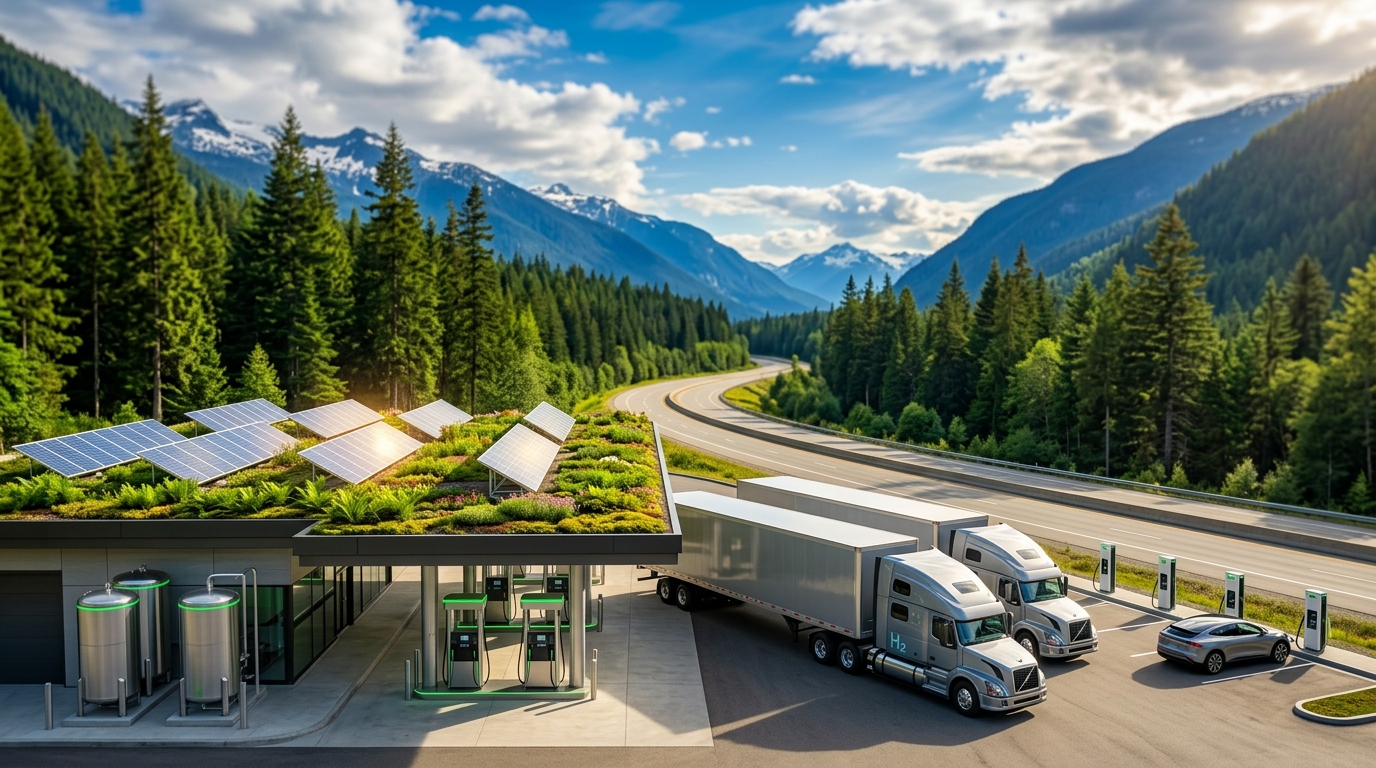
For years, British Columbia’s hydrogen ambitions were measured in government-funded pilots. That phase is ending. A cluster of private operators is now commissioning the province’s first commercial hydrogen fuelling stations along the Highway 1 corridor between Metro Vancouver and Kamloops—infrastructure financed by private capital rather than public demonstration grants. For fleet operators and logistics investors, the strategic window to position ahead of this infrastructure build-out is open today.
The primary catalyst is federal policy. The Clean Hydrogen Investment Tax Credit, introduced in the 2023 federal budget, covers up to 40 per cent of eligible capital costs for green hydrogen production and fuelling infrastructure. This incentive is rewriting project economics for station operators who previously relied on operating subsidies. Projects that were once marginal are now pencilling out, and the pipeline of committed private capital along Highway 1 reflects this shift.
The corridor is a logical first target. Highway 1 handles an estimated 12,000 to 15,000 commercial vehicle trips per day between Metro Vancouver and the Interior, representing one of the densest heavy freight routes in Western Canada. This concentration of demand supports the utilisation rates necessary for commercial viability. The route also fits within the operational range of current-generation hydrogen fuel cell Class 8 trucks, which typically travel 500 to 800 kilometres between fills.
BC’s policy framework is aligned with these private efforts. The CleanBC Hydrogen Strategy targets hydrogen for seven per cent of the province’s total energy by 2030. By identifying the Highway 1 freight corridor as a priority zone, the strategy has helped operators navigate regulatory and permitting pathways that previously delayed project timelines.
The first stations are slated for commissioning in the second and third quarters of 2026. Developers are currently negotiating multi-year fuel supply agreements—or offtake structures—with fleet customers to secure project financing. For fleet operators, this creates a clear decision: sign an offtake agreement to lock in pricing and supply, or risk facing a thinner market with less leverage once capacity is fully committed.
Interest among BC fleet operators is growing. The BC Trucking Association has documented increasing interest in alternative fuels, driven by policy headwinds such as the federal Clean Fuel Regulations, rising carbon pricing, and the prospect of zero-emission vehicle mandates. For long-haul operators, hydrogen offers a zero-emission pathway that matches current operational requirements better than battery-electric technology.
Economic scrutiny remains necessary. Green hydrogen remains more expensive per kilometre than diesel, though the gap is narrowing as electrolyser costs fall and carbon pricing on diesel increases. The Canadian Hydrogen Association projects that green hydrogen could reach cost parity with diesel on a total cost of ownership basis between 2028 and 2032 in jurisdictions with low-cost renewable power, such as BC.
For cleantech investors, the signal is structural. While the Canada Infrastructure Bank continues to support enabling infrastructure, the transition to private-led financing marks a significant inflection point. BC’s combination of low-carbon electricity, dense freight routes, and federal tax credits creates a credible early-market environment.
Several risks remain. Hydrogen supply chain reliability has not yet been demonstrated at scale in BC. Furthermore, station downtime has been a persistent challenge in California’s more mature market. Fleet operators should prioritize contractual protections regarding supply reliability and pricing in any offtake agreements. Additionally, the federal tax credit requires projects to meet specific domestic content and labour conditions, adding complexity to execution.
Despite these challenges, the fundamental shift is clear: private capital is moving on BC hydrogen infrastructure. The Highway 1 corridor serves as the proving ground. Logistics investors and fleet operators who engage with the emerging offtake market now will be better positioned than those who wait for the infrastructure to be fully realized.