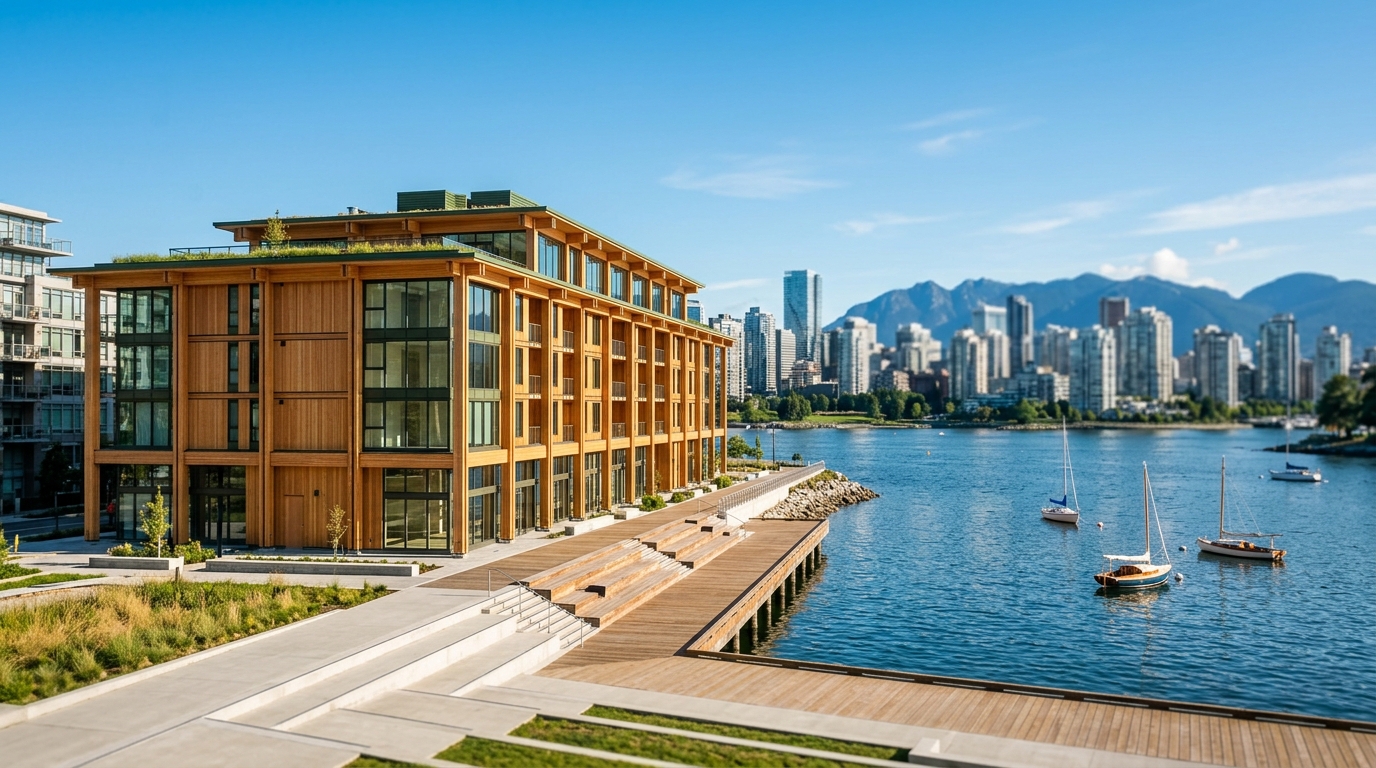
Walk the ground floor of a recently completed mid-rise in Vancouver’s Mount Pleasant neighbourhood and you will notice something the concrete towers around it lack: the scent of the forest. Cross-laminated timber (CLT) panels line the ceiling, Douglas fir columns frame the lobby, and the building’s embodied carbon footprint is a fraction of what steel and concrete would have produced. That sensory detail—wood grain where rebar once stood—is now a competitive export product, and BC firms are racing to lead the category internationally.
The data behind that race is striking. BC accounts for the majority of Canada’s CLT production capacity, a structural advantage built on Interior forests, provincial procurement policy, and a decade of investment in mass timber expertise. As the European Union tightens embodied carbon requirements for new buildings and U.S. federal procurement rules increasingly penalise carbon-intensive materials, that advantage is translating into contract flow extending well beyond BC’s borders.
The global mass timber market is projected to grow significantly through 2030, driven by carbon accounting that finally prices the emissions locked into concrete and steel, advances in engineered wood products, and a generation of architects and developers who watched early BC showcase projects prove the concept at scale.
The Regulatory Tailwind
The primary driver is regulation. The EU’s revised Construction Products Regulation and forthcoming whole-life carbon requirements for publicly funded buildings are forcing developers to account for embodied carbon, favouring mass timber. Australia’s National Construction Code has moved in a similar direction. In the U.S., the Inflation Reduction Act’s Buy Clean provisions and state-level procurement rules in California, Oregon, and Washington are creating a parallel pull.
For BC producers and designers, this regulatory convergence is a rare opportunity: demand is being legislated into existence in markets they are already positioned to serve. FPInnovations, the forest products research institute with a significant presence in Vancouver, has been tracking the international uptake of Canadian CLT and has noted growing inquiry from European and Asia-Pacific markets tied to carbon compliance timelines.
Domestically, BC’s Wood First Act requires that wood-frame construction be given primary consideration in all provincially funded buildings—a policy floor that has kept the local supply chain active, skilled, and cost-competitive.
Who Is Winning the Contracts
The firms capturing international work share a common profile: they invested early in mass timber expertise, built portfolios of completed projects, and developed the engineering depth to navigate foreign code compliance. These firms generally fall into two categories: manufacturers, constrained by fibre supply, and design-engineering firms, constrained by human capital.
Mercer Mass Timber (which acquired the assets of Structurlam in 2023) represents the manufacturing side of the equation—a producer with the scale to fulfil large international orders. Nordic Structures, with roots in Quebec but significant BC project experience, has similarly expanded its geographic footprint as North American demand has grown.
On the design and engineering side, several Metro Vancouver firms have built reputations that now precede them into international RFP processes. The competitive advantage is partly technical—BC engineers have more completed mass timber high-rises in their portfolios than almost anywhere else on earth—and partly relational, built through conferences and research partnerships.
The Canadian Wood Council has been active in international market development, running trade missions and technical delegations that have opened doors in the UK, Germany, Japan, and Australia. The Council’s export development work has been credited with accelerating the pipeline for BC-origin products in markets where Canadian wood had previously been viewed primarily as commodity lumber.
The Next 18 Months
Capacity remains a critical concern. BC’s CLT mills are running at high utilization, and the Interior’s fibre supply—already under pressure from the mountain pine beetle legacy and wildfire—is a constraint that cannot be ignored. Firms that want to capture the international wave must invest in production capacity now.
The next 18 months will likely see a shakeout between BC firms that have built the operational depth to deliver at international scale and those that have the design credentials but lack the supply chain to back them up. The most competitive players are those who have locked in fibre supply agreements, invested in precision manufacturing equipment, and built the project management capacity to execute across multiple time zones and code regimes simultaneously.
There is also a skills dimension. Mass timber construction requires specialized trades knowledge—connection detailing, moisture management, and acoustic performance—that differs from conventional concrete or steel. BC’s construction workforce has been building this knowledge base for a decade, and that expertise is itself an export product: several Vancouver firms are now being engaged to train local workforces in target markets.
The Bottom Line
For Vancouver developers, engineers, and manufacturers, the signal is clear: the international window is open, the regulatory tailwind is real, and BC’s structural advantages—production capacity, design expertise, completed project portfolios, and provincial policy support—are genuine. The firms that move decisively on capacity and international business development in the next 18 months are positioning themselves to lead a category that will only grow as carbon accounting becomes standard practice in construction procurement worldwide.
The scent of forest in a Mount Pleasant lobby is no longer just an aesthetic choice. It is, increasingly, a compliance solution—and BC knows how to build it better than almost anyone else on the planet.



