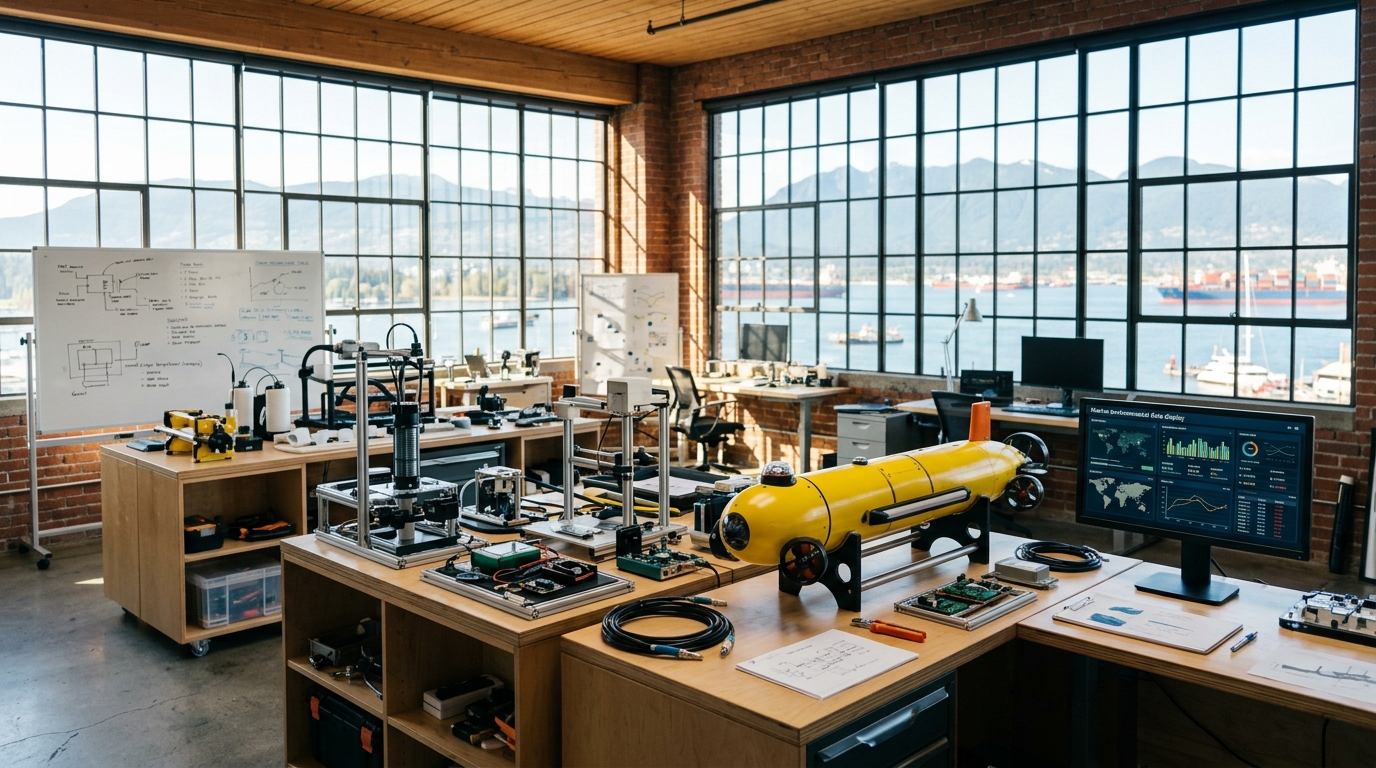
There is a moment in every deep-tech vertical when government procurement stops being a consolation prize and starts being the smartest business development move a founder can make. For BC’s ocean technology cluster, that moment is now.
A cohort of Metro Vancouver and Victoria-based startups—building everything from autonomous underwater vehicles (AUVs) to marine biosensors and AI-driven fisheries-monitoring platforms—has quietly assembled something most early-stage companies never achieve: anchor revenue from federal contracts, combined with credible interest from international strategic acquirers. It is a combination that changes the fundraising calculus entirely.
The engine driving this shift is Transport Canada’s Oceans Protection Plan 2.0, which includes a $2-billion, nine-year federal commitment to marine safety, spill response, and Indigenous coastal stewardship. Alongside it, Fisheries and Oceans Canada’s accelerating digitization program has been pushing contracts toward technology vendors who can modernize stock assessment, habitat monitoring, and vessel tracking infrastructure. For BC firms positioned at that intersection, the timing is exceptional.
The Dual Revenue Thesis
Federal procurement does two things simultaneously for an ocean tech startup. It provides non-dilutive, recurring revenue that extends runway without another equity round. It also functions as third-party technology validation—the kind that a Norwegian energy major or an Australian port operator weighs heavily when evaluating acquisition targets.
BC sits at a natural advantage. The province’s coastline, salmon fisheries, and port infrastructure create a domestic proving ground that few jurisdictions can replicate. A sensor array that survives a winter in Hecate Strait is a sensor array that can sell in the North Sea.
Canada’s Ocean Supercluster, headquartered in Halifax but with significant BC membership, has been a conduit for co-investment between federal dollars and private capital. Several Metro Vancouver companies in its portfolio have used Supercluster project funding as a bridge to DFO procurement relationships—a sequencing that sophisticated founders are now deliberately engineering from day one.
Who Is Moving from Pilot to Procurement
The cluster is not monolithic. The companies generating the most acquisition interest share a common profile: they have moved at least one product from pilot contract to multi-year procurement, they have international data sets, and they have been deliberate about IP ownership rather than licensing core technology to government partners.
Foresight Canada’s clean technology portfolio includes several BC ocean tech firms that fit this description, particularly in the marine emissions monitoring and ballast water management segments—areas where International Maritime Organization regulatory tightening is creating commercial pull from global shipping operators.
The BC Tech Association’s ocean tech working group has been tracking the procurement pipeline and flagging the acquisition dynamic to its members, noting that international interest tends to arrive 12 to 18 months after a company lands its first significant federal contract—precisely the window several cluster members are now entering.
The Acquirer Landscape
The strategic acquirers circling BC ocean tech are well-capitalized and motivated. Norwegian maritime technology firms—many of them subsidiaries of energy and shipping conglomerates—have been active acquirers globally, with transaction multiples in comparable Norwegian deals running at significant premiums to traditional software valuations, reflecting the scarcity of proven, deployment-ready ocean technology.
Australian acquirers, particularly those connected to offshore energy and fisheries management, represent a second vector. Australian strategic acquisitions in the marine tech space have similarly commanded premiums driven by the difficulty of replicating real-world deployment data—exactly the asset BC companies are accumulating through their federal contracts.
The pattern is consistent: acquirers are not buying revenue. They are buying validated technology, government relationships, and deployment data that would take years and hundreds of millions of dollars to replicate organically.
The Bigger Picture
Ocean tech has been the quiet achiever of BC’s deep-tech scene for years—overshadowed by AI, fintech, and clean energy in the headlines, but steadily maturing in the background. The federal procurement cycle is now acting as a forcing function, accelerating the timeline from promising startup to acquisition-ready asset.
For founders in the cluster, the strategic imperative is clear: structure government contracts to retain IP, build international data sets wherever possible, and treat DFO and Transport Canada relationships as references—not just revenue. For investors, the question is simpler: which BC ocean tech companies are 12 to 18 months past their first major federal contract? That is where the acquisition conversations are happening.
The ocean is patient. The acquirers are not.