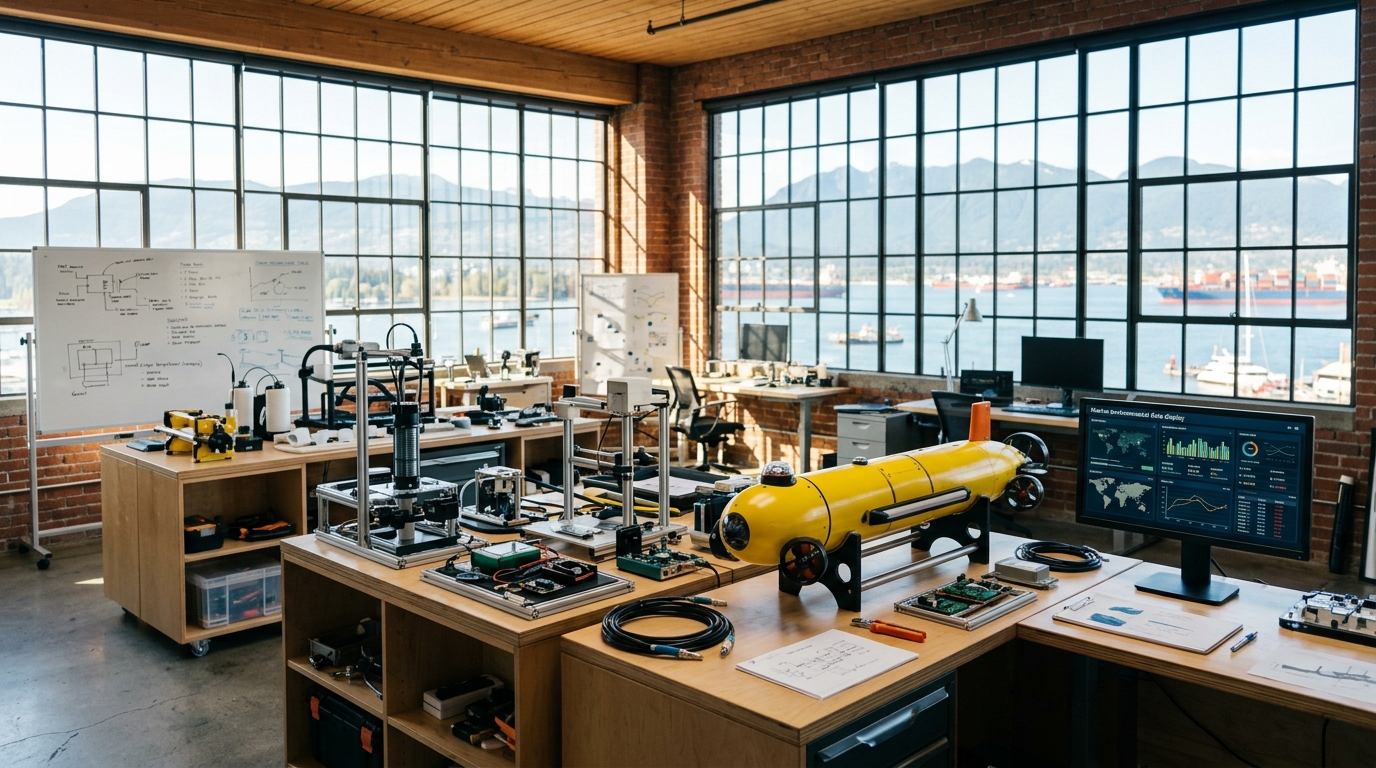
The signal is clear. The window is defined. Yet, many of BC’s ocean tech founders have not fully grasped the opportunity.
Ottawa’s commitment of $647 million over five years to transition BC’s coastal salmon farming away from open-net pens is more than an environmental policy; it is a procurement catalyst. The first contracts are already moving through the Fisheries and Oceans Canada (DFO) vendor pipeline.
For BC’s ocean tech cluster, this represents a significant revenue opportunity.
What the policy unlocks
The federal government's Pacific aquaculture transition program aims to phase out Discovery Islands open-net licences while driving demand for technologies that make land-based and offshore aquaculture viable at scale.
This shift creates a market for closed-containment systems, real-time water quality sensors, autonomous underwater vehicles (AUVs) for biomass monitoring, remote feeding platforms, and feed conversion optimization software. These tools are essential to making recirculating aquaculture systems (RAS) competitive with the open-net model that has dominated the BC coast for decades.
BC hosts more than 200 ocean tech firms, primarily in Metro Vancouver and Greater Victoria, with specialized expertise in sensors, AUVs, and marine data systems.
The procurement window: 2025 to 2028
The aquaculture transition program has a structural urgency that compresses the typical government sales cycle. Licence holders facing transition deadlines require technology solutions immediately.
DFO’s procurement framework includes direct vendor engagement for technology demonstration projects. These contracts, typically ranging from $250,000 to $2 million, serve as the entry point for BC firms to establish the reference customer relationships necessary to scale.
The window of opportunity is roughly 2025 to 2028. Once the first phase of the transition is complete, procurement will likely shift from technology adoption to operational supply. Founders who secure DFO vendor status during this period will be well-positioned within the evolving ecosystem.
BC firms in position
Ocean Networks Canada, based at the University of Victoria, has developed sophisticated ocean monitoring infrastructure that provides a foundation for commercial spinouts in aquaculture monitoring. Similarly, Innovate BC’s ocean tech portfolio includes firms specializing in AI-driven diagnostics and offshore monitoring. The firms best positioned for the DFO transition are those with existing operational deployments in BC waters, providing the data federal procurement officers require.
The export thesis
The global blue economy is projected by the OECD to exceed USD $3 trillion by 2030. As regions in Southeast Asia, Northern Europe, and South America face similar sustainability pressures, the technologies developed for BC’s transition become directly exportable.
The federal transition program essentially subsidizes the R&D and validation required to make these technologies credible to international buyers. While angel deal flow data from NACO shows BC deep-tech investment has historically favoured AI and biotech, ocean tech remains undercapitalized relative to its export potential, offering attractive entry points for early-stage investors.
For founders in sensors, AUV systems, RAS technology, or marine data platforms, the priority is clear: ensure your company is on the DFO’s radar before the window closes.