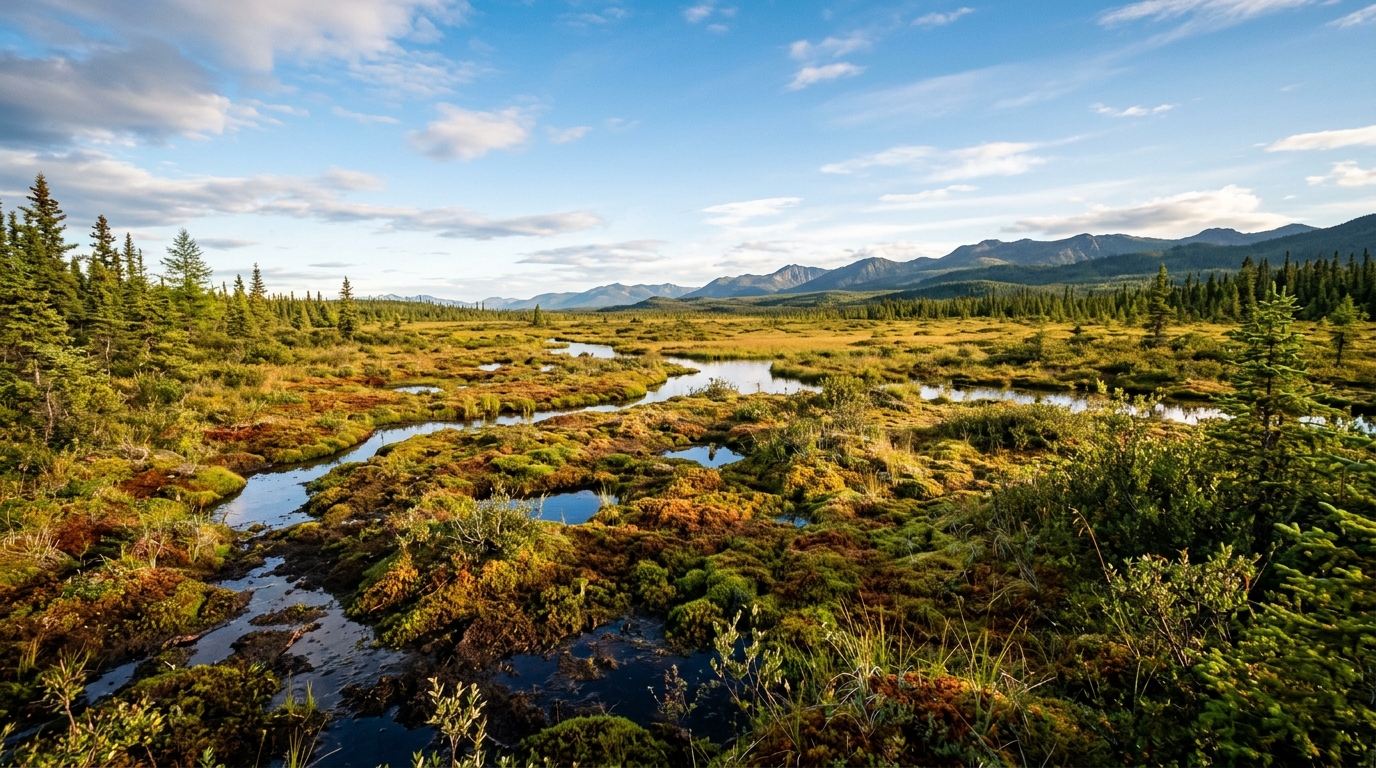
In BC’s carbon market conversation, the spotlight falls reliably on forestry offsets and, more recently, Fraser Valley soil carbon projects. Meanwhile, something considerably larger sits largely unexamined beneath the boreal and sub-boreal north: peatlands that have been accumulating carbon for thousands of years and that, under the right conservation finance structure, could generate verified credits among the most defensible available on the voluntary market.
The scale of the underlying asset is significant. Canada holds an estimated 25 per cent of the world's peatland area, with the boreal zone—including substantial coverage across northern BC—representing the country's single largest terrestrial carbon reservoir. Unlike forests, which release stored carbon rapidly when disturbed, peatlands accumulate carbon over millennia and, when drained or degraded, emit it over decades. That asymmetry—slow gain, fast loss—is precisely what makes verified peat protection compelling to institutional carbon buyers operating under tightening quality standards.
Yet the Verra Verified Carbon Standard registry lists only a handful of active peatland projects across Canada, and BC’s representation among them is minimal. The gap between the asset's theoretical scale and its market development is the central business story here.
The carbon math
Peat soils store carbon at densities that routinely exceed those of the overlying forest biomass. Canadian peatlands are estimated to store between 100 and 300 tonnes of carbon per hectare, with deeper, older deposits exceeding that range. At current voluntary market pricing for high-integrity nature-based credits—which have traded in the USD $15 to $50 per tonne range for verified, co-benefit-rich projects—even a conservatively structured peatland protection project covering 50,000 hectares of northern BC territory could represent a material long-term revenue stream.
The comparison to traditional resource royalties is instructive. Timber harvesting generates one-time stumpage revenue and leaves the land in a degraded state. Oil and gas royalties are subject to commodity price cycles and, increasingly, stranded-asset risk as decarbonization policy tightens. A verified peatland carbon project, structured under a 30-year crediting period, generates annual revenue from an asset that remains intact—and potentially appreciates in credit value as supply tightens and corporate net-zero commitments mature.
Who holds the position
The critical variable in BC’s peatland carbon opportunity is territorial rights. Much of the province’s northern peatland area falls within the traditional territories of First Nations whose land stewardship authority—whether through treaty, title, or co-management agreements—gives them a structurally defensible position as project proponents under Verra and Gold Standard methodologies.
The First Nations Forestry Council has been among the organizations working to expand Indigenous access to conservation finance mechanisms, though peatland-specific project development remains at an early stage relative to the forestry offset work that has dominated the conversation. A small number of Indigenous-led land stewardship organizations in northern BC are in early-stage project structuring, but few have reached the validation phase required for credit issuance.
The methodological pathway matters. Verra’s VM0036 methodology for rewetting and conserving peatlands provides a credible framework, but project development costs—baseline assessments, monitoring infrastructure, third-party validation—are non-trivial. NatureFinance and allied organizations have documented the upfront capital barrier as a primary constraint on nature-based carbon project development in Indigenous territories globally, a pattern that applies directly to BC’s northern peatlands.
The buyer side
For institutional carbon buyers, the quality calculus has shifted materially since the offset credibility controversies of 2022 and 2023. Buyers with Science Based Targets commitments and internal carbon accounting standards are increasingly discriminating between credit types—and peatland protection, with its permanence characteristics and measurable co-benefits, scores well against tightening procurement criteria.
Demand for high-integrity nature-based credits has remained resilient even as lower-quality offset categories faced scrutiny, and peatland credits from jurisdictions with strong governance frameworks—Canada being an obvious candidate—represent a category that serious buyers have had limited opportunity to access at scale.
Reality check: the development gap
The opportunity is real. The gap between opportunity and deployed capital is also real. Project development in remote northern BC involves genuine logistical complexity—baseline carbon stock measurement in peatland environments requires specialized methodology, and monitoring over a 30-year crediting period demands durable institutional capacity that many emerging Indigenous stewardship organizations are still building.
There is also a policy dimension. BC’s provincial offset framework has historically prioritized forestry and industrial projects, and peatland-specific guidance from regulators remains underdeveloped. Federal engagement through Environment and Climate Change Canada's nature-based climate solutions programming offers some project development support, but the capital stack for a first-of-kind BC peatland credit project has not yet been fully assembled.
The 30-year asset question
What makes this a capital markets story, not just a conservation story, is the time horizon. Carbon crediting agreements structured today will govern how northern BC peatland carbon is monetized through the mid-2050s—a period during which corporate net-zero commitments will be tested against actual emissions trajectories and offset demand is widely projected to grow substantially.
Indigenous communities that establish project proponent status now, under validated methodologies with institutional co-investment partners, are positioning for a long-duration revenue stream from an asset class that is structurally scarce. The alternative—watching the asset remain unmonetized while adjacent forestry and agricultural carbon projects absorb available buyer capital—carries its own opportunity cost.
The peat is there. The carbon is there. The territorial rights framework, in many cases, is there. What remains is the project development capital, the methodological infrastructure, and the institutional appetite to treat BC’s northern peatlands as the carbon asset class they already are.