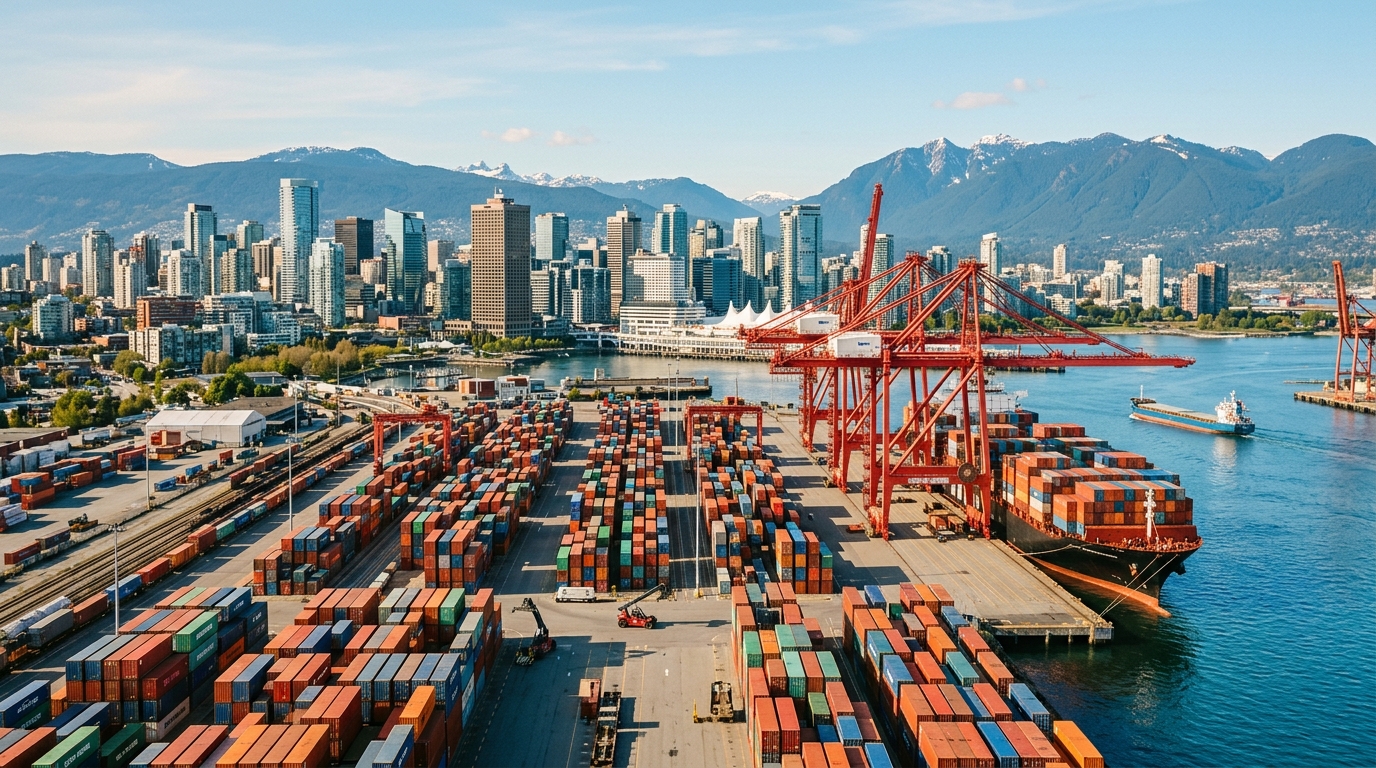
Data arriving at the Vancouver Fraser Port Authority this quarter suggests a shift beyond cyclical trade fluctuations. Container inquiry volumes from Asian manufacturers—particularly those seeking alternatives to direct U.S. entry—have climbed measurably in early 2026, according to freight forwarders operating along the BC coast. This trend signals a structural realignment in Pacific trade, and Metro Vancouver's logistics sector is positioned to capture a durable share of this market.
The core dynamic is clear. U.S. tariffs on Chinese goods now exceed 145% on select product categories as of early 2026, making direct shipments from China to American ports economically prohibitive for electronics, consumer goods, and light industrial components. Canada has not imposed equivalent measures. This asymmetry creates a landed-cost differential that BC logistics operators are beginning to market: goods re-processed, warehoused, or re-documented in BC before crossing the border can move through a fundamentally different cost structure than those arriving directly at Los Angeles or Seattle.
For manufacturers willing to invest in a Canadian supply chain node, BC acts as a tariff-efficient gateway into the North American market.
The Port of Vancouver handles significant daily trade, serving as Canada's largest port by tonnage and the third-largest in North America by total trade value. Its infrastructure—deep-water berths, on-dock rail connections to CN and CP, and proximity to the Trans-Canada corridor—provides a structural advantage over Prince Rupert for time-sensitive cargo and over Seattle for goods benefiting from Canadian customs treatment. However, capturing contracts requires more than infrastructure; it demands bonded warehouse capacity, licensed customs brokerage, and cross-border rail partnerships.
Members of the Canadian International Freight Forwarders Association report a notable uptick in inbound inquiries from manufacturers in China, Vietnam, and South Korea during Q1 2026. These firms are exploring whether Canadian transhipment or value-added processing can restore margins eroded by tariff escalation.
The competitive window, however, is finite. Prince Rupert is expanding its container terminal capacity, while Seattle and Tacoma are lobbying for foreign-trade zone designations to replicate the Canadian cost advantage. Meanwhile, Ottawa is reviewing bonded warehouse regulations and customs broker licensing frameworks—changes that could either accelerate BC's advantage or introduce new compliance friction.
The BC Ministry of Jobs, Economic Development and Innovation has prioritized supply chain diversification, and Export Development Canada identified Canadian Pacific gateway infrastructure as an underutilized asset. Logistics operators are not waiting for government programs to determine their capital deployment.
The fastest-moving firms are those already holding bonded warehouse licences, which allow foreign goods to be stored, re-packaged, or lightly processed without triggering Canadian import duties until they enter the domestic market or are re-exported. Expanding this capacity is a long-term play, requiring 12 to 18 months for licensing, fire-code compliance, and security infrastructure. Firms that began this process in late 2025 are now nearing operational readiness.
The BC Trucking Association reports that cross-border freight volumes on the Pacific Highway and Cascade corridors already reflect early re-routing activity, with southbound loads carrying a higher proportion of goods with Canadian customs documentation.
What this means for Vancouver
For BC logistics operators, the opportunity is compressed. The best-positioned firms offer an integrated service stack: port reception, bonded warehousing, customs brokerage, value-added processing, and southbound cross-border transport under a single contract. This integration is what Asian manufacturers require when evaluating a Canadian gateway strategy.
For the broader Vancouver business community, the implications extend beyond logistics. A durable increase in transhipment and value-added processing would drive demand for industrial real estate, customs legal services, trade finance, and specialized labour. The supply chain realignment is, at its core, an economic development story for Metro Vancouver. The firms that move now are writing the first chapter.



