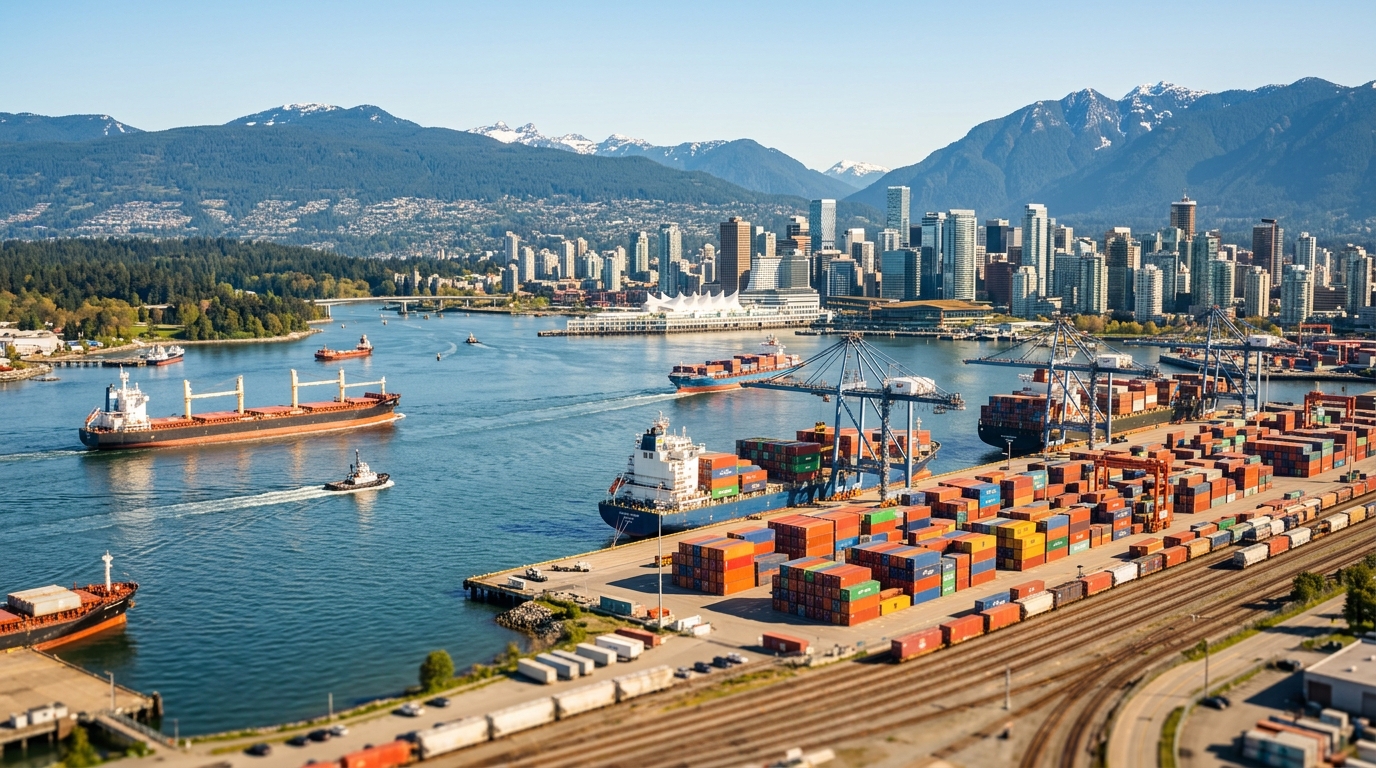
Since this publication explored ILWU contract uncertainty in The Longshoreman Variable and Metro Vancouver's last-mile constraints in The Last-Mile Bottleneck, a third pressure on the region's logistics ecosystem has sharpened into a reality operators can no longer treat as a future concern. Prince Rupert's Fairview Container Terminal Phase 2 is not just on track—it is ahead of its internal milestones, and freight routing decisions are changing in real time.
The data is clear. Prince Rupert captured approximately 25% of Canada's west coast container volume in 2025, up from under 15% a decade ago. Over that same period, the Port of Vancouver handled approximately 3.5 million TEU in 2025. The Fairview expansion is targeting a total annual capacity of 1.8 million TEU upon completion—a figure that would establish Prince Rupert as a primary gateway for trans-Pacific volume, rather than merely a relief valve.
Shippers are moving north due to geography and economics. Prince Rupert sits roughly 1,500 kilometres closer to Asia than Metro Vancouver by sea, saving approximately two sailing days on key trans-Pacific lanes. CN Rail's 2026 capital plan includes significant allocation to the Prince Rupert–Chicago corridor, reinforcing the northern gateway's competitive position for cargo destined for the continental interior. For importers of time-sensitive goods—such as consumer electronics and automotive components—that transit-time arithmetic increasingly favours the north.
The routing shift is no longer theoretical. Logistics operators in the Lower Mainland are seeing the impact in their order books, with a growing industry trend of freight forwarders diverting Asian import volume through Prince Rupert to utilize CN intermodal service directly to inland distribution points. This shift is driven by both transit-time gains and a strategic desire to mitigate exposure to the labour uncertainty at southern terminals documented in our earlier coverage.
The warehouse footprint question follows. Metro Vancouver industrial real estate—already strained, as detailed in our Fraser Valley Pivot coverage—is calibrated around Port of Vancouver dwell times and truck-out patterns. If a meaningful share of import volume shifts to a northern port with direct rail delivery to inland facilities, the case for expensive Lower Mainland warehouse space weakens. Supply chain analysts have flagged that Canada's west coast port split is approaching an inflection point where routing decisions become self-reinforcing: as more volume moves north, carrier frequency improves, attracting further volume.
This is not to suggest Vancouver is losing its status as Canada's primary Pacific gateway; that position remains secure for bulk commodities, energy exports, and the deep retail and manufacturing base anchored in the Lower Mainland. BC's northern corridor strategy acknowledges a complementary relationship between the two ports. However, for logistics operators whose network assumptions were last stress-tested before 2020, the current moment warrants a hard look at whether those assumptions still hold.
The operators with the most to gain are mid-size importers in the $50 million to $500 million revenue range—large enough to negotiate direct intermodal contracts with CN, yet small enough that a routing change represents a meaningful cost lever. Statistics Canada's trade-by-port data shows accelerating volume growth through northern BC entry points, a signal that this shift is embedded in real commercial decisions.
If your business imports goods from Asia and you have not reviewed your port-of-entry assumptions since before the pandemic, you may be paying more—in freight costs, transit time, and supply chain risk—than necessary. Prince Rupert is no longer a backup plan. For a growing number of shippers, it is becoming the primary route. Operators who reconfigure their carrier relationships and warehousing footprints in the next 12 to 18 months will hold a structural cost advantage over those who wait for the shift to become impossible to ignore.



