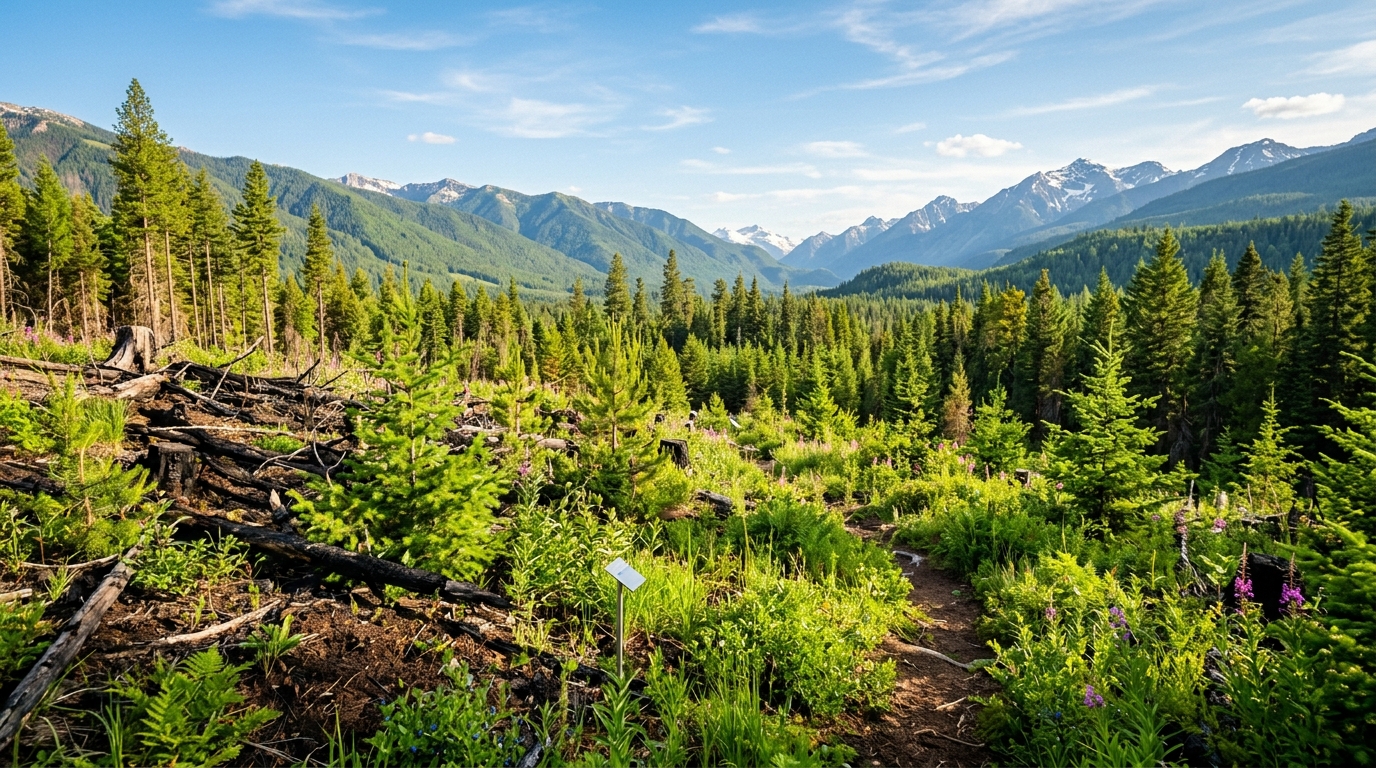
For decades, prescribed burning in British Columbia was a cost centre: a necessary, underfunded tool for reducing wildfire fuel loads with no financial return for the landowners and First Nations who bore the operational burden. That calculus is shifting. As BC’s expanded prescribed burn program accelerates following consecutive catastrophic wildfire seasons, a growing number of landowners are discovering that managed fire can generate a tradeable commodity: verified carbon credits.
The mechanics are straightforward in principle but complex in practice. When a landowner conducts a prescribed burn that demonstrably reduces the probability of a larger, uncontrolled wildfire, the avoided emissions from that hypothetical fire can be quantified and credited. Two leading voluntary carbon standard bodies — Verra's Verified Carbon Standard and the Gold Standard — have developed methodologies that allow this calculation. Under verified conditions, avoided emissions from managed fire can generate between 0.5 and 2 tonnes of CO2 equivalent per hectare, depending on forest type, fuel load, and baseline fire risk.
BC conducted approximately 35,000 hectares of prescribed burns in 2025, with the province targeting a doubling of that figure by 2028. At the lower end of the credit-yield range, that scale implies a substantial pool of potentially creditable emissions reductions, though the share of burns that will meet the rigorous additionality and verification requirements of major carbon standards remains to be seen.
The Verification Hurdle
Additionality is the central test: would the prescribed burn have occurred without the prospect of carbon revenue? Regulators and standard bodies apply this test strictly to ensure credits do not reward business-as-usual activity. For BC landowners, this means the burn must be documented as exceeding provincial regulatory requirements, and the avoided-fire scenario must be modelled against a credible baseline.
Verification requires third-party auditing by an accredited body. The process typically takes six to eighteen months and costs tens of thousands of dollars, a barrier that favours larger land holdings or aggregated projects. This is where aggregation platforms and carbon brokers become critical. Firms such as South Pole and Anew Climate, both active in Canadian forestry carbon markets, have begun structuring projects that pool smaller landowners to spread verification costs, making participation viable at the 500-to-2,000-hectare scale common among BC private and First Nations forest tenures.
The Price Signal
Voluntary carbon credit prices for high-integrity forestry and land-use credits were trading in the $15 to $35 per tonne range in early 2026. At a midpoint of $25 per tonne, a 1,000-hectare prescribed burn generating 1 tonne per hectare yields $25,000 in gross credit revenue. Against operational burn costs that can range from $150 to $400 per hectare depending on terrain, carbon revenue does not make a burn profitable on its own. However, it meaningfully offsets costs, converting an expense into a partially subsidised activity for First Nations and rural landowners already managing land for ecological and safety reasons.
The economics improve at scale. A landowner managing a 10,000-hectare tenure with a rolling five-year burn cycle could accumulate $200,000 to $500,000 in carbon revenue over a decade—revenue that, unlike timber, requires no harvest or replanting.
First Nations at the Front
The First Nations Forestry Council of BC has identified prescribed burn carbon projects as a priority, noting that many Nations hold large forest tenures and have practised cultural burning for generations. Cultural burning programs that predate provincial regulation can, in some cases, demonstrate a long-standing practice that exceeds regulatory minimums—a baseline that supports a strong additionality claim.
Several Nations in the Interior and on the Coast are in early-stage discussions with carbon project developers, though no BC prescribed-burn carbon projects have yet reached the issuance stage under Verra or Gold Standard registries.
Reality Check
The voluntary carbon market has experienced volatility. High-profile investigations into the integrity of certain forestry offset methodologies have made corporate buyers more selective. The market has bifurcated: high-integrity, third-party verified credits from stable jurisdictions like BC command a premium, while lower-quality credits have seen demand soften.
For BC landowners, this selectivity is an advantage. The province’s legal and regulatory framework, combined with credible wildfire risk data and established forestry monitoring infrastructure, provides the transparent baseline that institutional buyers demand. The program is early-stage and the verification pipeline is long, but the intersection of provincial wildfire policy and voluntary carbon markets is no longer theoretical. For landowners with the tenure scale and patience for an 18-month verification cycle, prescribed burning has become a business decision as much as an ecological one.