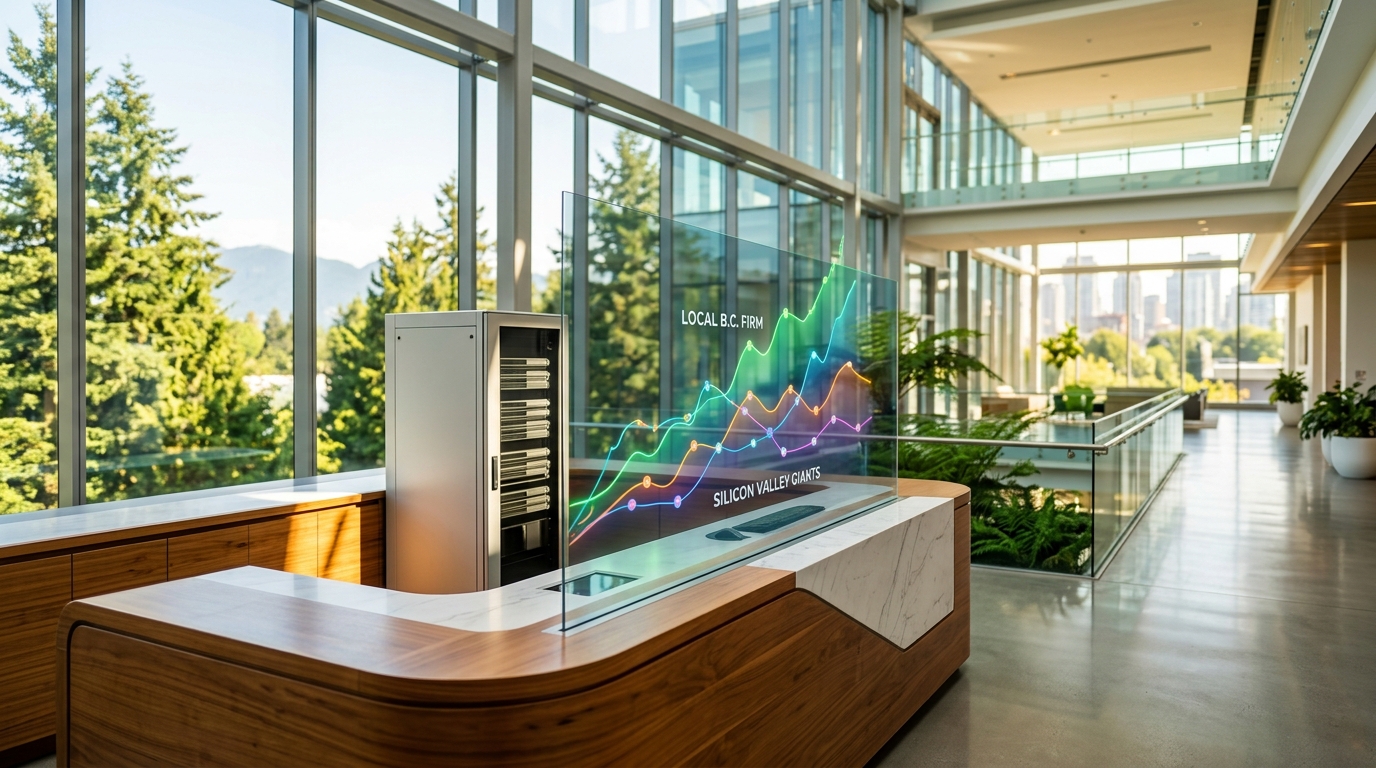
Canada has committed $360 million over seven years to quantum technology, and the clock is ticking for Vancouver’s tech sector. The National Research Council and NSERC are expected to announce grant decisions this quarter. For the first time, Metro Vancouver’s photonics and quantum sensing firms are appearing not just as talent pipelines, but as serious contract contenders.
Federal quantum contracts provide more than revenue; they serve as multi-year visibility signals that help unlock private capital. Securing these awards can provide the validation necessary for Series A investors to underwrite a firm’s growth. Conversely, remaining on the sidelines risks cementing a company’s status as a research-stage project rather than a commercial entity.
The competitive field in British Columbia is anchored by spinouts from UBC's Stewart Blusson Quantum Matter Institute, which has generated more than 20 commercialization-stage projects since 2018. Local firms are competing in quantum sensing—where Vancouver holds significant intellectual property depth—and photonic quantum computing, an area where the region’s proximity to fibre and semiconductor manufacturing offers a strategic advantage.
Vancouver is working to overcome a well-documented regional imbalance. Ontario accounts for roughly 60 per cent of Canada's quantum patent filings, while British Columbia’s share remains below 15 per cent. Historically, federal procurement has followed the established cluster around the University of Waterloo’s Institute for Quantum Computing.
This cycle, however, features a mandate for geographic diversification within the National Quantum Strategy. Quantum Industry Canada has advocated for spreading anchor investments beyond the Waterloo-Toronto corridor. While it remains to be seen how this influences final decisions, Vancouver firms are better positioned to benefit from this shift than in previous cycles.
The sensing sector is particularly promising for investors. Quantum sensing applications—including precision navigation, subsurface imaging, and medical diagnostics—offer shorter commercialization timelines than full-scale quantum computing. NSERC's Alliance Quantum grants program has already seeded several BC-based projects, creating a pipeline of firms that are technically prepared for larger NRC contracts.
The funding architecture is critical. NRC's Industrial Research Assistance Program (IRAP) and the NQS contract stream operate on different timelines and criteria. IRAP grants are accessible for early-stage development, while NQS anchor contracts offer the multi-year revenue visibility—typically three-to-five year terms—that can fundamentally alter a company's financing trajectory.
For founders and investors, the NRC's NQS program office remains the primary point of contact for eligibility and timelines. Additionally, the Blusson QMI’s tech transfer office provides insight into which spinouts possess the IP maturity to compete for federal funding. Finally, NRC IRAP disbursement records offer a view into which BC firms have already established federal funding relationships.
The window for these opportunities is narrow. Firms that secure anchor contracts during this cycle will gain a structural advantage for future funding. Vancouver possesses the talent and academic infrastructure to compete; the next 90 days will determine if the local ecosystem can effectively capitalize on the federal government's shift toward geographic distribution.