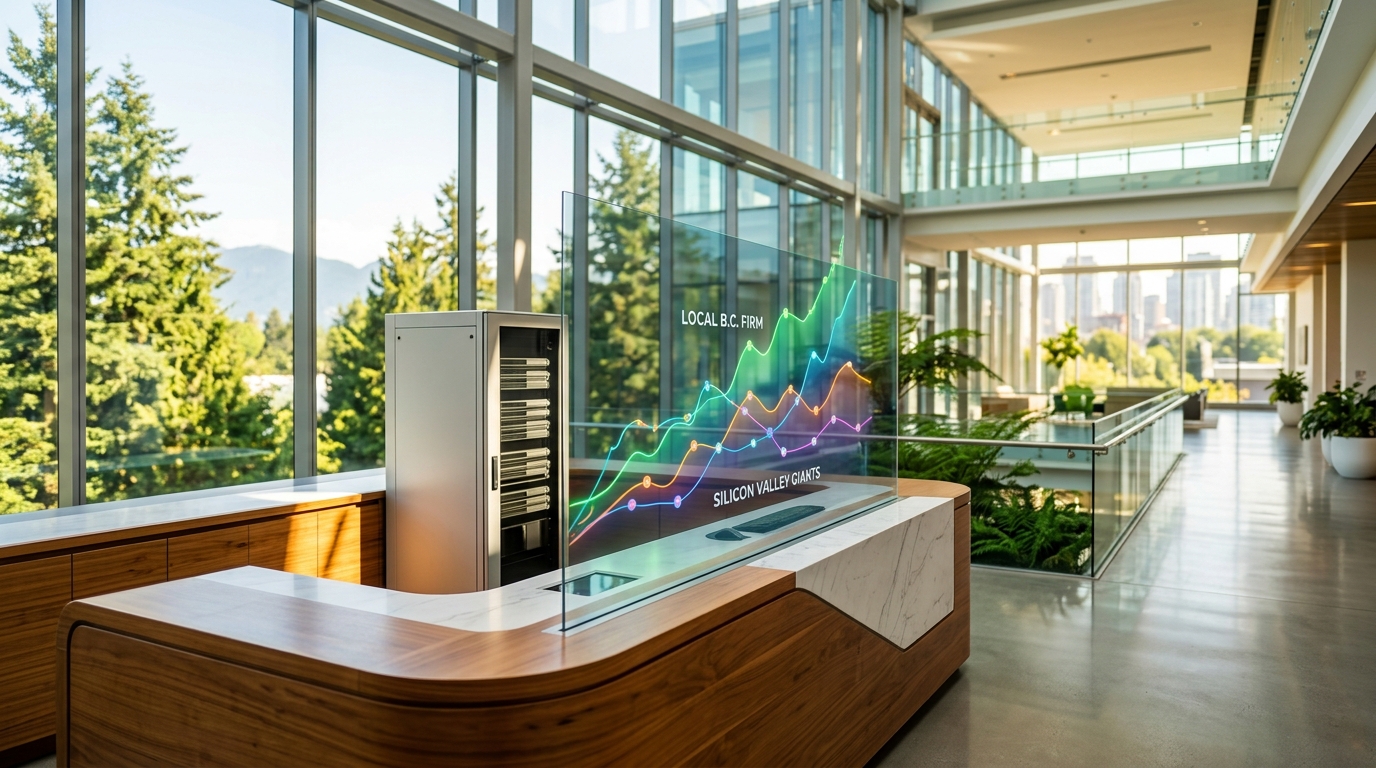
Consider this: Canada committed $360-million to its National Quantum Strategy in Budget 2021. Five years later, that capital is moving from line items into lab expansions, graduate fellowships, and commercialisation programs. A disproportionate share of that infrastructure sits in Metro Vancouver—a structural advantage that many investors have yet to price in.
The convergence is specific. Burnaby is home to D-Wave Quantum Inc., the only publicly traded pure-play quantum computing company in Canada. A short drive west, UBC's Stewart Blusson Quantum Matter Institute has produced quantum materials research and early-stage spinouts for over a decade. Layered on top is a new NRC-backed quantum commercialisation program designed to bridge the gap between academic discovery and market-ready technology. This density is no coincidence.
The question for founders and investors is whether the next 18 months represent the final window to enter at pre-recognition pricing—before Toronto's MaRS ecosystem and Waterloo's Quantum Valley absorb the national narrative and the capital that follows.
Why the Window Is Now
Platform shifts follow a predictable pattern: infrastructure is built, talent concentrates, and early commercial applications prove out before capital floods in. Vancouver has experienced this before in AI and biotech, where foundational research was local, but the Series B cheques were signed in San Francisco or Toronto.
Quantum differs because the federal government has structured the National Quantum Strategy to build Canadian commercial capacity. NRC programs, IRAP quantum streams, and university-industry partnerships are designed to keep spinouts domiciled in Canada during early growth. For Vancouver founders, this is a meaningful shift from previous exit paths.
D-Wave’s public market status provides a structural signal. As a NYSE-listed company trading under QBTS, D-Wave offers a publicly legible benchmark. Institutional investors now have a quantum comparable headquartered in Burnaby, which helps Vancouver register on the mental maps of allocators in New York, London, and Singapore.
The talent picture is also shifting. International researchers are increasingly weighing Vancouver, driven by UBC SBQMI’s profile and Canada’s Global Talent Stream. While the cluster is not yet at critical mass, it is approaching the threshold where network effects drive recruitment.
What the Cluster Actually Looks Like
D-Wave serves as the anchor tenant. The company has spent over two decades building quantum annealing systems and has moved toward hybrid classical-quantum approaches deployable on real enterprise problems. Its customer base spans logistics optimisation, financial modelling, and materials science—areas that align with Vancouver’s strengths in finance, port logistics, and life sciences.
UBC SBQMI operates at the earlier end of the commercialisation curve, with strong output in quantum materials and topological systems. The NRC program acts as the final piece, de-risking the transition from lab to market by providing technical validation and co-investment signals. For founders in quantum sensing, cryptography, or simulation, this pathway offers patient, technically sophisticated capital.
The Competitive Frame
Intellectual honesty requires acknowledging the competition. Waterloo's quantum ecosystem holds a decade-long head start in commercialisation infrastructure, while Toronto’s MaRS Discovery District benefits from proximity to Bay Street capital. Vancouver’s advantages are real, but they are not decisive on their own. The cluster wins if local and national capital commits to the ecosystem in the next cycle. Canadian venture deal flow data indicates quantum has been undercapitalised relative to AI and cleantech over the past three years. That gap is closing, but the destination of those incremental dollars remains the variable.
What Founders and Investors Should Do
For founders, the immediate opportunity lies in the application layer. Building software tools, optimisation algorithms, and vertical applications on top of accessible quantum systems is tractable today. The strongest near-term signals are in financial portfolio optimisation, supply chain modelling, and molecular simulation.
For investors, the play is early, but federal infrastructure de-risking changes the calculus. Seed and pre-seed rounds in quantum application companies are bets on which teams are best positioned to capture value when enterprise adoption accelerates. The talent density around UBC and D-Wave creates a sourcing advantage for locally based investors that will diminish as the cluster gains national visibility.
The 18-month window is not arbitrary. Federal program deployment, D-Wave's product cycle, and the typical lag between research output and spinout formation all point to a period of maximum opportunity. After that, the story will be well-known—and well-priced.