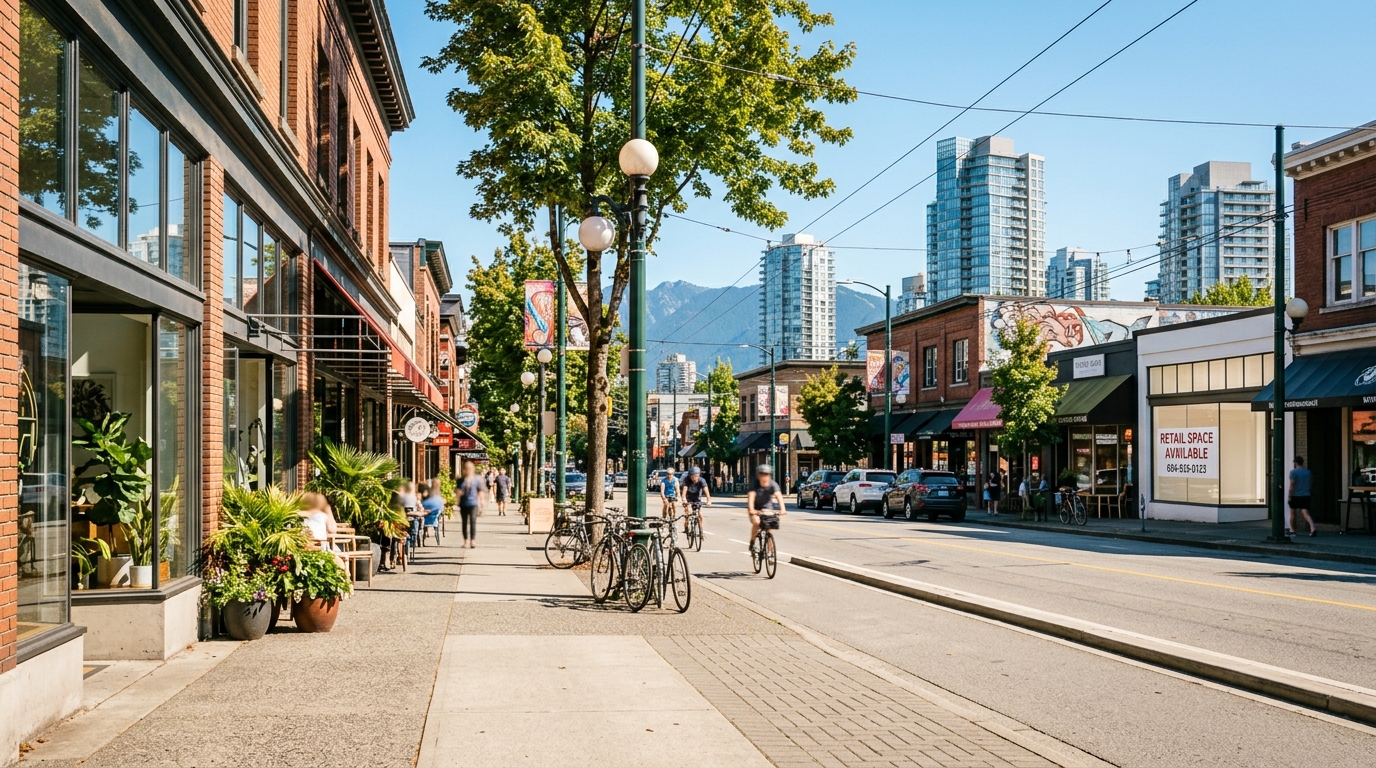
Walk down Robson Street on a Tuesday afternoon and count the brown papered windows. Then, walk down Main Street. The contrast illustrates the state of Metro Vancouver's retail market in mid-2026—and why these two environments demand different playbooks from operators scouting their next location.
Metro Vancouver's street-level retail vacancy rate has bifurcated sharply by corridor. As of mid-2026, vacancy rates on Robson Street and in Gastown are estimated to exceed 15%, while Main Street and Mount Pleasant remain near full occupancy. This gap is not a temporary fluctuation; it reflects a structural standoff between landlords unwilling to lower asking rents—which would reprice their entire asset—and prospective tenants who refuse to pay 2019 rates for 2026 foot traffic. Into this impasse, the pop-up lease has emerged as a vital instrument.
Rather than conceding on headline rent, landlords on struggling corridors are increasingly signing short-term agreements—typically three to six months, sometimes extending to a year—at terms that were rare five years ago. Free or heavily discounted base rent, flexible exit clauses, and tenant improvement contributions are now common. The landlord's calculus is simple: a live tenant generating income and street activity is preferable to a dark window that degrades the block's appeal, and short-term deals avoid setting a permanent rent benchmark for future appraisals.
For retail founders, this is an opening. Commercial brokers tracking the Metro Vancouver retail market note that the gap between asking and effective rents on high-vacancy corridors has widened significantly since 2024, when a wave of national retail bankruptcies freed significant space just as consumer foot traffic patterns shifted. This has created a rare moment of negotiating leverage for independent operators and emerging brands.
The street-by-street picture is critical. Robson Street west of Burrard has seen sustained vacancy as international fashion brands have rationalized their Canadian footprints. Gastown, despite its tourism appeal, has struggled to convert visitor traffic into consistent retail revenue for non-hospitality tenants. These are the corridors where a well-positioned founder can present a pop-up proposal to a landlord genuinely open to negotiation.
Contrast this with Cambie Village, the Fraser Street corridor, or the Broadway spine through Mount Pleasant. City of Vancouver business licence data reflects the demand pressure on these strips; local-serving retail with strong residential density has proven resilient. Vacancy on these streets is tight, rents have held, and landlords have little incentive to negotiate. Founders chasing these locations are competing, not leveraging.
The pop-up model serves as a proving ground. Retailers are using it strategically: an independent operator secures a three-month pop-up on a high-vacancy corridor at reduced rent, builds a customer base, demonstrates sales performance, and eventually converts to a longer-term anchor lease at rates below the corridor's previous peak. The landlord secures an anchor; the retailer gains a flagship location at a sustainable cost.
The Retail Council of Canada's BC chapter has flagged this bifurcated market as a defining feature of the province's retail landscape for the second half of 2026. Operators with flexible capital and short decision timelines are best positioned to capture these opportunities before landlords find conventional tenants or remove space from the market for conversion.
The office conversion trend is beginning to touch retail podiums as well. Some landlords holding distressed street-level retail are evaluating whether ground-floor space can be repositioned for service, medical, or light industrial uses. If this conversion wave accelerates, the pop-up window will narrow. The landlord standoff has a timer.
For investors, the strategic question is whether the pop-up holding strategy is disciplined or merely passive. Urban Land Institute BC chapter analysis of similar markets suggests that landlords who use short-term tenancy to maintain neighbourhood vitality tend to outperform those who simply hold dark space on principle.
For founders, the advice is straightforward: move fast, come prepared, and know your corridors. Bring a business plan and a track record. Landlords signing pop-up deals on Robson or in Gastown are not desperate; they are selective. They want tenants who improve the block, not those who reinforce the vacancy narrative.
The bottom line: Metro Vancouver's retail vacancy is not evenly distributed, and neither is the opportunity. On corridors where landlords are sitting on 15%-plus vacancy, founders with flexible capital and fast execution have more leverage than they have had in years. The operators who move in the next two quarters will set their cost basis for the next five years.



