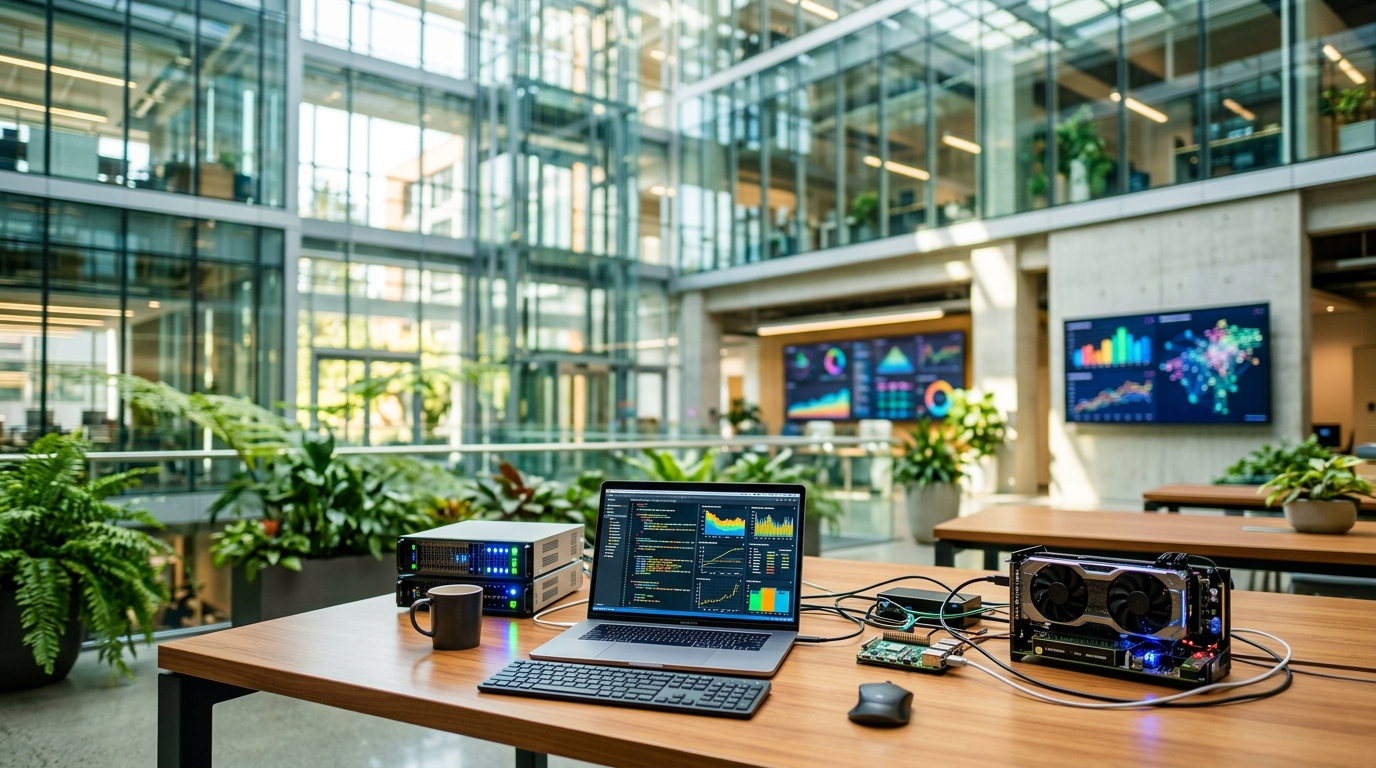
The most compelling AI company in Vancouver right now might have seven employees and a $0 monthly OpenAI bill. While much of the industry fixates on nine-figure VC rounds and hyperscaler infrastructure, a quieter trend is compounding in the city's co-working spaces: founders who have figured out how to deploy Meta's Llama series and Mistral variants on modest hardware to build products that are indistinguishable from those of their well-capitalised competitors.
The cost differential is significant. At production scale—processing millions of tokens per day—proprietary API inference fees can cost a startup thousands of dollars monthly. While specific TCO benchmarks vary by workload, industry analysis suggests that self-hosting open-source equivalents on leased GPU instances can reduce those costs by 80 to 95 per cent. For a pre-revenue startup, that gap is often the difference between sustainability and failure.
Emad Mostaque, who founded Stability AI, noted in a public address on open-source AI economics that the venture math changes fundamentally when inference costs approach zero. He argued that businesses are no longer "renting intelligence" from a hyperscaler, but instead owning their own infrastructure.
The open-source LLM ecosystem has matured sharply over the past 18 months. The current generation—Llama 3 and its derivatives, alongside Mistral’s instruction-tuned variants—benchmarks competitively against closed models on reasoning, summarisation, and code generation. The barrier to entry has also dropped; tooling from the open-source community, including quantisation libraries, allows a technically literate team to deploy production-ready models in days.
Evidence of this shift is visible in download data. Hugging Face has reported consistent growth in model downloads, with particular acceleration in variants suited to resource-constrained deployment.
In B.C., the B.C. Tech Association has tracked a rise in AI-native companies founded in 2025 and 2026 that prioritize open-source stacks. The Creative Destruction Lab Pacific cohort has observed a similar shift, with founders pitching open-source-first architectures becoming commonplace.
The competitive advantage extends beyond cost. Startups that self-host their models maintain total control over their data pipeline—a critical selling point for enterprise buyers in regulated sectors like legal, health tech, and financial services. For these clients, the promise that data never leaves the company's own infrastructure is a powerful closer in sales cycles.
Constraints remain. Self-hosting requires engineering capacity that very small teams may lack. GPU availability in Canada, while improving with the data centre build-out underway in B.C., remains tighter than in U.S. markets. Furthermore, open-source models still lag behind frontier models on the most complex multi-step reasoning tasks.
However, for document processing, summarisation, and structured data extraction, current open-source models perform at a level that enterprise buyers accept. Successful founders are those who have disciplined themselves to focus on product categories where these models excel.
This shift alters the funding dependency curve. A company that reaches revenue with $500,000 in seed capital because its infrastructure costs are near zero does not require a $5-million Series A to prove its model. This changes negotiating leverage, dilution outcomes, and the viability of building in a market like Vancouver, where the talent pool is robust but the local capital pool is shallower than in San Francisco.
As agentic AI workflows—which chain model calls together—become more common, the cost of using proprietary APIs will multiply. Startups running self-hosted models, by contrast, keep their marginal costs low. At the architectural level, the choice of model stack has become a strategic decision rather than a technical one.
Vancouver's smallest AI companies are running a quiet infrastructure experiment. By prioritizing capital efficiency, they are building businesses that are not only resilient but also less beholden to the traditional, high-burn venture capital cycle.