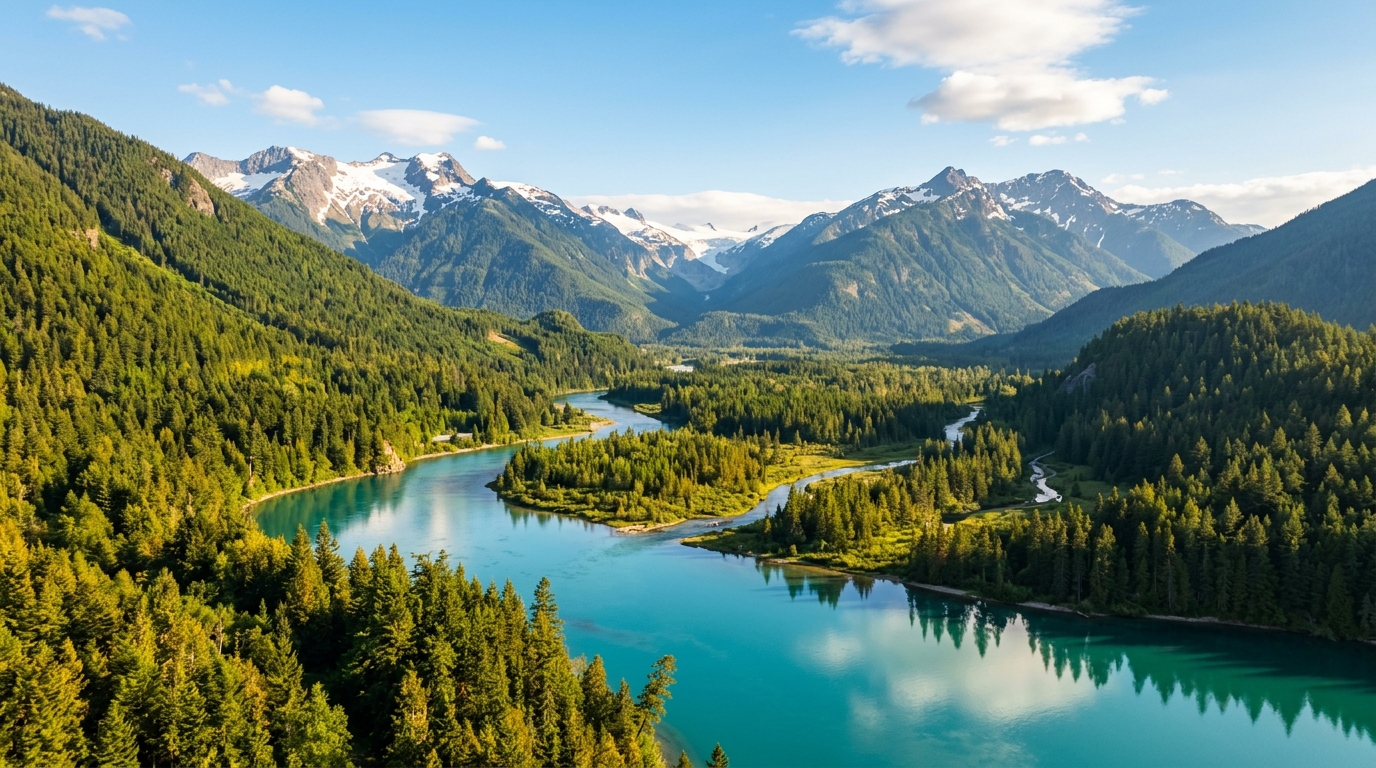
For most of BC’s manufacturing history, water was a utility taken for granted—much like the power grid or road access. That assumption is now being stress-tested by a third consecutive year of below-average snowpack across the province’s Interior watersheds. Operators who reprice that risk now will carry a measurable cost advantage into the next decade.
According to the BC River Forecast Centre’s April 1 bulletin, snowpack across key Interior watersheds tracked at 65 to 75 per cent of normal. Streamflow forecasts for the summer peak season follow directly from that data. When snowpack is deficient, the recharge that sustains surface water allocations through July and August is significantly reduced.
The regulatory consequence is curtailment. Under BC’s Water Sustainability Act, which governs more than 44,000 active water licences, allocation follows a "first in time, first in right" doctrine. In drought conditions, junior licence holders—which include most industrial users who secured rights after agricultural and municipal allocations—are the first to be cut off. Curtailment notices have increased year-over-year since 2022, according to BC Ministry of Environment water licence data.
The sectors most exposed
Food and beverage processors in the Okanagan, Thompson, and Fraser Canyon corridors face the sharpest near-term exposure. Fruit and vegetable processing, dairy operations, and craft beverage producers are concentrated in watersheds where junior licences dominate the industrial allocation queue. Food and Beverage BC’s member surveys have flagged water access as an escalating operational concern, particularly for processors running continuous-flow cleaning and cooling systems that require high daily volumes.
Data centres present a different but equally concrete exposure. Large-scale facilities using direct water cooling—increasingly common as rack densities climb with AI workloads—can consume between one and five million litres of water per day. For operators eyeing Interior BC sites as alternatives to Metro Vancouver’s constrained land and power markets, water allocation status is now a site-selection variable that ranks alongside grid interconnection capacity and fibre access.
Operational responses
Many processors are now investing in closed-loop cooling and process-water recirculation systems, which can reduce freshwater draw by up to 60 per cent compared to open-loop configurations. For facilities of significant scale, the capital outlay is being weighed against the risk of curtailment, which could idle production lines during peak harvest season. The financial arithmetic increasingly favours the infrastructure investment to ensure operational continuity.
Equipment suppliers and water treatment firms report shifting inquiry volumes. Closed-loop cooling systems, on-site storage reservoirs, and advanced filtration for process-water reuse are moving from niche industrial applications toward standard capital planning considerations for any new Interior BC facility drawing more than 50,000 litres per day.
The regulatory gap
The Water Sustainability Act’s allocation framework was designed for a hydrological baseline that is becoming less reliable. Water stress modelling from the Pacific Institute for Climate Solutions projects that Interior BC’s summer low-flow conditions will intensify through mid-century. As the province has not signalled a structural revision to the licence priority system, industrial users must manage around the existing framework.
Environment and Climate Change Canada’s drought monitor currently rates significant portions of the BC Interior at severe to extreme drought status. The BC Agriculture Council has called for accelerated investment in on-farm storage and efficiency infrastructure, a priority that applies with equal force to industrial processors sharing the same watersheds.
The capital-planning window
Operators who model water risk into site selection and capital expenditure planning now—before a curtailment notice forces an emergency response—avoid the premium pricing of reactive procurement and the production losses that accompany unplanned shutdowns. Equipment suppliers, water storage engineering firms, and consultants who can navigate BC’s licence transfer and storage approval processes are positioned for sustained demand growth.
Water has joined power, labour, and logistics as a variable that serious operators in BC’s Interior must model explicitly. The third consecutive drought year is not an anomaly to wait out; it is the data point that reprices the assumption.