British Columbia’s voluntary carbon market has, until now, been almost entirely a forestry story. Improved forest management credits, logged-area deferrals, and mass timber supply chains have dominated the province’s climate finance conversation. However, a quieter shift is occurring along the province’s tidal margins—one that could unlock an entirely new asset class for coastal operators, aquaculture firms, and First Nations enterprises managing some of the most carbon-dense ecosystems on Earth.
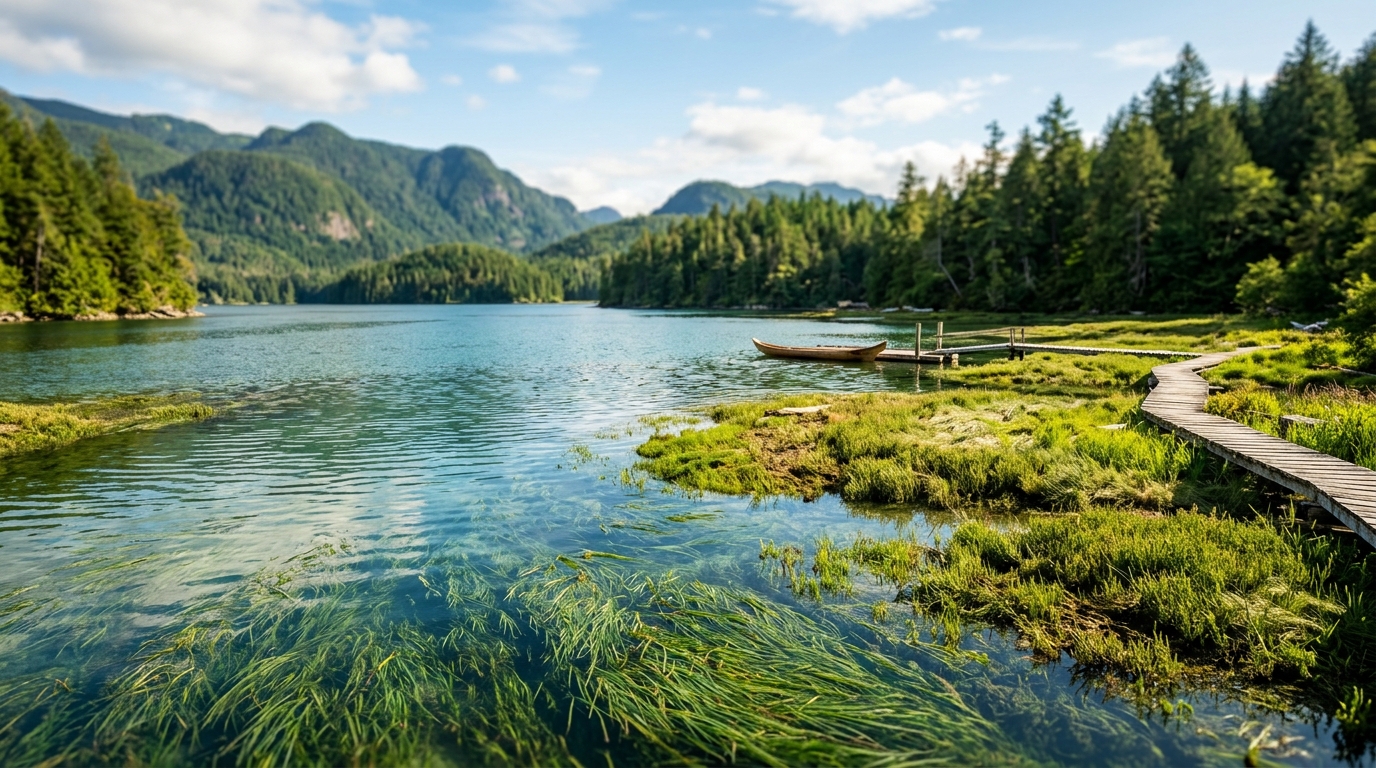
The asset in question is blue carbon: the organic carbon stored and sequestered by coastal and marine ecosystems, principally seagrass meadows, tidal marshes, and kelp forests. According to research from Australia’s CSIRO, these ecosystems sequester carbon at rates up to 10 times faster per hectare than their terrestrial counterparts. Crucially, they store that carbon in sediments that can hold it for millennia. For carbon buyers increasingly focused on permanence and co-benefits, that profile is highly attractive.
BC’s competitive position is structural. The province’s coastline stretches approximately 27,000 kilometres—among the longest in the world—encompassing extensive seagrass habitat in the Salish Sea, productive kelp forests along the outer coast, and tidal marsh systems at river deltas from the Fraser to the Skeena. This geography is the foundation of a potential blue carbon inventory that has barely been mapped for commercial purposes, let alone registered.
The methodology gap
The central constraint on blue carbon credit issuance is the current absence of broadly accepted, registry-approved methodologies for measuring, reporting, and verifying marine sequestration at the project level. Verra has published VM0033, a methodology covering tidal wetland and seagrass restoration, but its applicability to conservation projects remains limited. Kelp forest crediting methodology is at an even earlier stage.
The Gold Standard Foundation is developing marine and coastal carbon protocols with a focus on high-integrity co-benefit requirements that align with its broader biodiversity and community standards. For premium buyers willing to pay for credits that carry fisheries and biodiversity validation, Gold Standard’s framework may ultimately prove to be the more commercially relevant pathway.
Who is at the table
In BC, the earliest conversations are happening at the intersection of First Nations coastal governance and aquaculture. The Coastal First Nations — Great Bear Initiative, which represents nine First Nations governing the Great Bear Rainforest and Haida Gwaii coastlines, has been active in forest carbon markets and is well-positioned to extend that expertise into marine ecosystems. These nations hold constitutionally protected rights and title over some of the most intact coastal habitat remaining in the Pacific—a combination of legal standing and ecological integrity that carbon registries increasingly require.
Aquaculture operators represent a distinct entry point. Shellfish and seaweed cultivators already interact directly with the coastal ecosystem; some are exploring whether their operations, which can support seagrass recovery and improve water column conditions, could qualify for co-benefit credits. The commercial logic is straightforward: a seaweed farm that demonstrates measurable carbon sequestration and habitat improvement offers a differentiated product for buyers under growing scrutiny regarding credit quality.
The economics of blue carbon
High-integrity voluntary carbon credits are currently trading in the range of $15–$50 USD per tonne, with marine credits carrying demonstrated co-benefits—such as fisheries productivity and biodiversity uplift—commanding prices toward the upper end of that band. For context, BC’s forest carbon credits have historically traded closer to the lower end of the voluntary market range, in part due to questions regarding additionality and permanence.
Navigating the path forward
The timeline for maturity is measured in years. Methodology validation for kelp and conservation-focused seagrass projects could take three to five years to reach registry approval. Baseline ecosystem mapping—a prerequisite for any credible credit issuance—requires DFO coastal ecosystem data and original survey work. Project development costs for marine credits are significant.
There is also a governance question specific to BC. Marine areas involve overlapping federal, provincial, and First Nations jurisdiction—a complexity that forest carbon projects largely avoid. Resolving free, prior, and informed consent requirements, benefit-sharing structures, and project boundary definitions will require legal and governance work that the forestry carbon market has taken two decades to partially resolve.
None of this negates the opportunity; it contextualizes it. Coastal operators and First Nations enterprises that begin the baseline work now—ecosystem assessment, stakeholder alignment, and registry pre-consultation—will be positioned to issue credits when methodology approval arrives. In BC’s carbon economy, the advantage belongs to those who treat uncertainty as a development window.