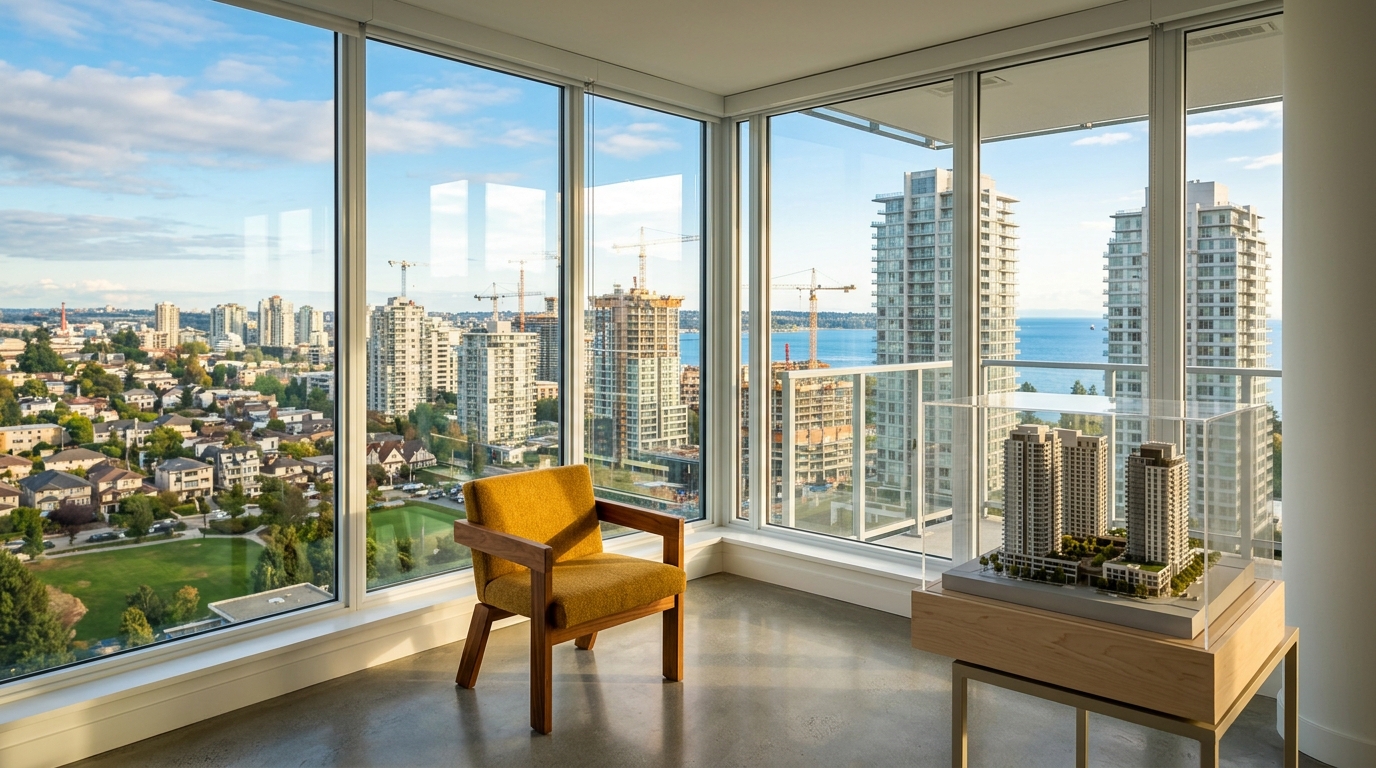
Stand at the corner of Broadway and Cambie on a Tuesday afternoon and the view tells two stories. To the south, the copper-and-glass dome of City Hall. To the north and east, a corridor of low-rise storefronts and aging apartment blocks that, on paper, have been transformed. The Broadway Plan, adopted by Vancouver City Council in 2022, rezoned approximately 500 blocks along the Millennium Line extension for towers reaching up to 40 storeys—one of the most ambitious upzoning decisions in Canadian municipal history. Two years on, the skyline has yet to catch up with the policy.
The gap between approvals and actual construction is widening, with implications reaching far beyond the construction sector. The Broadway Corridor was always about more than housing: it served as the supply-side justification for billions of dollars in transit infrastructure, the anchor of Vancouver’s densification strategy, and a test of whether rezoning alone can move the market. Currently, the answer is complex.
Vancouver CMA multi-family residential starts declined year-over-year in 2025, according to Canada Mortgage and Housing Corporation data—a trend that counters the Broadway Plan’s ambitions. While rezoning applications advance and development permits are issued, the conversion rate from permit to construction start has slowed. The City of Vancouver’s own Development and Building Services permit data confirms a robust pipeline, but a pipeline is not a building.
Three forces are stalling projects. The first is construction cost inflation. Altus Group estimates that construction costs in Metro Vancouver rose an average of six to eight per cent annually between 2022 and 2025, eroding project viability. A development pencilled at $450 per square foot in 2022 may now face costs of $520 or higher before financing charges.
The second force is presale weakness. The presale condominium market across Metro Vancouver softened through 2024 and into early 2025, with absorption rates falling short of the thresholds lenders require to release construction financing. Most lenders require 60 to 70 per cent of units to be presold before funding construction—a bar many Broadway corridor projects struggle to clear.
The third force is the financing environment. While the Bank of Canada has lowered rates from their 2023 peak, the Urban Development Institute Pacific Region has flagged in member surveys that construction lending conditions remain restrictive, with lenders requiring more conservative loan-to-cost ratios and higher equity contributions than in the 2016–2021 cycle.
The human consequence is clear: units counted in Vancouver’s housing supply projections are not being built on the assumed schedule. TransLink’s investment case for the Millennium Line Broadway Extension, which cost over $2.8 billion, relied on station-area density targets. Ridership models assuming a densifying corridor by the late 2020s may require revision if timelines slip.
This is not a story of policy failure. Rezoning is a necessary condition for supply, but it is not sufficient. The plan unlocked the legal capacity to build, but it cannot override construction economics or lender risk appetite. Those are market conditions that move on their own schedule.
The more useful question for operators and planners is: what does a realistic supply timeline look like? Market analysis from commercial real estate firms suggests that projects with secured financing—typically rental-only developments—are advancing closer to schedule. The ownership-market condominium pipeline remains most exposed to the presale-financing squeeze.
That distinction matters for policy. BC’s BC Builds program and federal co-investment tools are the primary mechanisms by which the Broadway Plan’s supply potential is unlocked in the near term, as these projects are less dependent on presale absorption.
For investors, the message is nuanced. Land values along Broadway remain durable, but the carry cost of holding entitled land while waiting for construction economics to recover is a significant drag. Developers who acquired at peak 2021–2022 prices face the tightest squeeze.
The bottom line: The Broadway Plan created the conditions for a generational transformation of Vancouver’s most important intensification corridor. The current gap between approvals and construction reflects market friction, not policy failure. Stakeholders should track CMHC’s Q2 2026 starts data as the clearest near-term signal of whether the pipeline is beginning to move.



