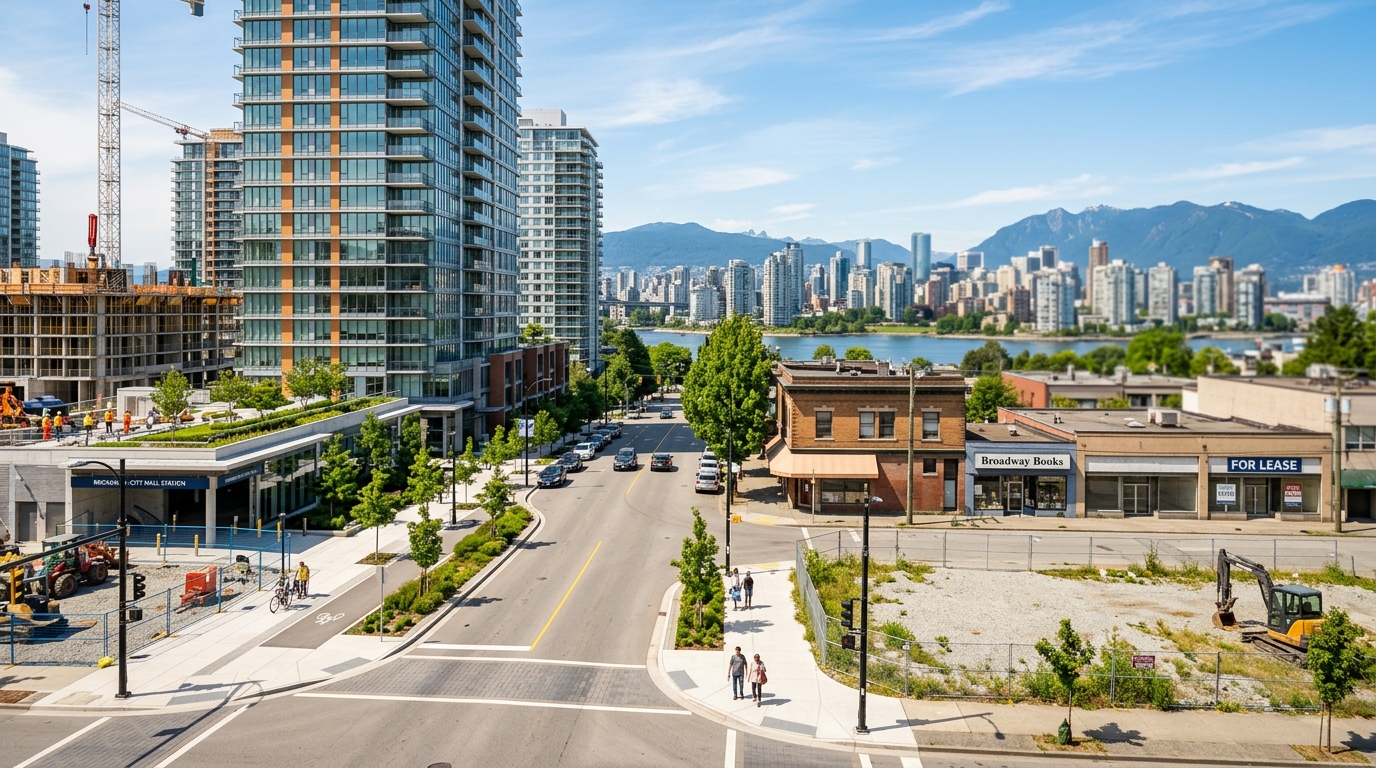
Stand at the corner of Broadway and Arbutus on a Tuesday morning and you can feel the momentum. A construction hoarding wraps the south side of the block; a rezoning notice is stapled to a telephone pole; and a land assembly sign—signalling that a developer has stitched together several lots—faces the future station entrance. Walk four blocks east, past the coffee shops and low-rise walk-ups, and the energy shifts. The signs disappear. The lots remain unchanged. Owners are waiting—or stuck.
That contrast defines the Broadway Plan at its two-year mark. Approved by Vancouver City Council in 2022 and covering the corridor from Clark Drive to Vine Street, the plan represents the largest single upzoning in the city's history. The goal was clear: new density and housing tied to the arrival of the Broadway Subway, now expected to open in 2027. In practice, a two-tier market has emerged.
The Station Premium
Sites within roughly 200 metres of the Broadway Subway extension stations—Mount Pleasant, Oak-VGH, and Arbutus—are transacting at a premium compared to mid-block equivalents. This is in addition to the existing Millennium Line stations at VCC-Clark and Broadway-City Hall. BC Assessment data for the 2026 roll shows land value uplift concentrated around these catchment zones, while mid-block parcels show comparatively modest gains.
Investment sales brokers report that station-area sites, particularly those permitting tower forms, are drawing competitive offers from institutional and private equity buyers. Mid-block parcels, where the plan permits mid-rise forms of six to twelve storeys, are moving more slowly.
Three Blockers for Mid-Block Parcels
Developers and advisors active on the corridor point to three compounding challenges for mid-block landowners.
Assembly complexity. The Broadway Plan's mid-rise zones often require the consolidation of three to six individual lots. On blocks where ownership is fragmented—a mix of single-family lots, strata buildings, and commercial properties—assembling a site without a holdout is difficult. Near stations, the financial incentive for owners to sell is higher, helping assemblies close. Mid-block, where the per-lot premium is lower, negotiations often drag.
Soil remediation. The corridor's commercial history—including dry cleaners and auto shops—has left a legacy of contaminated soil. Phase II environmental assessments are surfacing remediation liabilities that were not priced into acquisition assumptions made in 2022 and 2023. For a station-proximate tower site, a $2–4 million remediation cost is often absorbable. For a mid-rise project, the same liability can render a deal unfinanceable.
Financing costs. The interest rate environment of 2024 and 2025 hit mid-rise projects harder than towers. Towers near stations attracted institutional equity partners willing to accept lower returns for transit-oriented quality. Mid-rise projects, with smaller unit counts and less compelling transit adjacency, have relied on conventional construction financing at rates that have compressed pro forma margins. The Urban Development Institute Pacific has flagged financing viability as a systemic concern for the mid-rise segment.
The Rezoning Tracker
The City of Vancouver's rezoning application tracker shows an uneven pipeline. Applications for high-density tower forms near stations have moved faster than mid-block applications, many of which remain in pre-application or have been resubmitted as proponents rework financial models. While the city has streamlined processing with dedicated staff, this has primarily benefited larger station-area projects that justify the upfront investment in professional teams.
The 2027 Opening
The Broadway Subway's 2027 opening serves as a deadline. Once the line is operational, the station-area premium will be fully priced into land values. For mid-block landowners, the subway's opening will sharpen the contrast between transit-adjacent and non-adjacent parcels, potentially widening the valuation gap. Selling into a pre-opening market may produce better outcomes than holding through an opening that cements this two-tier structure.
The Bottom Line
The Broadway Plan is performing near its station nodes but underdelivering in mid-block zones. For investors and developers, station-proximate holdings are performing, while mid-block exposure carrying assembly, remediation, or financing risk requires a reassessment before the subway ribbon is cut.



