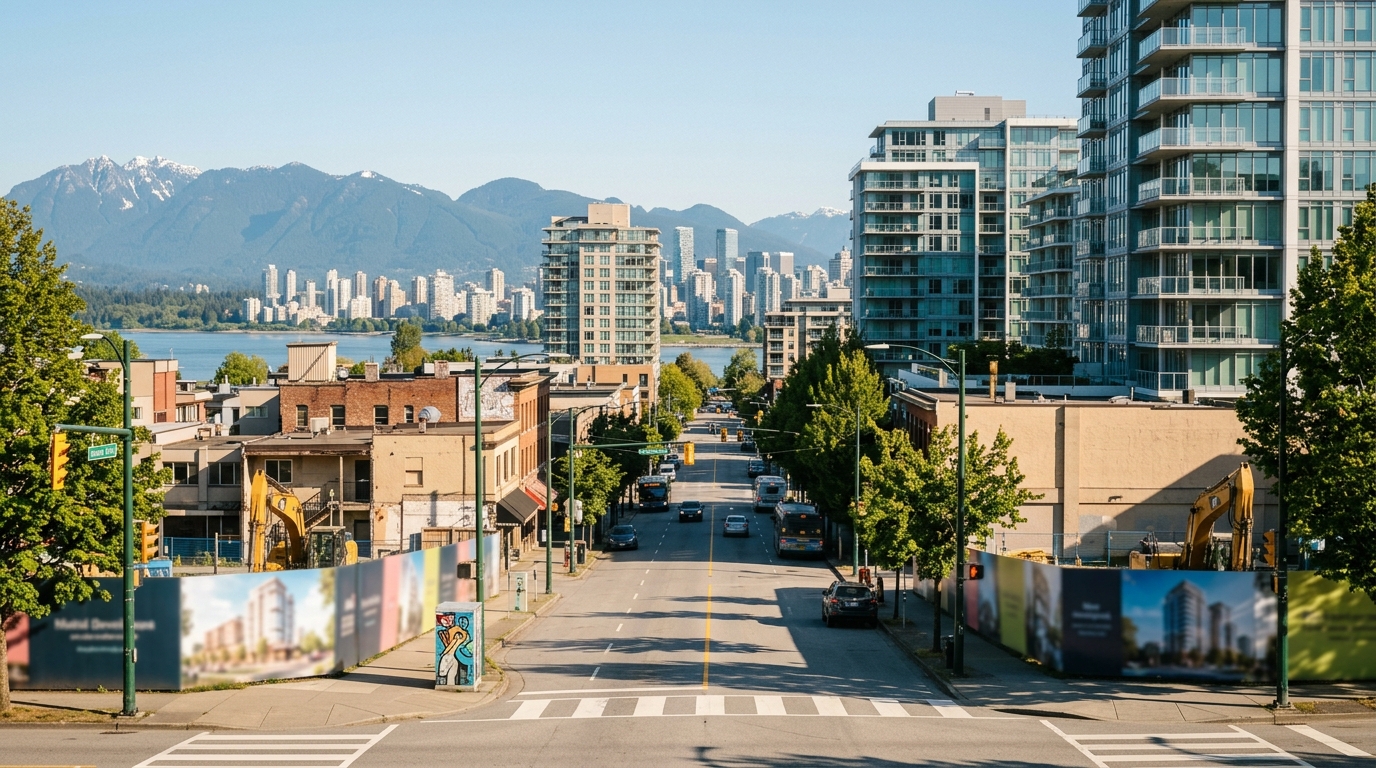
Stand at the corner of Great Northern Way and Quebec Street on a weekday morning and the transformation is visible: tower cranes punctuate the skyline, hoardings wrap parcels that sat dormant for a decade, and ground-floor retail in new developments is already leased. The Broadway Subway Project's Millennium Line extension — scheduled for substantial completion in 2026, with public service to follow after testing — is one of the most telegraphed value-creation events in Metro Vancouver's modern history. The corridor has been on institutional radars since the Broadway Plan was adopted in 2022. The critical question for capital allocation is simple: where is the value still ahead, and where has it already been collected?
The six new stations spanning 5.7 kilometres from VCC–Clark to Arbutus do not represent a uniform opportunity. Each node sits within its own micro-market, zoning envelope, and stage of the development cycle. Treating the corridor as a single trade is a mistake that leads capital to buy the headline and miss the spread.
The Broadway Plan: What the Policy Actually Unlocks
The City of Vancouver's Broadway Plan targets 30,000 new residents and 40,000 new jobs by 2050. This policy signal—clear, sustained, and backed by senior government capital—drew institutional and mid-market developers to the corridor between 2022 and 2024. Assemblies transacted in that period captured the first wave of uplift. For investors entering now, identifying sites in the pre-assembly or early-entitlement phase is the essential filter.
The City's development applications portal shows an active but uneven pipeline. Mount Pleasant and the Great Northern Way–Emily Carr station area have seen the densest clustering of rezoning applications. Arbutus, the western terminus, presents a different profile: larger parcels, more complex ownership structures, and a neighbourhood character debate that has slowed some applications.
Node by Node: A Rough Triage
Great Northern Way–Emily Carr: This station benefits from the Emily Carr University relocation and the Creative District designation. BC Assessment data reflects significant step-ups in assessed value over the 2023–2025 cycle, consistent with sites transitioning from industrial to mixed-use pricing. The opportunity here lies in mid-block parcels between Quebec and Main—sites adjacent to the station premium but not yet fully repriced.
Mount Pleasant: The most active node is also the most competed. Commercial and land sales data from Greater Vancouver REALTORS shows that well-located assemblies within 400 metres of the station have traded at values reflecting the rezoning premium in full. For developers without existing site control, the remaining play is limited to distressed or strata wind-up scenarios.
South Granville and Arbutus: These western nodes present a compelling risk-reward calculation for 2025–2026. Arbutus combines an underutilized commercial strip with a neighbourhood that has historically resisted density, though that political calculus is shifting as the Broadway Plan's weight becomes harder to contest. Market intelligence from major commercial brokerages suggests Arbutus-area parcels have lagged eastern stations in repricing, partly due to assembly complexity. This lag may represent the corridor's remaining first-mover window.
The Entitlement Timeline Is the Real Variable
For investors, the most important variable is the entitlement timeline. The City's development permit processing times remain a concern, and the Broadway Plan's scale has created a volume of applications that the permitting apparatus is still absorbing. Sites with pre-application meetings or existing rezoning approvals carry a meaningful premium over raw land—a premium often not reflected in assessed values but evident in arm's-length transactions.
Metro Vancouver Regional District land-use filings also merit attention: regional planning around the Jericho Lands and False Creek Flats will shape long-term density in ways that could affect relative station-area values over a ten-year hold.
The Bottom Line
The Broadway corridor is not a single trade; it is six distinct micro-markets at different stages of a value-creation cycle. The eastern nodes have substantially repriced, leaving only situational opportunities. The western nodes retain more upside but carry greater complexity. The edge for investors lies in entitlement-stage assets, joint-venture structures with local operators, and a clear-eyed assessment of the City's permitting capacity. The subway is coming—the question is whether your basis reflects what is already known, or what is still being discovered.



