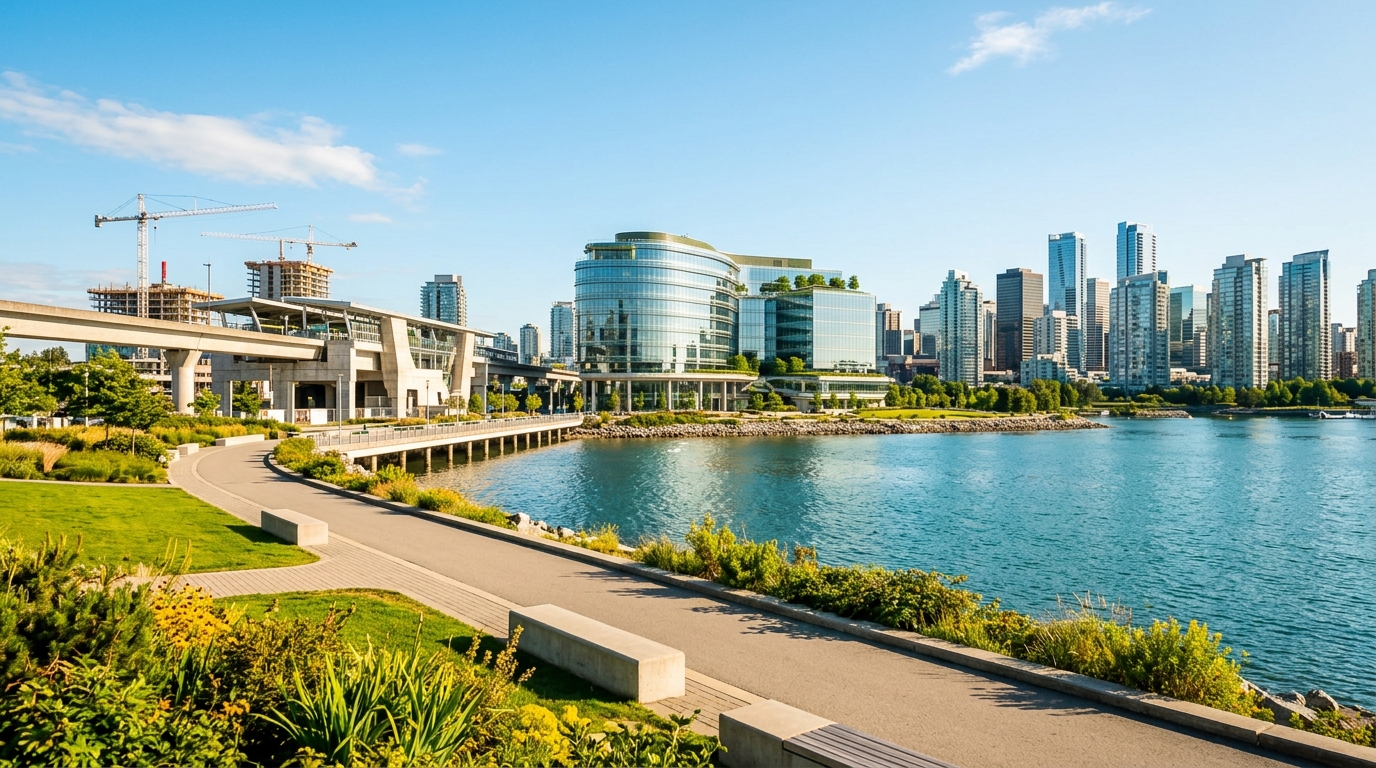
Stand at the corner of Lougheed Highway and Willingdon Avenue on a Tuesday morning and you will notice a steady stream of lanyarded professionals stepping off the Millennium Line and filing into mid-rise office towers that were, until recently, considered secondary-market filler. The foot traffic reflects a shift that leasing data is now confirming.
Burnaby's two major transit-anchored office corridors—Brentwood and Lougheed—are absorbing a measurable volume of mid-size tenants who have been priced out of, or have chosen to move away from, Downtown Vancouver's Class A market. According to CBRE Canada's Q2 2026 Metro Vancouver Office MarketView, suburban Burnaby office vacancy has tightened noticeably in the first half of the year, with positive net absorption recorded across both corridors—a reversal from the sluggish post-pandemic pattern that defined 2023 and 2024.
The rent differential is the engine driving this shift. Colliers International's Burnaby submarket data puts average asking rents for quality suburban office space in the Brentwood and Lougheed nodes at roughly $22 to $26 per square foot net net net, compared to $38 to $45 per square foot NNN for comparable Class A inventory in Downtown Vancouver. That gap, representing a 30 to 40 per cent discount, is wide enough to be a strategic decision for a 5,000- to 15,000-square-foot tenant rather than a consolation prize.
The tenant mix arriving in Burnaby is telling. Professional services firms—accountancies, consultancies, and regulatory affairs practices—have long been quiet occupiers of suburban nodes. What is new in 2026 is the volume of health-tech and government-adjacent organizations signing longer-term leases. These tenants require professional-grade space, reliable transit access, and predictable occupancy costs. They have concluded that a 25-minute commute from Waterfront station via the Expo and Millennium Lines is an acceptable trade for a materially lower rent bill.
TransLink ridership figures for Brentwood Town Centre and Lougheed Town Centre stations support the transit-access narrative: both stations have seen sustained ridership growth through 2025 and into 2026, reflecting not just residential density but the growing daytime office population. For tenants evaluating staff commute patterns—a live issue in hybrid-work negotiations—the Millennium Line's frequency and reliability is a genuine selling point.
The Broadway Plan corridor, intended to provide a third major alternative to Downtown Vancouver, has not yet delivered the supply pipeline that planners anticipated. As the Ledger reported earlier this year, rezoned sites along Broadway are moving through development permits more slowly than projected. This leaves a gap between approved density and actual occupiable space, redirecting tenant demand eastward along the SkyTrain spine.
Market Snapshot — Burnaby Office Corridors, Q2 2026
- Brentwood / Lougheed average asking rent: $22–$26/sq ft NNN (per Colliers)
- Downtown Vancouver Class A average asking rent: $38–$45/sq ft NNN (per CBRE)
- Rent differential: 30–40% in favour of Burnaby
- Net absorption: Positive in both Burnaby corridors, Q1–Q2 2026 (per CBRE MarketView)
- New completions anticipated 2026–2028: Several towers in planning or construction phase (per City of Burnaby development data)
For investors, the durability question is paramount. Suburban office markets have historically served as overflow valves during downtown supply crunches. The bear case for Burnaby is that if downtown vacancy rises—and Avison Young's leasing activity reports note that several large downtown blocks could return to market through 2027—the rent differential narrows and Burnaby's competitive advantage compresses.
The bull case rests on structural factors: the combination of SkyTrain access, a maturing amenity base around Brentwood Town Centre, and a tenant cohort that has successfully completed a full lease cycle in the suburbs and chosen to renew. City of Burnaby permit data indicates the municipality is actively supporting densification, providing the long-term supply pipeline that institutional investors require.
The smarter framing for investors may be less about "overflow versus structural," and more about which buildings are positioned to hold tenants through the next cycle. Transit proximity, building quality, and parking ratios vary significantly. Assets within a five-minute walk of a Millennium Line station, with floor plates above 15,000 square feet and modern mechanical systems, are capturing the professional services and health-tech tenants who represent durable demand.
Burnaby's office corridors are no longer just catching what downtown drops. The rent differential is real, the transit infrastructure is proven, and the tenant mix includes organizations making deliberate, long-term location decisions. For investors willing to perform site-level due diligence, the Brentwood and Lougheed corridors offer a risk-adjusted entry point into the Metro Vancouver office market that the downtown core cannot currently match. Investors should monitor Q3 absorption data and Broadway Plan construction timelines to determine if this shift is accelerating.



