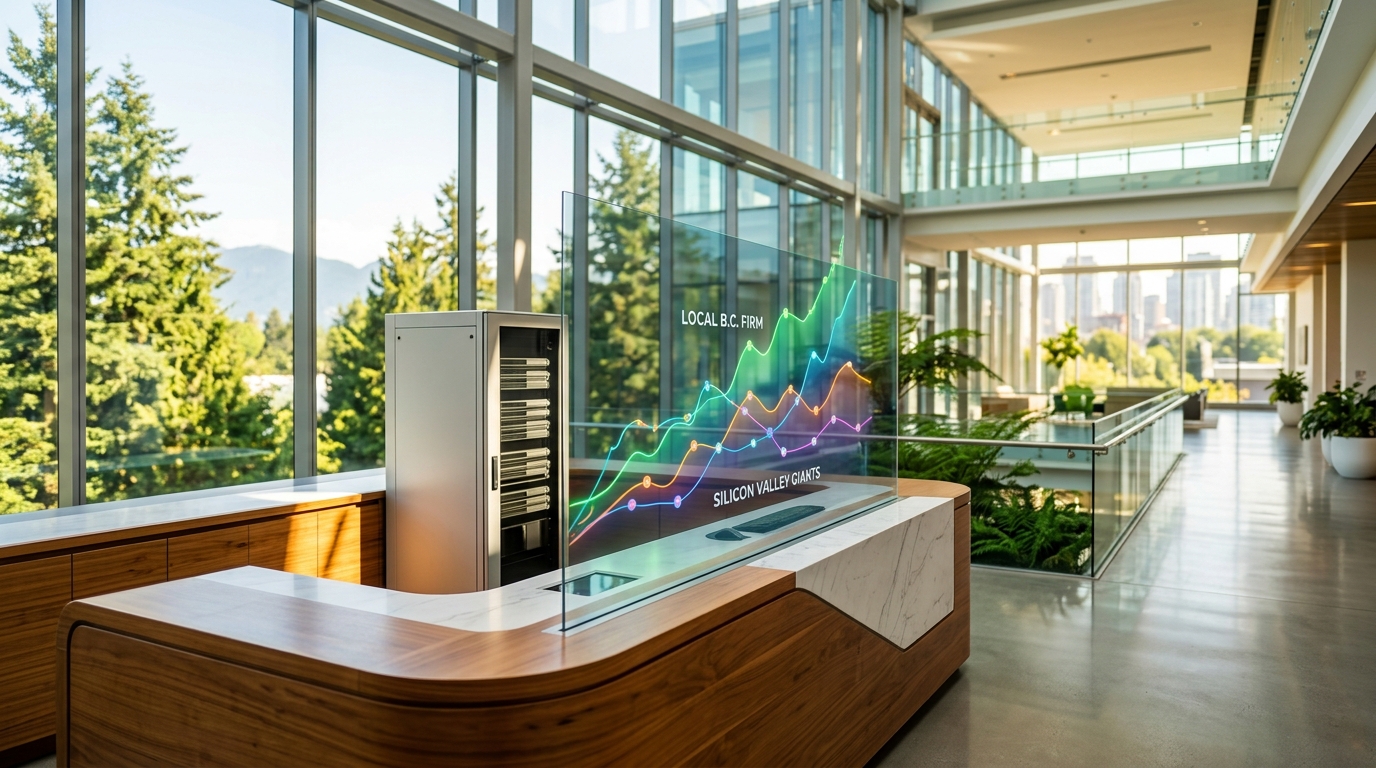
The most consequential commercial real estate decision in Metro Vancouver this decade won't involve condos or office towers. It will involve server racks, cooling systems, and enough power draw to light a small city. Hyperscale data centre developers are in active site selection conversations across the region’s eastern municipalities, with Burnaby and Surrey emerging as frontrunners.
A single hyperscale facility—the kind operated by major cloud providers—typically represents a capital investment of $500 million to over $1 billion. Landing one would reshape a municipality's commercial tax base; losing one to Calgary means missing a generational opportunity.
The draw to Metro Vancouver is technical: fibre density, existing substation infrastructure, proximity to U.S. interconnects via the Pacific Northwest corridor, and climate. British Columbia’s cooler ambient temperatures provide a measurable advantage in power usage effectiveness (PUE), the industry's standard efficiency metric. While cooling is a major operating cost in Phoenix or Singapore, the local climate does much of the heavy lifting in Burnaby.
Power remains both the primary opportunity and the bottleneck. BC Hydro’s large-load interconnection queue has seen a notable increase in data centre applicants as AI infrastructure demand accelerates. The queue reflects the surge in AI-driven power demand that has strained utility grids globally. Furthermore, BC Hydro’s predominantly hydroelectric grid offers a sustainability narrative that helps hyperscale operators meet net-zero commitments.
The competition beyond British Columbia is immediate. According to CBRE's Canadian data centre market analysis, Calgary and Toronto hold advantages in available powered shell inventory and shovel-ready industrial land. Calgary has aggressively positioned itself on operating costs, leveraging Alberta's electricity market and lower municipal tax rates. Toronto remains the hub for enterprise demand, particularly within the financial services and media sectors.
Metro Vancouver offers a unique combination of Pacific Rim connectivity and a hydro-backed grid. For operators serving Asia-Pacific markets—and for AI inference workloads requiring proximity to end users—a facility in Burnaby or Surrey functions as a critical Pacific gateway.
The municipal competition is distinct: Burnaby’s existing commercial and industrial zoning near Willingdon and the Still Creek corridor provides a head start on permitting. Surrey offers larger contiguous parcels in the Campbell Heights and Bridgeview industrial areas, accommodating the 20- to 50-acre footprints often required for a single campus.
Data centres tend to cluster. When a hyperscale anchor commits to a market, colocation providers, edge operators, and managed service companies follow. Research indicates that anchor data centre tenants create demand for adjacent industrial and flex space within a two-to-five kilometre radius. This secondary effect may ultimately provide as much economic value as the anchor facility itself.
For investors, the signal lies in infrastructure spending. Watch for BC Hydro capital project announcements regarding substation upgrades in the Burnaby-New Westminster and South Surrey corridors, as well as industrial land transaction volumes in Campbell Heights. Municipal rezoning applications for "technology campus" or "critical infrastructure" uses are also key indicators.
The window for Metro Vancouver to capture this investment is open but not indefinite. The region’s success depends on whether Burnaby and Surrey can compress permitting and utility timelines to compete with other provinces, and whether BC Hydro can navigate the interconnection queue without adding years to development schedules.