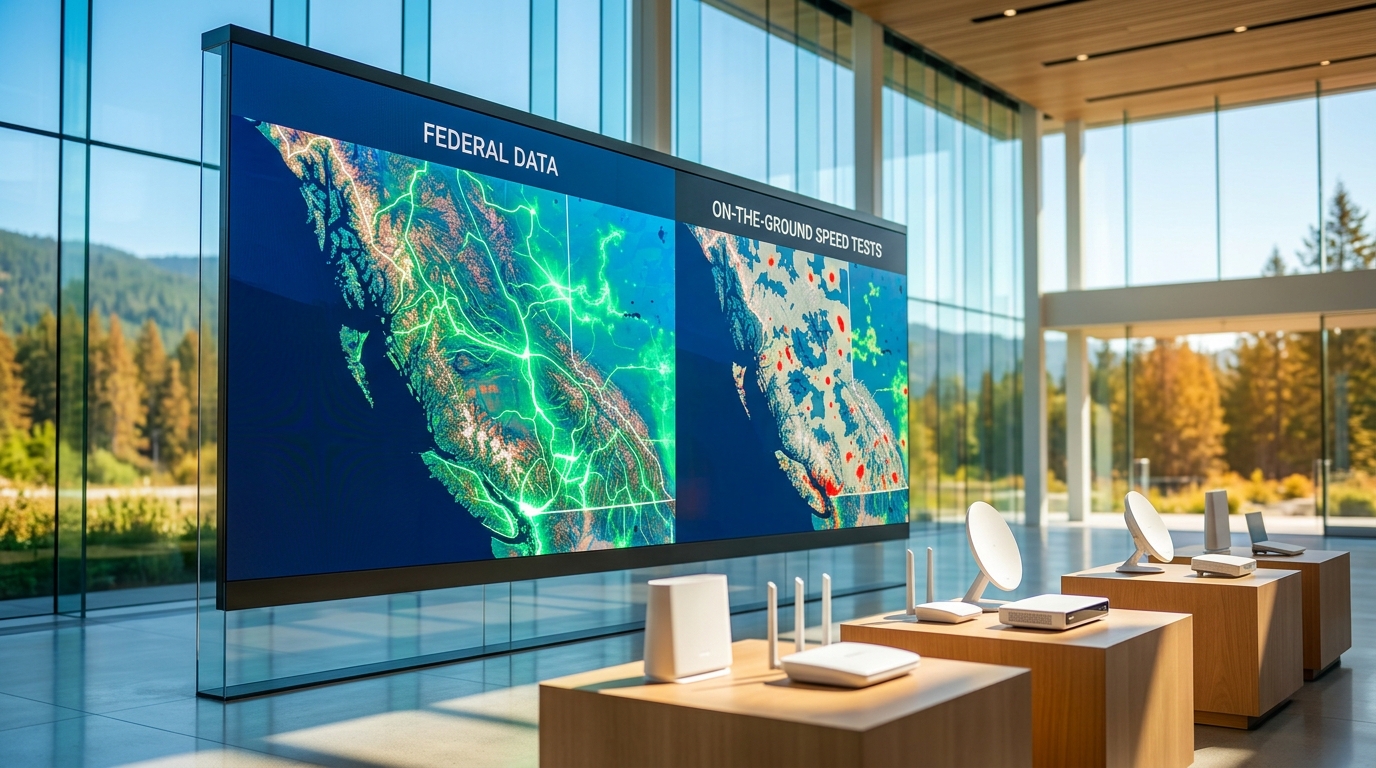
There is a version of British Columbia where most rural and remote communities already have fast, reliable internet. That version exists in Ottawa's data. The reality on the ground is considerably less connected—and the distance between those two versions is becoming a significant commercial opportunity in Canadian telecom.
Innovation, Science and Economic Development Canada's updated national broadband availability map, released in early 2026, shows substantial 50/10 Mbps coverage across BC's Interior and Northern regions. Municipal governments and First Nations communities in those same areas have spent this year documenting why that picture is inaccurate. Speed tests conducted by regional operators consistently show underperformance against the federal threshold. The implication is not merely technical; it is financial.
The Universal Broadband Fund represents a $2.75-billion federal commitment to close these gaps. Communities that appear covered on ISED's map are ineligible for UBF top-up grants in the next intake cycle. However, communities that can demonstrate they are not actually covered—proving that an incumbent's claimed service does not meet the standard—become eligible. That distinction is worth significant capital to any operator willing to perform the necessary documentation.
The First Nations Technology Council has estimated that more than 40 per cent of BC First Nations communities remain without reliable broadband. For Indigenous-owned telecom ventures and regional fixed wireless operators, that gap is a market opening.
The arbitrage process is clear: ISED's map relies on coverage data self-reported by incumbent carriers. Challengers can submit speed test evidence, engineering studies, and community affidavits demonstrating that claimed coverage does not meet the 50/10 standard. A successful challenge reclassifies an area as underserved, unlocking grant eligibility. The operator who successfully challenges the data is then well-positioned to bid on the resulting infrastructure contract.
Several BC operators are already pursuing this strategy. Fixed wireless providers in the Thompson-Okanagan and operators serving Northern BC communities have begun building the evidentiary record needed to contest incumbent coverage claims. The BC Ministry of Citizens' Services has been compiling provincial connectivity data that diverges from federal figures in several regions, providing additional ammunition for challengers.
The CRTC's own broadband reporting has repeatedly flagged the difficulty of verifying incumbent coverage claims, noting that availability maps do not capture actual service quality, network congestion, or whether infrastructure genuinely reaches individual premises. This institutional skepticism provides challengers with a credible foothold.
The BC Broadband Coalition, whose membership includes many of the regional operators best positioned to act, has long highlighted the mapping problem. The 2026 ISED update has sharpened that advocacy into an actionable challenge process with a clear financial upside.
BC's geography makes this dynamic particularly acute. The province accounts for a significant share of Canada's underserved communities by land area, and the topographic complexity of the Interior and Northern coast makes service difficult to verify from the outside. That same complexity has allowed overstated coverage data to persist.
The commercial logic is straightforward: operators who invest in rigorous speed-test documentation and community engagement are buying optionality on federal grant contracts. The UBF has already directed significant capital to BC, and the next intake cycle is expected to prioritize communities where coverage claims are actively disputed.
For BC's regional telecom sector, the federal map's inaccuracy is an asset. Incumbents built their coverage claims on the assumption that the data would go unchecked. A growing number of local operators are now verifying those claims—and building businesses on what they find.