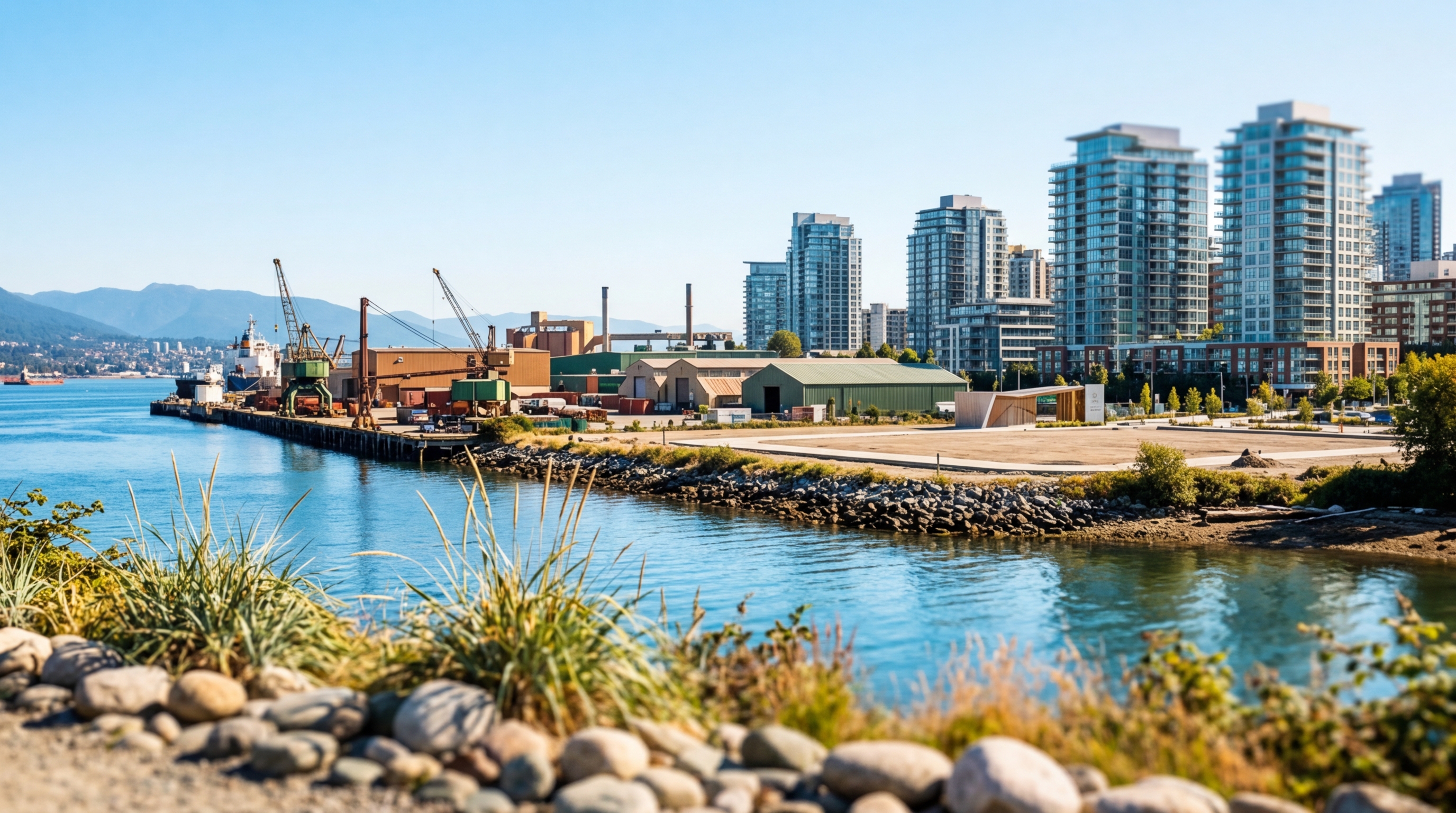
A key indicator of where Metro Vancouver's industrial market is heading is not found in a standard brokerage vacancy report or a port cargo manifest. Instead, it is visible in the corporate registry filings for Musqueam Capital Corporation. The economic development arm of the Musqueam Indian Band has quietly accumulated a portfolio of commercial and industrial assets along the Fraser River corridor that commands the attention of institutional investors.
Musqueam Capital is not an outlier. Across Metro Vancouver, First Nations economic development corporations have become among the most active and strategically disciplined acquirers of industrial land in a market where vacancy rates have remained near historic lows and average asking lease rates have climbed steadily through 2025 and into 2026. The Squamish Nation, through its development arm, and the Tsawwassen First Nation have each completed significant commercial real estate transactions in the past twelve months. The pipeline is accelerating.
For commercial real estate investors, industrial tenants, and development partners, this represents a structural shift. These are not passive landholders waiting for lease revenue; they are long-horizon capital allocators with unique financing access, treaty-backed land tenure, and geographic positioning adjacent to the Port of Vancouver's primary cargo corridors.
The Financing Advantage
What distinguishes First Nations development corporations from conventional industrial buyers is their capital stack. Both the Business Development Bank of Canada and Export Development Canada have expanded reconciliation-aligned financing programs. These offer Indigenous-owned enterprises preferential access to debt capital, including longer amortisation periods and reduced collateral requirements compared to conventional commercial lending.
This matters in a market where rising interest rates have squeezed conventional buyers. While private developers have pulled back from speculative industrial acquisitions, First Nations corporations—backed by BDC and EDC facilities, federal infrastructure funding, and revenue from existing land leases—have maintained acquisition capacity. The result is a buyer class that is counter-cyclical by design.
Federal funding through programs tied to the Indigenous Economic Strategy has further deepened this capital advantage, allowing development corporations to layer grant funding against debt-financed acquisitions in ways that conventional developers cannot replicate.
The Geographic Logic
The acquisition pattern is strategic. Musqueam, Squamish, and Tsawwassen territories encompass land adjacent to Metro Vancouver's most constrained industrial nodes: the Fraser Valley corridor, the North Shore marine terminals, and the approaches to the Deltaport and Tsawwassen container terminals. As Port of Vancouver throughput data shows continued growth in container volumes, the value of industrial land with proximity to these corridors has compounded.
Tsawwassen First Nation holds a significant position. Its treaty lands sit directly adjacent to the Tsawwassen Mills and Tsawwassen Commons commercial developments, and the Nation has been an active participant in the industrial and logistics land market in South Delta. The TFN's economic development framework explicitly targets industrial and logistics uses as a priority sector—a strategic alignment with the Port's own growth projections.
Squamish Nation's landholdings in North Vancouver—including the Sen̓áḵw development site—demonstrate a different approach: mixed-use density on land that carries no municipal property tax obligation. This structural cost advantage reshapes pro forma economics for any joint-venture partner.
Institutional Maturation
The scale of organised Indigenous economic activity in British Columbia is broader than individual transactions suggest. The BC Treaty Commission's most recent annual report documents the growing number of First Nations with active, professionally staffed economic development corporations. The First Nations Major Projects Coalition has tracked a marked increase in Nations moving from consultation roles to ownership positions—a shift now visible in Metro Vancouver's commercial real estate market.
These economic development corporations are not structured as community benefit funds. They are capitalised entities with professional investment staff, external advisors, and return-on-investment mandates. Their acquisition criteria—location relative to port infrastructure, lease covenant quality, zoning flexibility, and long-term land value—are indistinguishable from those of a sophisticated REIT.
Market Implications
For brokers and investors, the practical implications are significant. First Nations development corporations tend to be long-hold buyers with generational investment horizons rather than fund-cycle-driven timelines. This changes negotiating dynamics. A Nation acquiring an industrial asset is building a permanent income base. Vendors who understand this can structure transactions—including leaseback arrangements, phased closings, and joint-venture equity participation—that would not be available from a conventional buyer.
For tenants, the picture is nuanced. Metro Vancouver's industrial market remains among the tightest in North America, and First Nations-owned properties are not exempt from market lease rates. However, Nations with long-term development mandates may offer tenants stability, predictability, and a counterparty whose incentive is not to flip the asset at the next peak.
The reconciliation dimension is real, but it is secondary to the economic logic. These are sophisticated actors deploying capital with discipline. Their success advances Indigenous economic self-determination by design. In Metro Vancouver's industrial market, the question is no longer whether First Nations development corporations will be at the table; they are already there. The question is whether the investors, tenants, and brokers across from them are prepared to deal.



