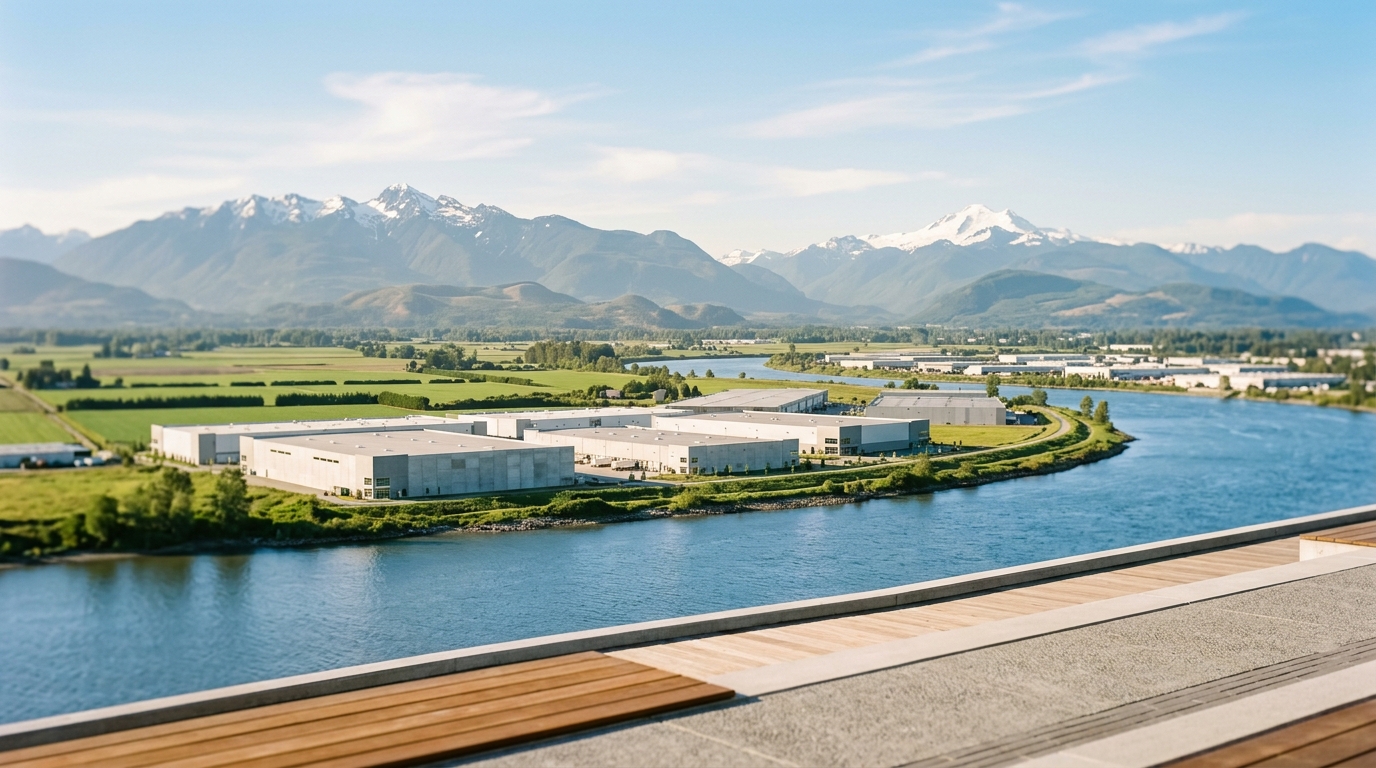
Drive east on the Trans-Canada Highway past Langley and the signs are clear. Lease inquiry boards sit in front of tilt-up concrete buildings that would have stood half-empty a decade ago. Cranes rise over new industrial pads in Abbotsford’s Mount Lehman corridor, and trucks queue at loading docks that did not exist three years ago. The Fraser Valley served as the overflow valve for Metro Vancouver’s industrial land squeeze, but that valve is tightening.
According to Colliers International's Q1 2026 Fraser Valley industrial market report, vacancy in Abbotsford has fallen below three per cent. Commercial real estate professionals define this as a landlord's market, where tenants hold little negotiating leverage and rents trend upward. For context, CBRE's most recent Metro Vancouver industrial data places the region's overall vacancy in the two-to-three per cent range, indicating that the gap that once made the Valley a bargain is compressing at both ends.
The asking-rate differential highlights this shift. Metro Vancouver industrial space—particularly in Burnaby, Richmond, and Delta—commands asking rates between $22 and $28 per square foot annually for newer product, according to CBRE Vancouver market data. Fraser Valley submarkets, including Abbotsford and Chilliwack, have historically offered space in the $14 to $18 range. That spread is narrowing as Valley landlords adjust expectations to match tightening supply.
This constraint is structural. Unlike Metro Vancouver, where the industrial land shortage stems from competing land uses and density pressure, the Fraser Valley's ceiling is set by the Agricultural Land Reserve. The ALR protects productive farmland, meaning serviced, development-ready industrial parcels outside its boundaries are finite. The City of Abbotsford's industrial land inventory has long flagged constrained supply, with high servicing costs for new parcels adding further friction to greenfield development.
Mission and Chilliwack offer marginally more breathing room than Abbotsford, but both markets have absorbed significant demand displacement over the past two years. Operators hoping for a market correction or a sudden influx of new supply are facing a reality that is not going to reset on their timeline.
The operators feeling this most acutely are mid-sized distributors, regional e-commerce fulfillment operations, and light manufacturers—the businesses that form the connective tissue of BC's traded-goods economy. Many relocated from Burnaby or Richmond when rents there crossed their threshold. The Fraser Valley provided a reprieve; that reprieve is now expiring.
As supply chain implications ripple outward, businesses weighing BC expansion are questioning whether any Lower Mainland-adjacent option remains viable. The alternatives—industrial space in the Okanagan, the Interior, or out of province—carry their own costs in transit time, labour access, and supply chain complexity.
The bottom line
The Fraser Valley offered a second chance to operators priced out of Metro Vancouver. That window is closing. Abbotsford's sub-three-per-cent vacancy and ALR constraints mean the cost advantage that made the Valley attractive is eroding. Operators with near-term space requirements—renewals due in the next 12 to 24 months or expansion plans contingent on affordable square footage—should treat this as an active decision. Businesses that move now will negotiate from a position of choice; those that wait may find themselves negotiating from a position of necessity.
What to watch: Chilliwack and Mission vacancy data in Q2 and Q3 2026 will indicate whether the tightening is spreading uniformly. Any provincial review of ALR exclusion applications near established industrial nodes—particularly along Highway 1—could signal a policy response. Additionally, watch for lease renewal rates in Abbotsford's Mount Lehman and Sumas Mountain corridors as a leading indicator of future rent trends.



