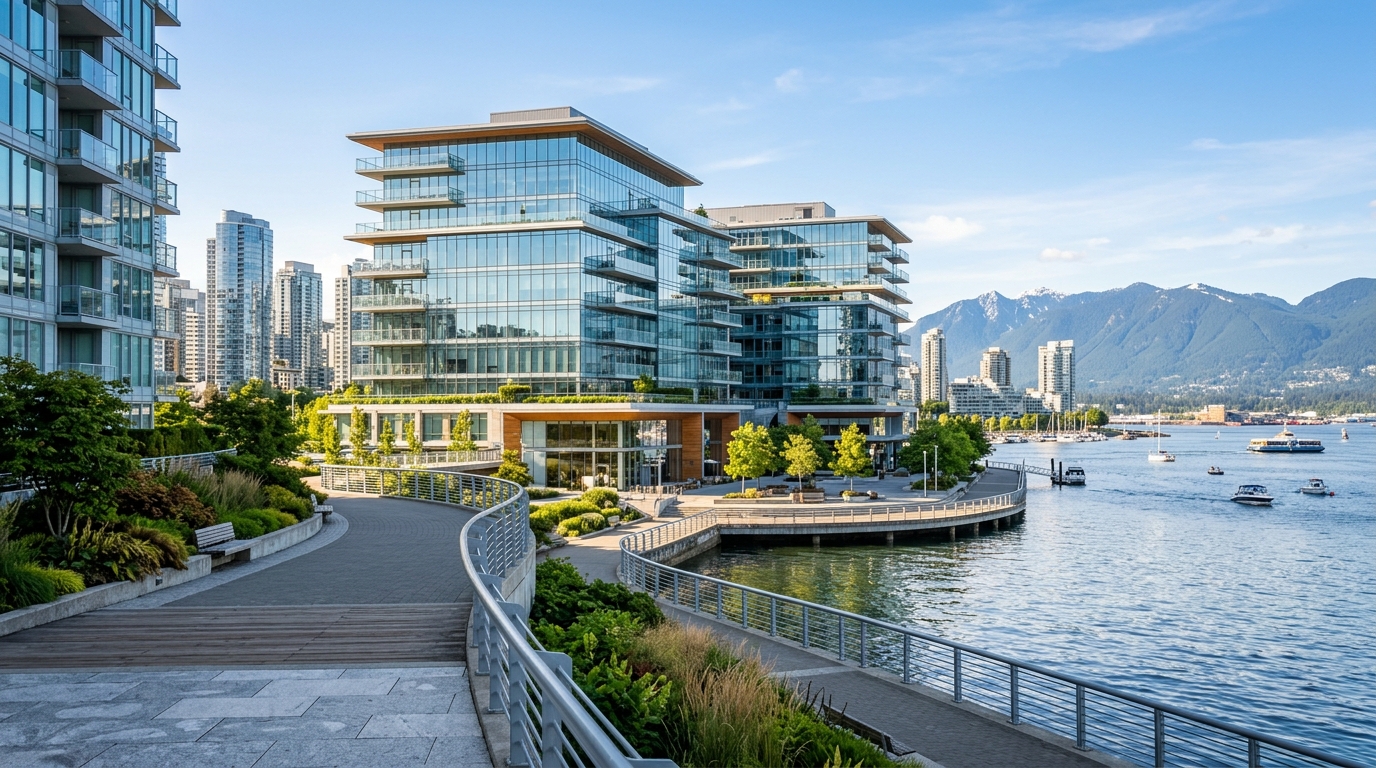
On the final trading day of June, a series of large-lot commercial transactions are expected to record across Metro Vancouver. Taken together, these deals crystallize what brokers have been tracking since April: institutional money is returning to the table—directly and in significant volume.
Preliminary data from CBRE Canada's Q2 2026 commercial investment tracking and Colliers International's Metro Vancouver mid-year snapshot indicate that total commercial transaction volume for the first half of 2026 is tracking above H1 2025 levels. If confirmed, this would mark the strongest first-half performance for the region's commercial sector since 2022. The office and mixed-use segments are leading the rebound in both deal count and dollar volume.
For developers managing stalled or deferred projects, this shift offers a critical market signal.
Why Institutional Buyers Are Moving Now
The return of institutional capital follows several converging forces in the first two quarters of 2026 that have improved the attractiveness of Metro Vancouver assets for pension funds, REITs, and private equity platforms.
First, the Bank of Canada's rate cycle has altered yield calculations. As the overnight rate has receded from its 2023–2024 highs, the spread between commercial cap rates and the cost of capital has widened, making acquisitions accretive again. This is particularly evident in the office segment, where prices corrected sharply.
Second, REALPAC transaction data suggests cap rate compression is underway in industrial and prime mixed-use categories. Office cap rates, while still elevated relative to pre-pandemic norms, are beginning to tighten in Vancouver's core and select suburban nodes.
Third, Metro Vancouver's supply fundamentals remain strong. Avison Young's BC capital markets team notes that Class A office space in the Broadway Corridor and downtown core is performing differently than the broader market—a bifurcation institutional buyers are pricing into their underwriting.
The Asset Class Breakdown
Industrial remains the most sought-after asset class. With cap rates for well-leased industrial product compressing due to structural land scarcity, institutional buyers are paying premiums for logistics and light-industrial assets with transit adjacency.
Mixed-use and retail-anchored developments are seeing renewed interest along the Expo and Millennium SkyTrain lines, supported by density bonusing and transit-oriented development policies. BC Assessment's commercial roll data reflects rising assessed values in these corridors, which is influencing transaction pricing.
Office remains nuanced. Institutional buyers are focusing on high-quality, ESG-compliant buildings with strong tenant covenants. The capital flowing into this segment is almost entirely targeted at trophy assets rather than commodity office space.
What This Means for Stalled Projects
The H1 volume signal provides a foundation for H2: increased developer confidence and lender appetite. As cap rates tighten, lenders are re-examining underwriting assumptions. Construction financing, which became difficult to secure in 2023 and 2024, tends to loosen when exit values rise. For developers holding mixed-use sites with stalled permits, projects that were previously underwater may now pencil.
Municipal development data indicates a backlog of applications that have not advanced to construction. A sustained recovery in H2 could help clear this backlog.
Metro Vancouver vs. the National Picture
National transaction data shows that while Toronto and Calgary are seeing improved volumes, Metro Vancouver's recovery is notable for its concentration in mixed-use and office segments. This reflects the region's supply constraints and its role as a Pacific gateway.
The Bottom Line
The close of H1 2026 marks an inflection point for Metro Vancouver's commercial market. For developers, the signal is clear: projects shelved in 2023 may now have a viable path forward. The operators best positioned are those who act before further cap rate compression narrows the margin for error.
Watch for CBRE and Colliers to release their full Q2 reports. Final transaction volume figures will set the tone for the fall construction season.
"


