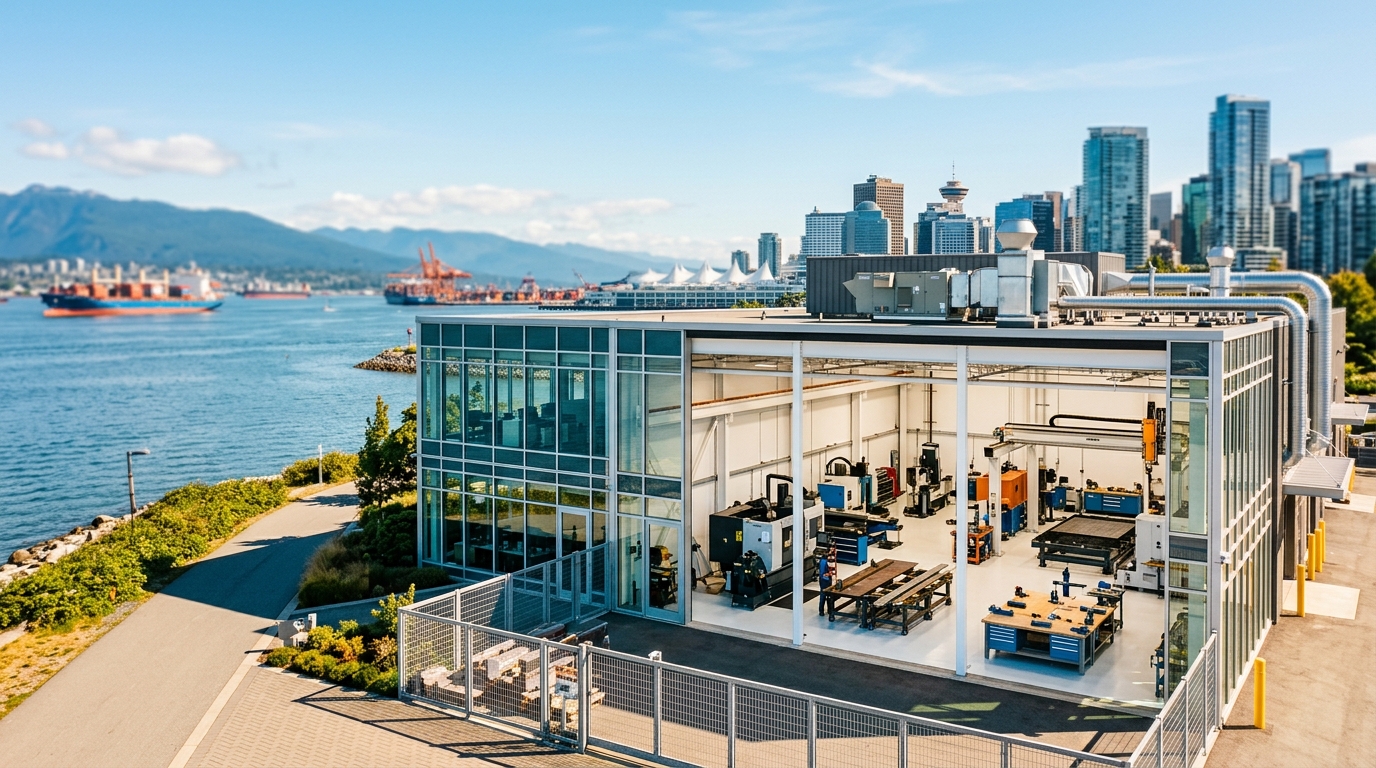
Walk the low-rise office corridors of Richmond’s Bridgeport district on a weekday morning and you will notice a shift: loading bays cut into glass-fronted lobbies, ventilation stacks rising above drop ceilings, and the hum of fabrication equipment where cubicle farms once stood. The industrial conversion play is no longer theoretical; it is unfolding block by block in Metro Vancouver’s overlooked commercial real estate.
The pressure driving this trend is well documented. Metro Vancouver’s industrial vacancy rate sat below 2% as of Q1 2026, according to CBRE, making it one of the tightest industrial markets in North America. Occupancy costs at traditional industrial parks have reached record highs, pricing out the light manufacturers and specialty producers that built their businesses on affordable production space. For that cohort, the conventional playbook—leasing in a suburban business park—has effectively stalled.
In its place, a counterintuitive strategy has emerged: the adaptive reuse of suburban office stock. Colliers’ Q1 2026 office market data puts suburban office vacancy in Richmond and South Burnaby at an estimated 15–22%—a mirror image of the industrial picture, and a gap that a growing number of operators are moving to close.
The economics are compelling. Industry cost analysis places adaptive reuse conversion at roughly 40–60% below greenfield industrial construction on a per-square-foot basis, once land, servicing, and construction timelines are factored in. For a mid-sized manufacturer, that gap can represent millions of dollars in capital retained for operations rather than concrete and steel.
The buildings best suited to conversion share a specific profile: single- or two-storey suburban office product from the 1980s and 1990s, with floor plates large enough for production lines, ceiling heights of 10 to 14 feet, and surface parking lots capable of accommodating truck access. Richmond’s Bridgeport and Cambie Road corridors and South Burnaby’s Boundary Road industrial fringe possess a high concentration of these assets, making both municipalities early centres of the trend.
Zoning is the critical variable. The City of Richmond has been advancing zoning amendments to streamline conversions from office to light industrial and hybrid production use, reducing approval timelines. Burnaby’s development applications database shows parallel activity in the South Burnaby corridor, with staff processing a queue of conversion proposals that would have faced longer timelines under previous policy.
Together, Richmond and Burnaby account for over one-third of Metro Vancouver’s total industrial inventory. Planning staff in both municipalities have signalled that applications meeting specific criteria—such as floor-loading capacity and compatibility with surrounding uses—are being processed on an expedited basis.
For commercial landlords, the calculus is clear. A suburban office building with declining occupancy is a liability; repositioned as a hybrid production-and-admin facility, it becomes an asset with a growth story. BC Assessment’s classification framework for hybrid-use properties is a critical factor for operators to review, as the assessed class influences both property tax exposure and financing terms.
The Urban Land Institute’s BC chapter has flagged adaptive reuse as an underleveraged strategy, noting that institutional appetite for converted industrial product is growing as purpose-built land becomes structurally scarce in the Lower Mainland.
The bottom line: This is a first-mover market. The pipeline of convertible suburban office assets is finite, and the zoning amendments that make conversions viable are still being processed. For manufacturers priced out of traditional space, the hybrid conversion path offers cost certainty and speed to occupancy. For landlords, the repositioning window is open, though competition for suitable buildings is intensifying.
What to watch: The formal publication of Richmond’s zoning amendment timeline, Burnaby’s development applications committee agenda, and Q2 2026 office vacancy data, which will indicate if the conversion trend is moving fast enough to meaningfully tighten supply.



