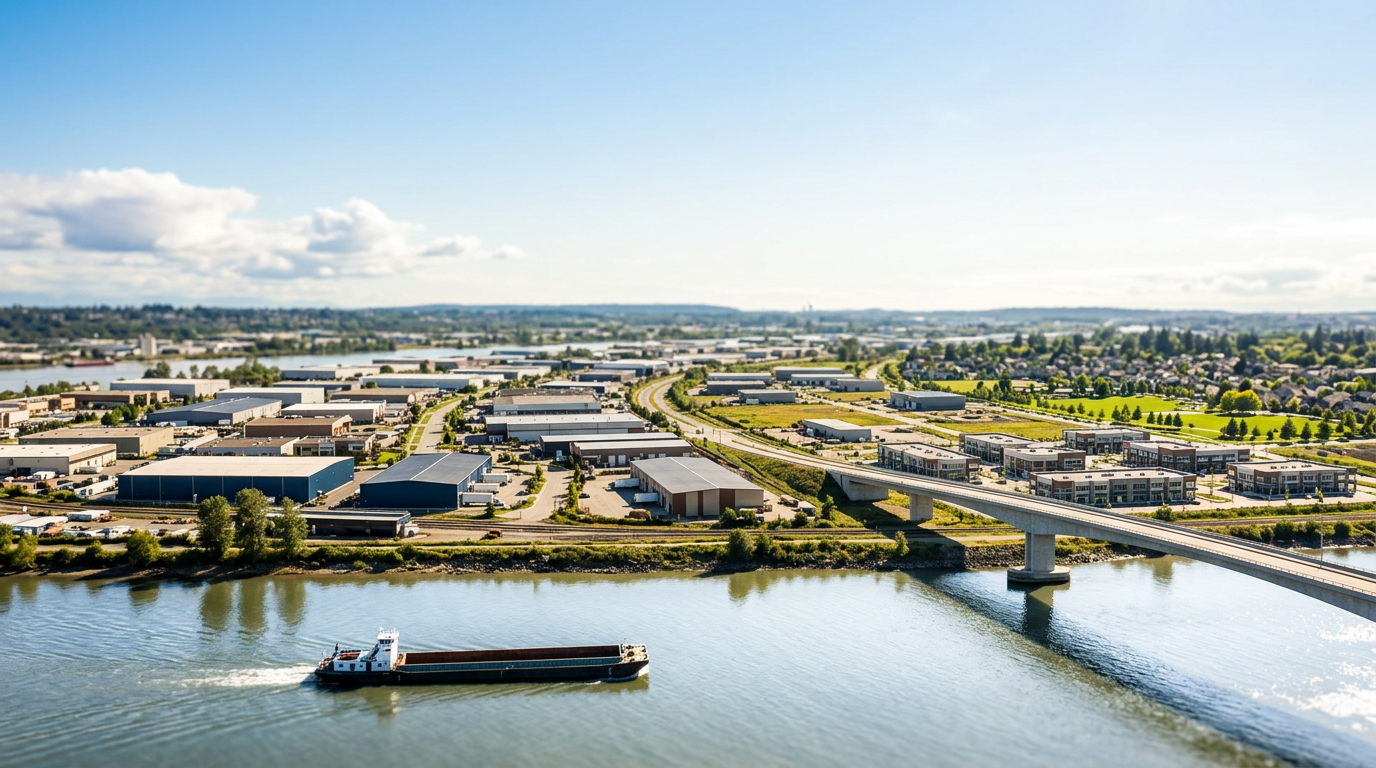
Drive east along the South Fraser Perimeter Road—a BC Ministry of Transportation project—and the shift is clear: trucks move faster, industrial parks appear newer, and "For Sale" signs are disappearing. In Cloverdale, Gloucester Industrial Estates, and the business parks flanking the Pitt Meadows Airport, a quiet repositioning is underway. Owner-operators and small investors priced out of Burnaby and Richmond are planting flags in these secondary markets, and the window to follow may be shorter than it appears.
Metro Vancouver's industrial market remains the region's most constrained asset class. According to CBRE's most recent Metro Vancouver industrial market data, the region's overall vacancy rate remains stubbornly below 2%. For businesses that lease, this translates into renewal anxiety; with few options available, landlords hold significant leverage in negotiations.
Ownership, in this environment, serves as a hedge. The most accessible entry point into industrial strata ownership is no longer in the urban core, but in the secondary markets to the south and east.
The Price Gap Remains Open
Colliers' BC industrial strata comparables and Avison Young's Q4 2025 Metro Vancouver industrial report confirm a persistent pricing differential. Burnaby and Richmond strata units—typically the 2,000–5,000 square foot range—trade between $550 and $700 per square foot. Surrey, Langley, and Pitt Meadows units transact at roughly $400–$500 per square foot, a gap of 20–30% depending on specifications and access.
Absorption data from Avison Young's Q4 2025 report shows that strata sales velocity in Surrey and Langley accelerated through the second half of 2025, with new completions absorbed at record rates.
Infrastructure Changes the Calculus
The historical discount in secondary markets was once justified by logistics friction. However, the South Fraser Perimeter Road has created a continuous truck route from Delta Port through Surrey into the Fraser Valley, reducing travel times. Combined with Highway 1 improvements, the logistics distance between secondary industrial nodes and major distribution arteries has compressed. For an owner-operator, the logistics penalty that once justified a premium in the core has largely evaporated.
The Vacancy Floor
Broker data from CBRE and Avison Young places vacancy in these submarkets below 3% and trending downward. While this remains higher than in the core, the market is tightening. The City of Surrey’s economic development department has identified industrial land supply as a critical constraint, noting that finite developable land faces increasing pressure from residential rezoning. Once this supply is exhausted, pricing dynamics in Surrey may mirror the trajectory seen in Burnaby a decade ago.
Owner-Operator Demand
The current buyer profile is dominated by small and mid-sized businesses—trades contractors, light manufacturers, and e-commerce operators—rather than institutional capital. For a contractor facing a lease renewal at $28–$32 per square foot in Burnaby, the total occupancy cost of a Surrey strata unit often proves more economical while providing equity and stability. BC Assessment's 2026 roll reflects this appreciation, yet the price gap remains wide enough to support the ownership-versus-lease calculus.
The Bottom Line
Colliers' forward supply data suggests that new completions in Surrey and Langley will peak in mid-2026 before tapering as serviced land becomes scarcer. For owner-operators, the data suggests the window to capture the 20–30% price discount is closing as secondary markets reprice to reflect their new fundamentals.



