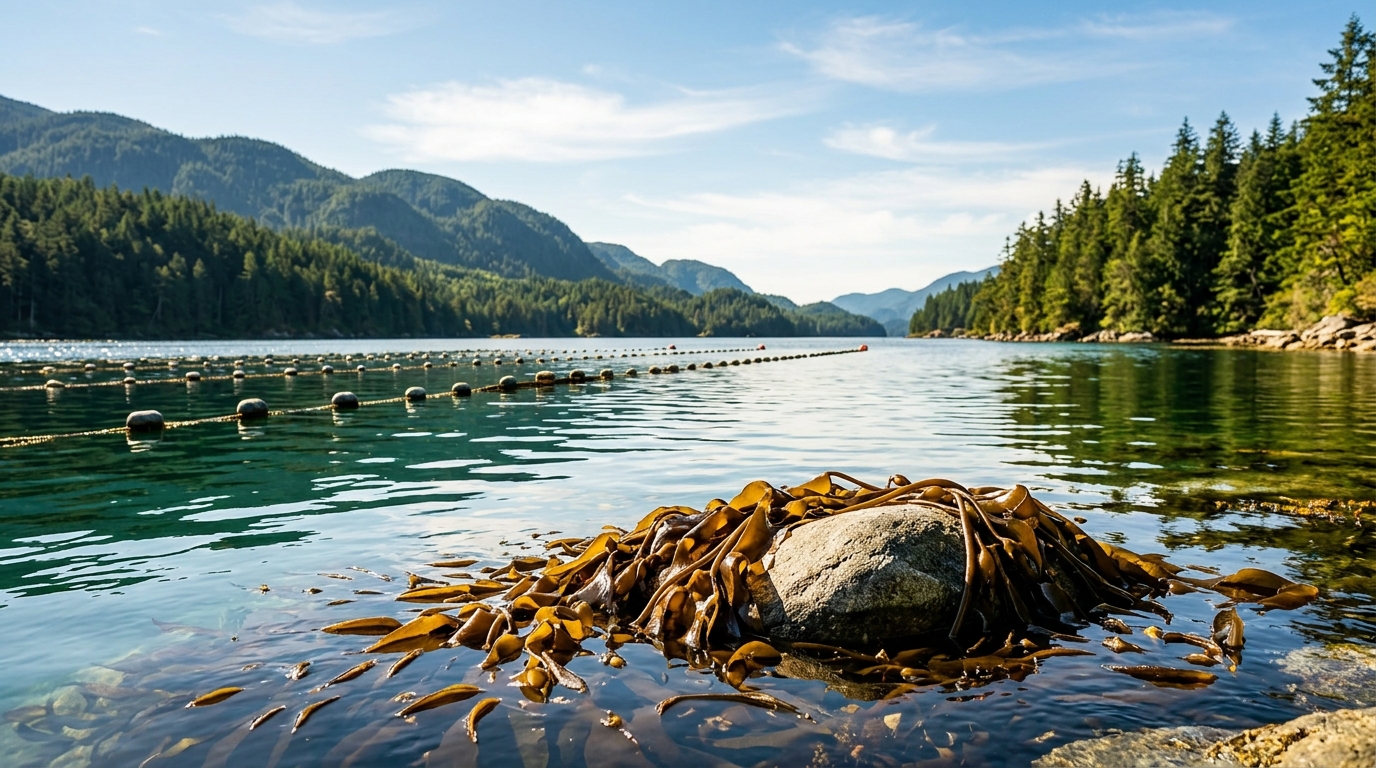
For decades, BC’s kelp forests have been an ecological asset and a commercial afterthought. That is shifting. A cluster of coastal operators—from the Sunshine Coast to the Central Coast—is moving toward commercial-scale seaweed aquaculture just as global buyers search for alternatives to Asian supply chains. The convergence of regulatory reform, proven export demand, and natural habitat advantage is creating a credible opportunity with the fundamentals already in place.
The global seaweed market was valued at approximately USD $9.1 billion in 2023 and is projected to reach USD $14.6 billion by 2028, driven by demand across food ingredients, nutraceuticals, cosmetics, and bioplastics. Translated to Canadian dollars, that projected market exceeds $20 billion—and BC producers are currently capturing only a fraction of it.
The supply gap is structural. Fisheries and Oceans Canada (DFO) data indicates that the licensing backlog has throttled sector growth for years. A 2025 DFO regulatory streamlining initiative is now moving tenure applications through the system faster, reducing the multi-year waits that have historically deterred investment. For operators with site assessments and business plans ready, the window is opening.
BC’s natural advantage is significant. The province’s 27,000 kilometres of coastline include some of the most productive cold-water kelp habitats in the Pacific. These nutrient-rich upwelling zones support high biomass yields without the inputs required in land-based systems. While competitors in warmer waters must manage temperature stress and lower nutrient density, BC producers work in conditions that approximate the wild habitat where commercial seaweed species evolved.
The export demand signal is clear. Buyers in Japan and South Korea are sourcing North American supply to reduce concentration risk in their procurement chains. European food manufacturers, responding to evolving EU novel foods approvals for seaweed ingredients, are similarly looking westward. BC producers report fielding significant export inquiries, a shift from a sector that previously operated almost entirely in domestic specialty food channels.
Coastal First Nations communities are positioned as both partners and principals in this expansion. Several nations along the Central and North Coast hold or are pursuing aquaculture tenure agreements that integrate seaweed cultivation with existing marine stewardship frameworks. The alignment between traditional ecological knowledge and sustainable aquaculture creates partnership models that differ from the extractive resource arrangements of earlier eras. For investors, tenure security tied to First Nations partnerships represents reduced regulatory and social risk.
Commercial seaweed aquaculture in BC remains early-stage. Processing infrastructure—including cold-chain logistics, drying and milling capacity, and quality certification—is underdeveloped relative to the sector’s ambitions. Species selection is also critical, as operators determine which varieties perform best across food, nutraceutical, and industrial applications. While the DFO streamlining initiative is encouraging, tenure applications still involve multi-agency coordination with Transport Canada, Environment and Climate Change Canada, and provincial bodies.
A $200-million export market is plausible over a five-to-seven-year horizon if tenure expansion proceeds and processing infrastructure investment follows. The input conditions—habitat quality, buyer demand, regulatory momentum, and community partnership frameworks—are aligning in a way they have not before. For the coastal economy, the opportunity is significant. For investors, the question is whether the necessary infrastructure investment will arrive fast enough to meet the growing demand.