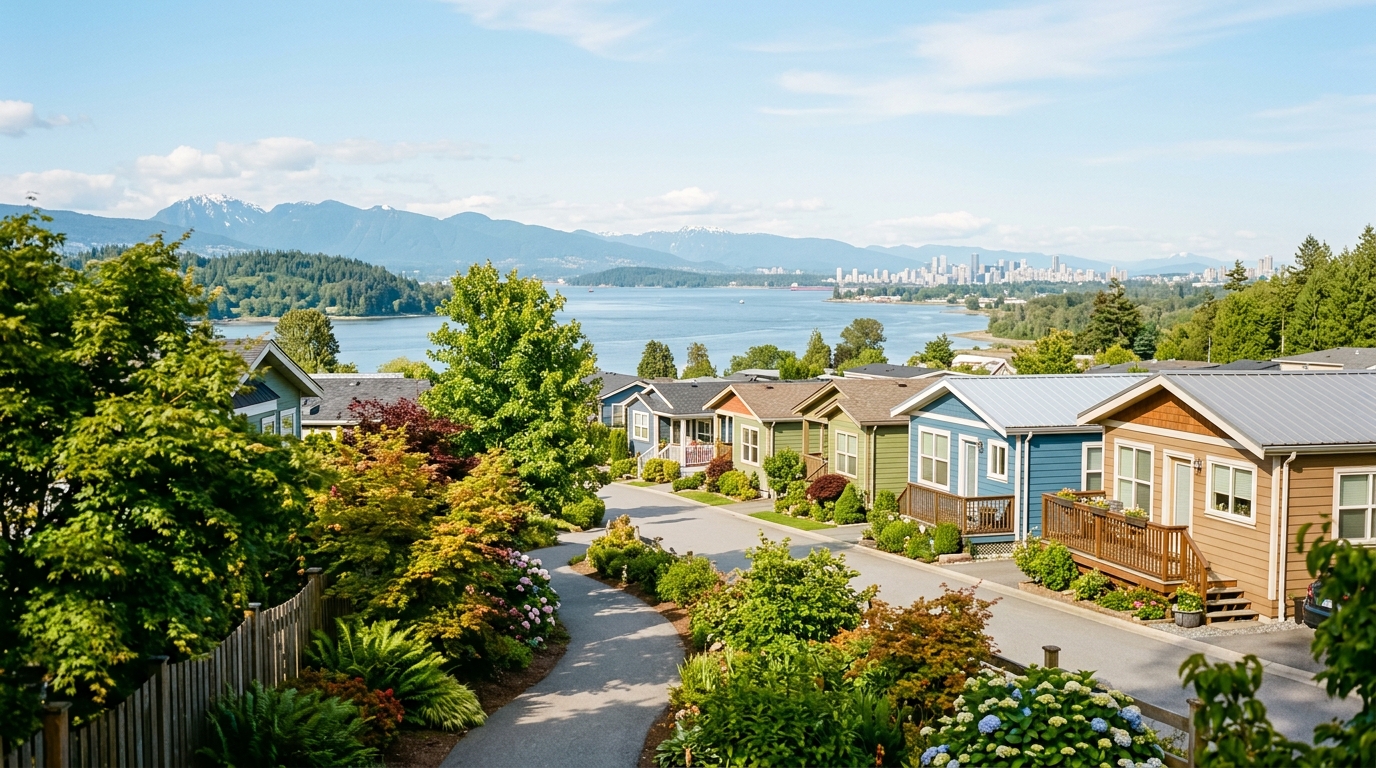
Drive east on the Trans-Canada Highway past Abbotsford and you will pass dozens of neatly kept manufactured home communities tucked behind service roads and tree lines. These sites, which rarely make headlines, quietly shelter tens of thousands of Fraser Valley families. A pad-lease site in Chilliwack where a three-bedroom manufactured home sells for $180,000 to $220,000 lacks the profile of a Yaletown penthouse, yet it is currently attracting unprecedented capital attention.
Private equity firms, regional developers, and non-profit housing operators are all circling the same asset class: manufactured home park land in the Fraser Valley. While their motivations differ, their timing is identical. A regulatory update advancing under BC's Manufactured Home Park Tenancy Act (MHPTA) is set to shift the sector's economics, creating both urgency and opportunity for deliberate operators.
The Affordability Case
The Fraser Valley benchmark home price sits roughly 30 to 40 per cent below the Metro Vancouver average, a disparity that has pushed ground-oriented ownership out of reach for most moderate-income households. Within that market, manufactured home communities represent a vital tier of workforce housing.
Across British Columbia, an estimated 50,000 or more residents live in these communities, typically on pad-lease arrangements. While this tenure structure—ownership without land title—has historically kept institutional capital at arm's length, that calculus is changing.
Land values in Chilliwack, Abbotsford, and Mission have risen substantially as growth pressure pushes eastward along the Highway 1 corridor. A manufactured home park on five to 15 acres of serviced, transit-adjacent land is no longer merely a cash-flowing rental operation; it is a strategic land play.
Two Capital Strategies
The capital entering this sector is not monolithic. Private equity-backed operators and regional developers view these parks as repositionable assets: they acquire at income-property valuations, stabilize cash flow, and eventually pursue rezoning for higher-density residential. In communities like Abbotsford, where the Official Community Plan increasingly supports density along transit corridors, the rezoning pathway is viable.
Conversely, non-profit housing societies and community land trusts are actively pursuing acquisitions to prevent displacement. Their model involves purchasing parks at market value, holding the land in perpetuity, and reinvesting surpluses into maintenance. The BC Non-Profit Housing Association prioritizes the preservation of these communities, noting that the replacement cost of equivalent affordable units would reach hundreds of thousands of dollars per door.
The MHPTA Update
A provincial update to the Manufactured Home Park Tenancy Act is raising the floor on tenant protections, particularly regarding relocation compensation. While compensation floors currently exist, enforcement has been inconsistent, and the gap between statutory minimums and actual relocation costs has caused significant community conflict.
The upcoming amendments are expected to increase compensation requirements and strengthen notice provisions. For operators pursuing repositioning, this increases the cost basis of future park closures. While it does not render the strategy unviable, it alters the financial math, particularly for smaller parks where compensation obligations represent a larger share of total project costs. This has accelerated deal timelines as buyers compete for a shrinking pool of pre-amendment assets.
Market Concentration
Chilliwack holds the highest concentration of manufactured home communities in the region and has seen the most acquisition activity, according to industry observations. Abbotsford and Mission are experiencing stronger redevelopment pressure due to rapid population growth and constrained land supply. The Manufactured Home Park Owners Alliance of BC reports that long-term family owners are increasingly receiving unsolicited acquisition offers, prompting succession decisions that might otherwise have been delayed.
The Bottom Line
Manufactured home communities are a functioning, affordable ownership tenure for thousands of residents and are now a primary target for institutional capital. The MHPTA update serves as a catalyst, but the underlying driver is market-based: as ground-oriented ownership becomes increasingly expensive in the Fraser Valley, this previously overlooked asset class has become highly attractive.
The question for the next 18 months is whether the regulatory framework and the non-profit acquisition pipeline can ensure that capital expansion preserves affordable housing supply. With the MHPTA amendments expected to receive a third reading in the fall legislative session, the current window for acquisition is closing, marking the beginning of a new economic era for this essential housing sector.



