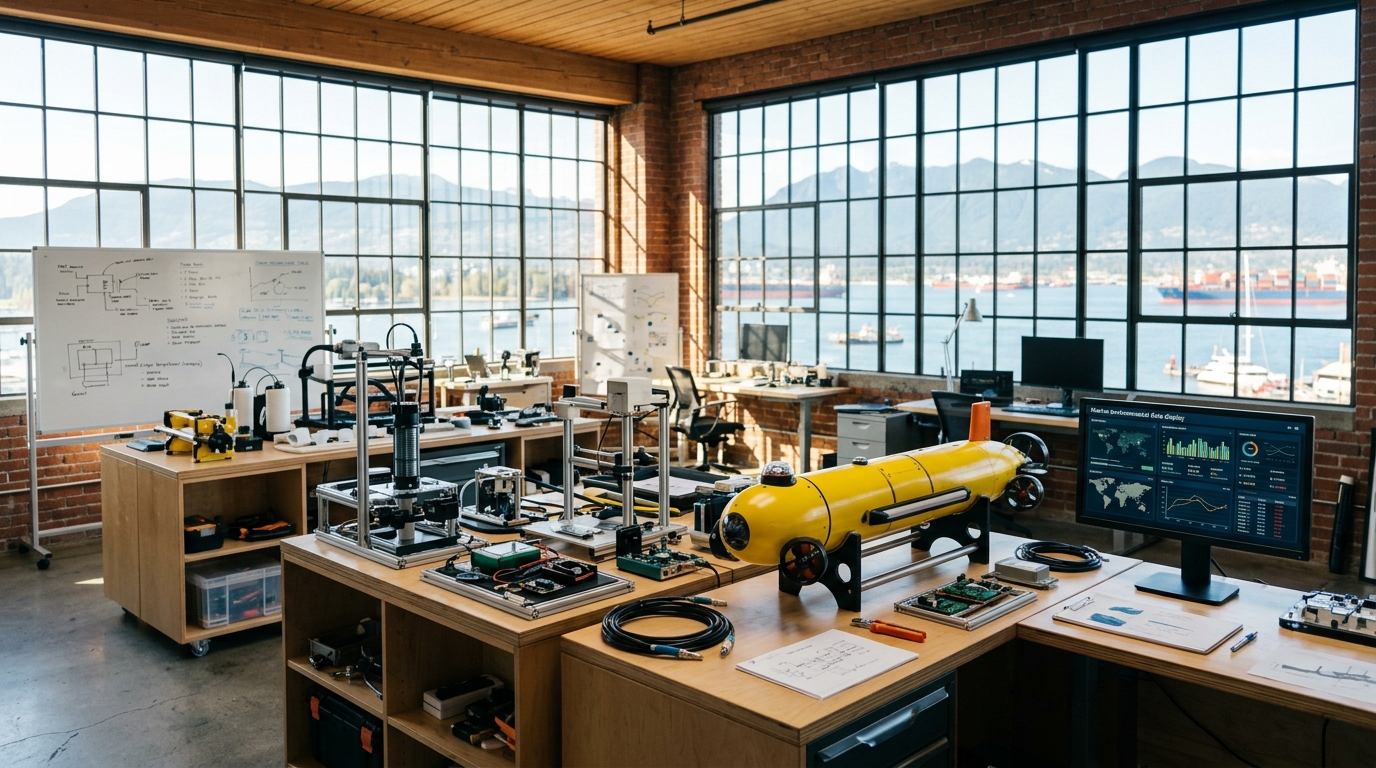
The test happens at dawn, when container traffic thins and the light is flat. A compact, unmanned surface vessel cuts through Burrard Inlet on a pre-programmed route, logging obstacle-avoidance data while a remote operator monitors from shore. No crew. No fuel bill. Just sensor data accumulating toward a contract milestone.
This is the quiet front edge of a sector beginning to move quickly. Metro Vancouver has assembled, largely without fanfare, a concentration of autonomous and remotely piloted vessel startups that are converting research into early revenue—and doing so through a funding path that sidesteps U.S. market dependency.
The structural advantage starts with geography. The Port of Vancouver is the largest port in Canada by tonnage, handling traffic across bulk commodities, containers, and cruise—a live, high-complexity operating environment that no simulated test basin can replicate. For a startup building collision-avoidance software or autonomous navigation systems, access to that environment is invaluable.
It also helps that Transport Canada has been quietly building one of North America's more permissive regulatory sandboxes for autonomous vessels. The department's pilot permit framework allows companies to operate autonomous and remotely piloted vessels in Canadian waters under controlled conditions, giving founders a legal pathway to collect real-world data. The number of active permits in BC waters has grown steadily since 2024, reflecting both regulator appetite and founder momentum.
The research pipeline feeding these companies runs through two institutions. UBC's Department of Mechanical Engineering has been producing marine robotics research with direct commercial applications, while SFU's robotics and computing programs have contributed founders and technical co-founders to several early-stage teams. The National Research Council's ocean technology funding streams have provided non-dilutive capital to at least a handful of BC-based teams at the pre-seed stage—a critical bridge between lab and first contract.
That first contract, increasingly, is coming from the federal government. Canada's defence procurement budget for autonomous maritime systems is expanding as the Royal Canadian Navy and the Department of National Defence accelerate interest in unmanned surface and subsurface platforms. For a seed-stage company, a federal procurement contract validates the technology, generates non-dilutive revenue, and signals to private investors that the product has cleared a serious due-diligence bar.
Federal defence procurement interest in autonomous maritime platforms has grown alongside NATO commitments and Arctic sovereignty priorities—a tailwind that BC founders are beginning to leverage. The pitch is straightforward: Canadian-built, Canadian-tested, operating in Canadian waters, with no export-control entanglement and no dependence on U.S. customer relationships.
That independence matters more now than it did two years ago. With U.S. trade policy creating friction for tech exporters across sectors, the ability to build a contract pipeline anchored in Canadian federal procurement and allied-nation defence spending is a structural moat. It is an intentional go-to-market strategy that several teams are now building around from day one.
The Vancouver Fraser Port Authority has signalled its own interest in the sector through its innovation partnership programming. The VFPA has been developing frameworks to work with technology companies on port efficiency and safety applications—including autonomous vessel monitoring, traffic management, and environmental sensing. For startups, a port authority partnership serves as both a revenue opportunity and a reference customer that opens doors with other major port operators globally.
The capital picture is early but real. Foresight Canada's cleantech and marine sector tracking shows seed and pre-seed activity in BC marine tech accelerating through 2025 and into 2026, with cheque sizes in the $500,000 to $2-million range—modest by software standards, but appropriate for hardware-software hybrid companies that can reach revenue on lean budgets through government contracts.
VANTEC Angel Network has seen deal flow in the sector increase, reflecting broader investor recognition that deep-tech hardware companies with government contract pipelines offer a more resilient risk profile than pure software plays.
Vancouver is building something that looks less like a startup cluster and more like a full-stack marine autonomy ecosystem—research institutions, regulatory infrastructure, port access, defence procurement interest, and early-stage capital arriving in the same geography at the same time. That convergence is rare and tends to produce companies that matter.
For founders considering the space, the window is open but not unlimited. Regulatory frameworks will tighten as the technology matures. First-mover advantage in government contracting is real; relationships and reference contracts compound. The founders who move now, build the safety record, and secure their names on early procurement vehicles will have a structural lead that is difficult to close later.
The harbour is the lab. The contracts are the proof. The question is which companies will be first to scale what they are learning at dawn in Burrard Inlet into something that operates at port-scale, globally.