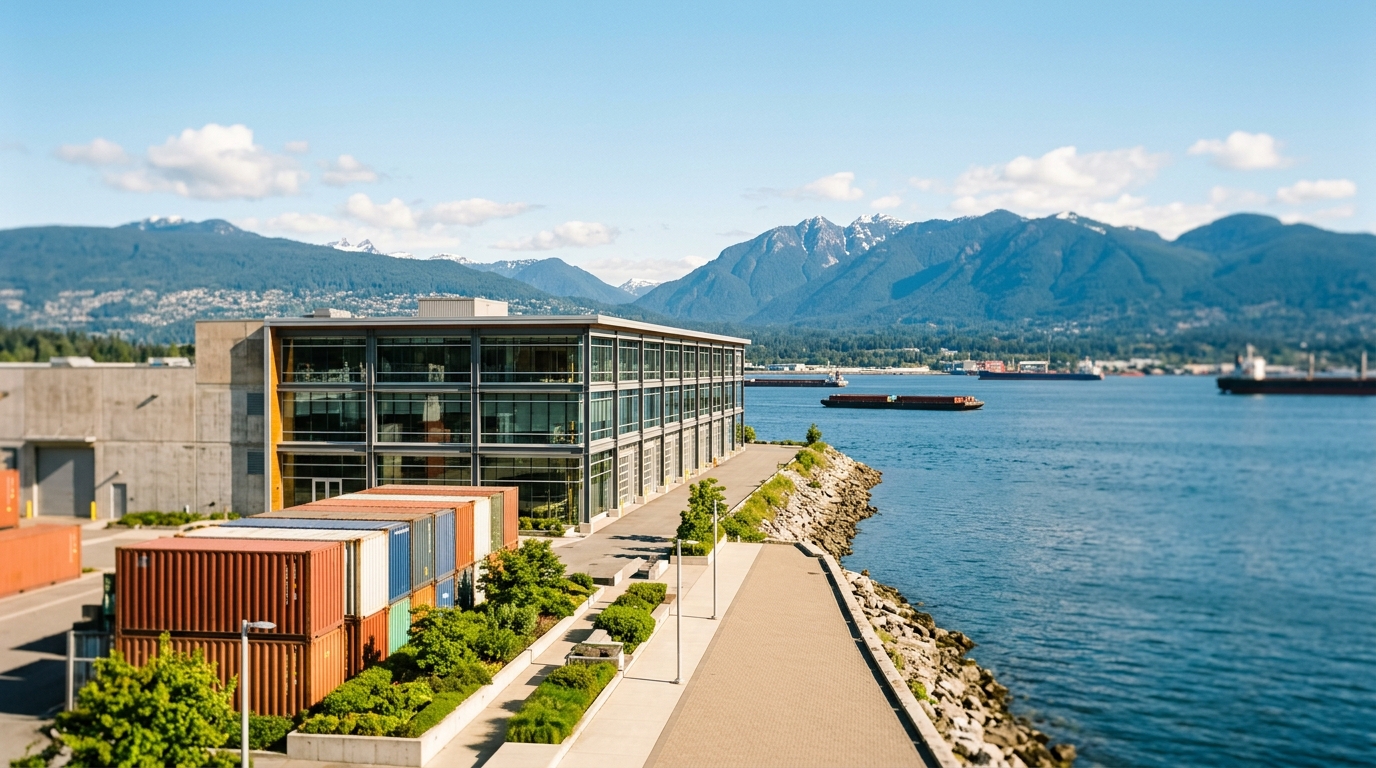
Drive east along Marine Way in Burnaby on any weekday morning and the industrial land squeeze is visible: loading docks humming before dawn, trucks queued into the street, and a persistent absence of "For Lease" signs. Metro Vancouver's industrial market has been tight for years, but mid-2026 data suggests the constraint has shifted from a cyclical challenge to a structural reality. For every company moving physical goods in this region—from national grocery chains to local craft brewers—the cost of doing business has reached a critical inflection point.
According to the CBRE Q2 2026 Vancouver Industrial Market Report, Metro Vancouver's industrial vacancy rate remains among the lowest in North America. New industrial strata product in Burnaby and Surrey is trading above $650 per square foot—a valuation that would have seemed extraordinary five years ago. Rising lease rates are compressing operator margins, forcing a fundamental rethink of last-mile logistics in one of Canada's most constrained urban geographies.
The root cause is structural. Metro Vancouver is hemmed in by mountains, the U.S. border, and the Pacific Ocean, while policy frameworks like the Agricultural Land Reserve effectively cap industrial expansion on accessible flat land. Furthermore, the Metro Vancouver Regional District's industrial land inventory documents a steady erosion of available space as mixed-use and residential developments compete for the same scarce acreage.
For logistics operators, this translates to significant rent increases—often 30 to 50 per cent upon lease renewal, depending on the facility's vintage. These costs inevitably permeate the supply chain. Retailers must navigate margin compression, pass costs to consumers, or adjust delivery windows and SKU counts. Operators who move decisively—restructuring their footprint or adopting new formats—are building a competitive "moat" that slower-moving rivals may struggle to overcome.
Three adaptation strategies are emerging among sophisticated logistics players in the region.
The first is multi-storey industrial. While common in land-constrained Asian markets, this format remains rare in Canada. Several projects are in planning stages in Vancouver, a shift that the Urban Development Institute of BC has identified as a critical evolution in logistics density. By stacking warehousing and distribution functions, operators can maximize usable square footage, though this requires navigating complex requirements for ramp access and floor-load specifications.
The second strategy is co-location and shared infrastructure. Smaller operators are increasingly sharing facilities to split fixed costs while maintaining dedicated inventory zones. This model demands sophisticated lease structures but provides access to prime locations that would be unaffordable for a single tenant.
The third shift is displacement to the Fraser Valley. Colliers International's BC industrial data shows accelerating absorption in the Fraser Valley. The City of Abbotsford's economic development office and its counterpart in Chilliwack report growing interest from Metro-based logistics tenants, reshaping the region's economic geography.
This displacement carries trade-offs. Last-mile delivery from the Fraser Valley to Vancouver's core increases time and fuel costs. For operators dealing in time-sensitive goods like fresh food, the distance penalty may outweigh rent savings. However, for those with less time-sensitive operations, the move often proves economically viable.
The industrial land squeeze also presents an opportunity for developers. Multi-storey projects and purpose-built facilities in the Fraser Valley are attracting significant capital. Simultaneously, logistics technology—including route optimization and micro-fulfilment—is drawing venture interest as operators seek efficiency gains to offset real estate costs.
Ultimately, Metro Vancouver's industrial land constraint is a permanent feature of the market. Operators who treat this as a recurring challenge to be solved at every lease renewal risk falling behind. Those who integrate these constraints into their long-term logistics models will be better positioned to compete as the region continues to evolve.



