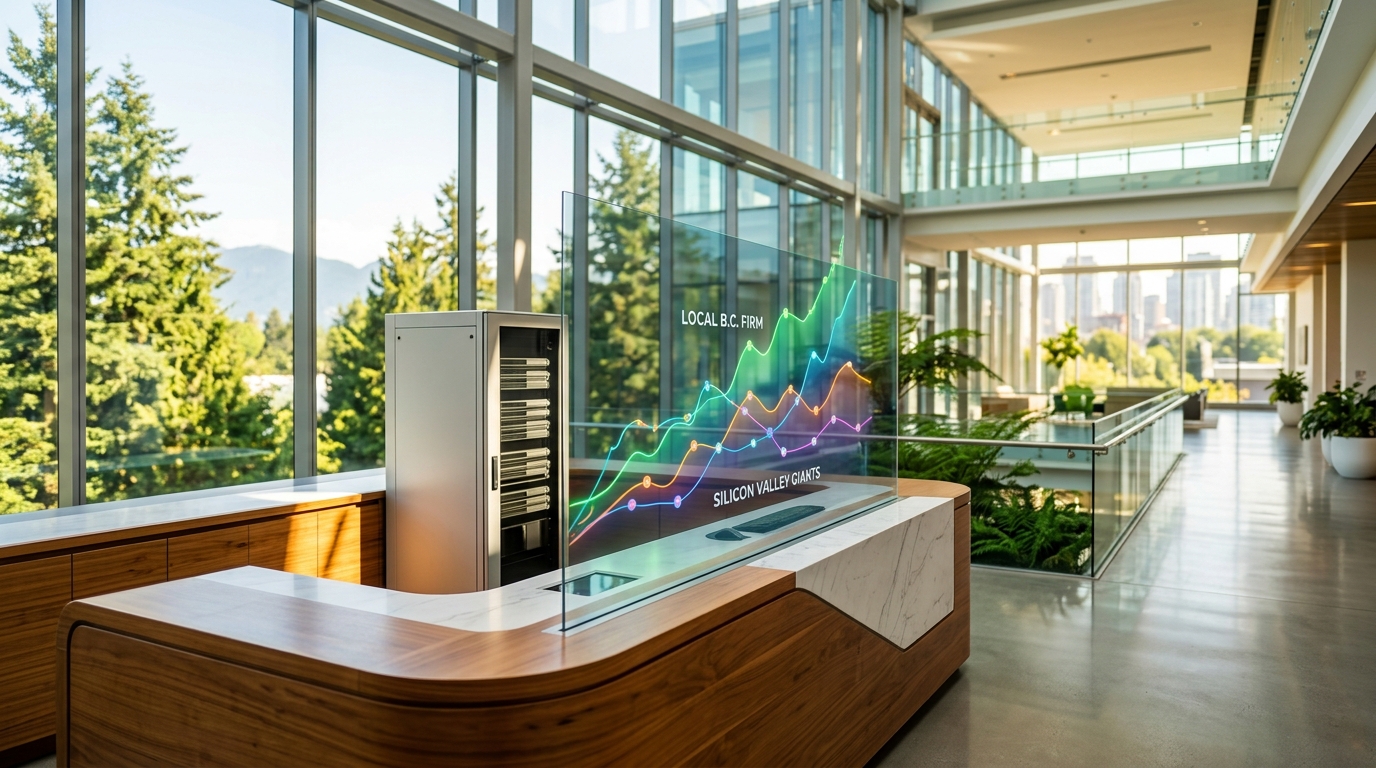
Industrial space in Metro Vancouver is, for all practical purposes, gone. Vacancy has held below 2% for multiple consecutive quarters, according to CBRE's Q1 2026 industrial market data. For traditional manufacturers requiring 20,000 square feet, this presents a significant hurdle. For a growing cohort of small producers, however, it has become a catalyst for innovation.
These micro-factory operators run highly automated production cells in spaces under 5,000 square feet—units that larger competitors often overlook. They compete on speed-to-market, customisation, and supply chain proximity. After years of tariff volatility and retailer anxiety regarding offshore exposure, these attributes now command a premium.
The timing is strategic. Automation capital costs have fallen roughly 30% since 2022, according to the Canadian Manufacturers & Exporters association, driven by the commoditisation of collaborative robots, vision systems, and modular conveyor hardware. Systems that required a $400,000 investment four years ago can now be implemented for under $280,000. In a 3,500-square-foot unit, this capital expenditure can often be recouped in under three years when factoring in labour and lease savings.
The Template Taking Shape
In Metro Vancouver’s apparel sector, producers are repositioning themselves as on-demand, cut-and-sew operations. Rather than chasing high-volume fast-fashion orders, they target mid-market Canadian retailers and direct-to-consumer brands requiring 200-unit runs with 10-day turnarounds. Automated spreading and cutting equipment—machinery that once demanded a 15,000-square-foot floor—now fits into a fraction of that space.
In food processing, the model is gaining traction among specialty and functional food producers in South Vancouver and Burnaby. Several have received support through Innovate BC's advanced manufacturing program, which prioritizes capital-efficient production. Beyond spatial benefits, these smaller facilities often operate under simplified food-safe certification frameworks, reducing the compliance overhead that can erode margins.
Specialty materials—including composites, technical textiles, and precision-cut industrial components—represent another high-growth segment. A composite parts maker utilizing a five-axis CNC cell and an automated quality-inspection station in 4,200 square feet can secure aerospace and marine contracts that require Canadian-content certification and tight delivery windows, offering a level of agility that offshore competitors struggle to match.
The Economics, Specifically
The financial viability of this model is attracting lenders and investors. A micro-factory operator who secures an industrial strata unit—a model becoming increasingly common in Metro Vancouver—converts lease expenses into equity while reducing per-square-foot occupancy costs. When combined with automation that reduces the need for additional full-time equivalent (FTE) positions, the operating leverage becomes significant.
BC's Manufacturing Jobs Action Plan identifies this model as a priority, recognising that the sector's future in high-cost regions depends on value density—revenue and margin per square foot—rather than raw volume. Manufacturing accounts for approximately 7% of BC's provincial GDP, a figure that remains stable as the sector shifts toward higher-value production.
While Canada's manufacturing PMI has shown consecutive months of contraction through early 2026, micro-factory operators in Metro Vancouver are bucking the trend, as their model is not dependent on the high-volume conditions currently facing headwinds.
Funding the Future
The National Research Council's Industrial Research Assistance Program (IRAP) has provided early-stage funding for several local operators, particularly those with automation or process-innovation components. Its non-dilutive structure is highly attractive for founders looking to preserve equity.
Commercial lenders are also beginning to treat micro-factory operations as a distinct asset class. The combination of owned industrial strata, automation equipment as collateral, and contracted revenue provides a more stable lending profile than conventional small manufacturing. Alternative lenders are increasingly offering equipment-financing structures that align repayment with production capacity rather than traditional amortisation schedules.
The Replicability Question
Successful operators share common traits: they identify product categories where speed and customisation command a price premium, they size automation investments to realistic order pipelines, and they secure space before scaling. In a market with sub-2% vacancy, waiting until contracts are signed to secure space is often a losing strategy.
The Greater Vancouver Board of Trade's manufacturing sector working group has identified industrial space access as the primary structural constraint on growth, making space efficiency a prerequisite for new entrants.
Metro Vancouver’s manufacturing sector is not contracting into irrelevance; it is concentrating into a higher-value, more automated, and spatially efficient form. Operators who treat these constraints as design parameters are winning. Those still searching for 20,000-square-foot leases at 2019 rates may find the search increasingly difficult.