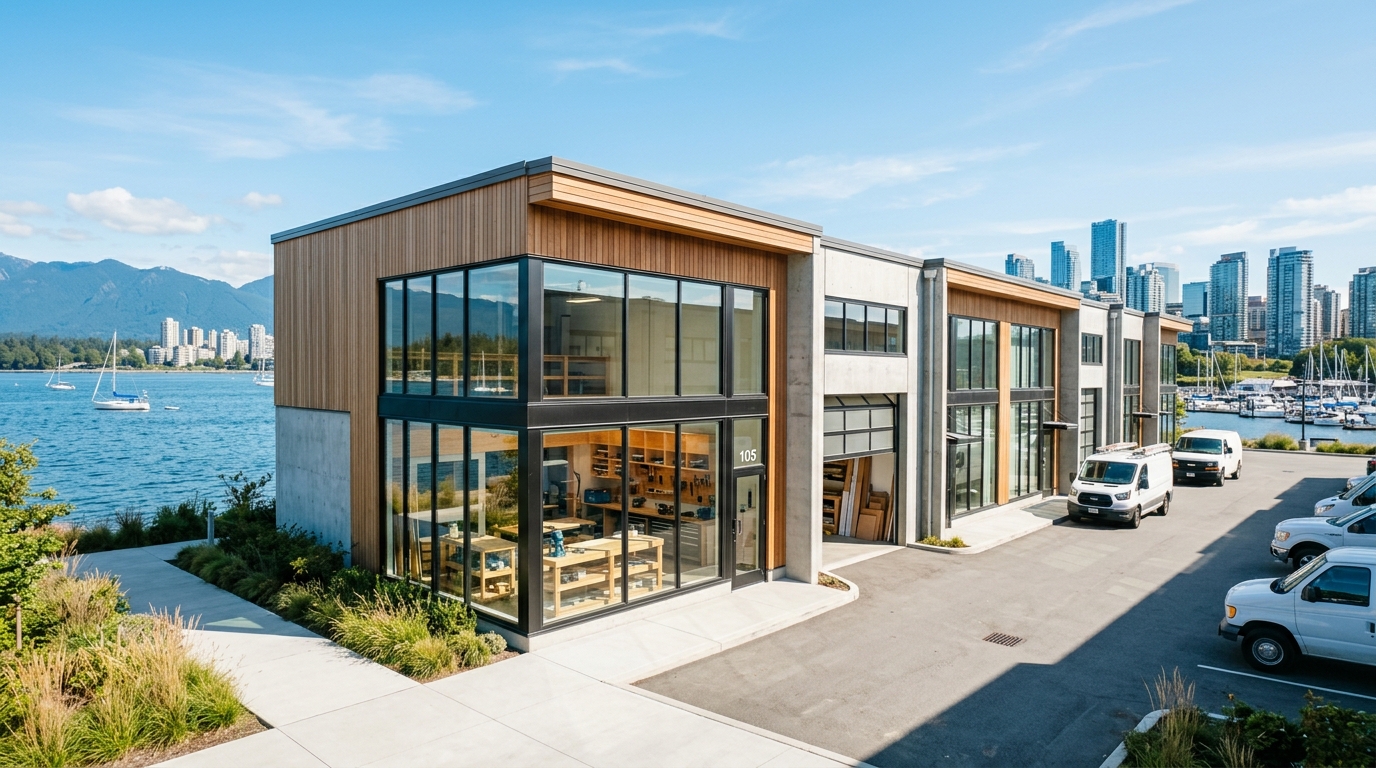
Consider a 3,200-square-foot concrete bay in East Burnaby—equipped with a roll-up door, 24-foot ceilings, and a mezzanine office—that a plumbing contractor purchased in 2018 for just under $900,000. Today, comparable units in the same complex trade for more than $1.7 million. The contractor hasn't moved or refinanced; he has simply continued his operations while his balance sheet transformed beneath him.
This scenario is playing out across Metro Vancouver’s industrial corridors, representing one of the region’s most significant, yet underreported, wealth-building narratives. Over the past decade, a sustained wave of small-bay industrial strata construction—concentrated in Burnaby, Coquitlam, and Richmond—has established a distinct asset class. These owner-occupiable units, typically priced between $800,000 and $2 million, allow tradespeople, light manufacturers, and logistics operators to build equity for the first time.
The data underscores the opportunity. Metro Vancouver's industrial vacancy rate sat below 2% as of the first quarter of 2026, according to Colliers International—a figure that has hovered near historic lows for three years. Meanwhile, industrial asking rents in Burnaby and Richmond have more than doubled since 2018, according to CBRE Vancouver, making leasing an increasingly difficult proposition for small operators.
This rent escalation drives the appeal of ownership. A business paying $22 to $26 per square foot annually—a standard range in Burnaby—faces unpredictable costs at every lease renewal. Conversely, an owner-occupier locks in a fixed mortgage payment, builds equity, and retains the flexibility to lease the unit if the business outgrows the space. In a market where industrial square footage functions as a scarce commodity, this optionality carries significant value.
Small-bay strata units under 5,000 square feet now represent the fastest-growing segment of new industrial supply in Metro Vancouver, according to Avison Young. Developers, including Beedie and Wesgroup, have delivered product in Coquitlam’s Burke Mountain corridor, Burnaby’s Still Creek area, and Richmond’s Bridgeport precinct.
The pipeline remains active. The City of Burnaby has continued to approve industrial strata rezonings in its Still Creek and Boundary Road corridors, while Coquitlam has expanded its employment land designations to accommodate the small-bay format. Both municipalities have signalled support for this typology to retain light industrial businesses facing land-cost pressure.
For buyers, the calculus has shifted. Units that were attainable for $800,000 to $1 million five years ago now often start at $1.2 million to $1.8 million, with top-tier units in Richmond’s logistics corridor exceeding $2 million. Financing typically requires a 25% to 35% down payment, meaning a buyer targeting a $1.5 million unit needs $375,000 to $525,000 in equity—a significant, though manageable, hurdle for an established business with retained earnings or a home equity line.
BC Assessment data shows consistent year-over-year appreciation in assessed values for industrial strata across Metro Vancouver, though these figures often lag transaction prices in a supply-constrained market. This gap has historically worked in owners' favour regarding property tax calculations.
What distinguishes this asset class is its dual-return structure. An owner-operator captures both the operational benefit of stable occupancy costs and the investment return of capital appreciation. For a plumbing contractor or a precision machining shop, the unit serves as both a business input and a retirement asset.
Risks remain. Rising interest rates between 2022 and 2024 compressed cap rates and slowed transaction volumes; buyers who purchased at the 2022 peak with aggressive financing faced a tighter debt-service environment. Furthermore, while market-level vacancy is low, it is not zero. Owners must also budget for strata fees, which in newer complexes can range from $400 to $800 per month.
Still, the structural case for the asset class remains robust. Metro Vancouver’s industrial land base is constrained by geography, the Agricultural Land Reserve, and residential encroachment. New supply is absorbed rapidly, reinforcing the equity position of current owners.
The bottom line: The micro-industrial strata market has matured into a legitimate wealth-building vehicle. While new entrants face higher prices, they benefit from the same structural tailwinds: scarce land, rising rents, and a financing model that converts occupancy costs into equity. For business owners evaluating their next lease renewal, the question is no longer whether to consider ownership, but whether they can secure a space in a competitive market.
What to watch: Q2 2026 transaction volumes from Colliers and CBRE will indicate if buyer demand remains steady at current price levels. Additionally, monitor Burnaby and Coquitlam’s mid-year zoning calendars for new employment land approvals, which will signal where the next tranche of strata supply will emerge.



