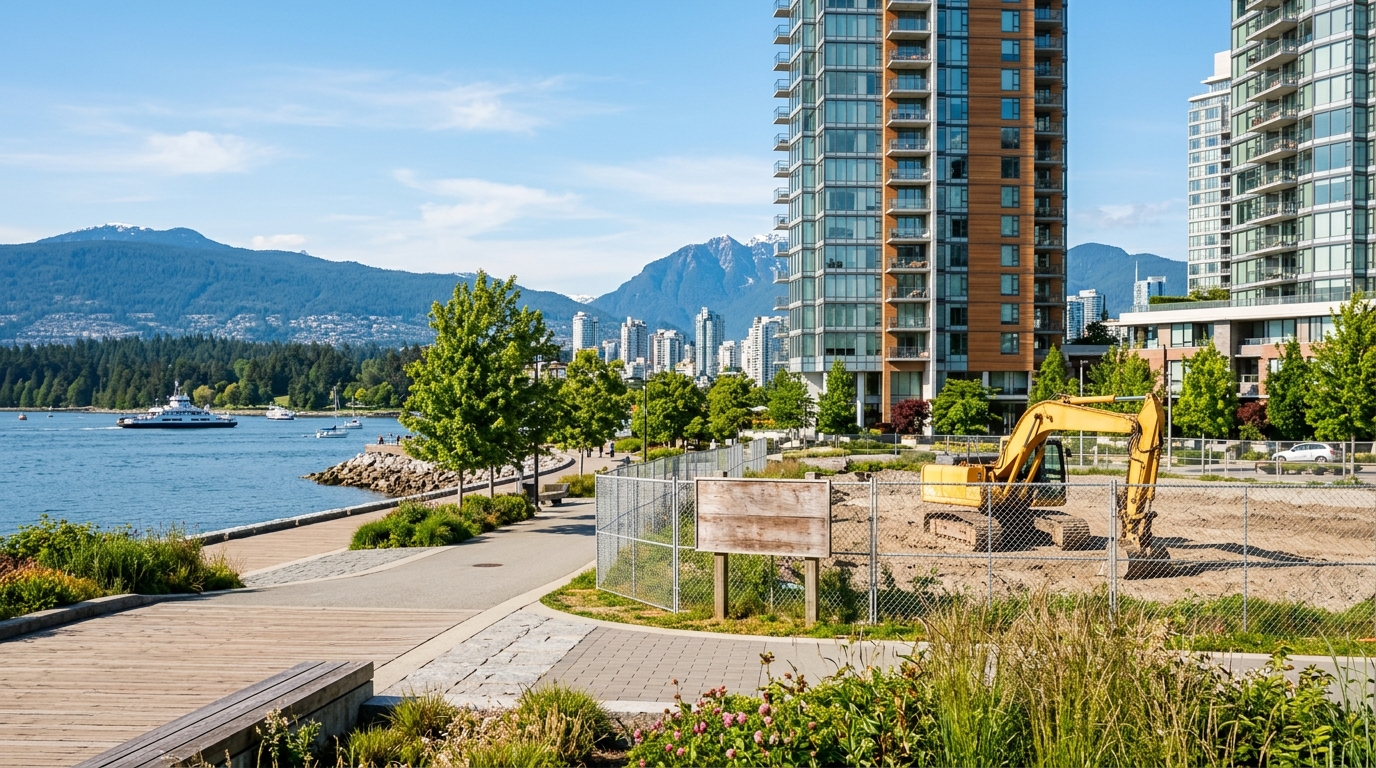
Stand at the corner of Nanaimo Street and East Hastings on any weekday morning and you will see the paradox in plain sight: a development permit notice tacked to a chain-link fence, the lot behind it perfectly quiet. No cranes. No excavators. No workers in high-vis vests. Just a piece of paper promising rental units that, for now, exist only on paper.
That scene is playing out across Metro Vancouver with striking regularity. According to Statistics Canada and municipal building permit data, the region recorded a significant surge in purpose-built rental permits through 2025 and into 2026—a genuine policy win for municipalities that have spent years streamlining approvals and upzoning transit corridors. But the number of projects that have actually broken ground tells a more sobering story. The gap between permitted units and started units has widened into one of the most consequential divergences in Metro Vancouver's housing market, with direct implications for rental supply well into 2028.
The mechanics of the stall are clear. Developers, lenders, and municipal planners point to three pressure points: hard construction costs that remain elevated after years of supply-chain disruption and labour scarcity; debt-service coverage ratios that many projects cannot yet satisfy at current financing rates; and a capital markets environment that has been slow to fully reprice risk following the Bank of Canada's rate-cutting cycle. Each is a solvable problem; together, they form a wall.
Hard costs for wood-frame purpose-built rental construction in Metro Vancouver remain stubbornly high. Industry benchmarks place per-square-foot construction costs for mid-rise wood-frame rental well above levels that pencil at current achievable rents in most submarkets outside the downtown core. Burnaby, New Westminster, and the Tri-Cities—precisely the transit-oriented corridors where the City of Vancouver and TransLink policy has concentrated density—are the zones where the math is most strained. Land values, while softening marginally from 2022 peaks according to BC Assessment data, have not corrected enough to compensate for elevated build costs.
The financing layer compounds the problem. Purpose-built rental projects in Canada lean heavily on CMHC's MLI Select program, which offers favourable loan-to-value ratios and amortization terms for projects meeting affordability, accessibility, and energy efficiency criteria. CMHC's own utilization data shows strong demand for the program, but lenders applying debt-service coverage ratio tests are finding that even MLI Select-eligible projects struggle to clear the threshold when construction cost estimates are stress-tested at current interest rates. The Bank of Canada has cut rates meaningfully, but the transmission lag between policy rate and the all-in financing cost for a major rental project—factoring in construction loan spreads, take-out financing assumptions, and lender risk appetite—means many projects approved in 2024 and early 2025 are still waiting for their pro formas to work.
The Urban Development Institute has consistently flagged this dynamic in its member sentiment surveys. The UDI's position is that the fundamental demand case for purpose-built rental in Metro Vancouver remains among the strongest in North America: vacancy rates remain near historic lows, population growth continues to outpace supply, and the policy environment has improved. What the industry is waiting for, in the UDI's framing, is for the financing environment to catch up with the policy environment. Those surveys have pointed to a meaningful cluster of projects that developers describe as "on hold pending financing confirmation" rather than cancelled—a distinction that matters enormously for the supply outlook.
For municipal planners, the permit-to-start gap is a flashing amber light. The City of Vancouver's Development Permit Board data shows the approvals pipeline has done its job. The machinery of rezoning, community amenity contribution negotiation, and design review has accelerated. However, a development permit is not a building permit; many projects with approved DPs still require building permits before construction can begin. A permit that does not convert to a start within 12 to 18 months is a unit that will not be available to renters until well into the 2030s. Metro Vancouver's housing supply targets are at risk if the conversion rate does not improve.
What unblocks the pipeline? There are three realistic levers. First, further Bank of Canada easing that flows through to construction and take-out financing costs. Second, expanded and accelerated CMHC MLI Select processing. Third, and perhaps most tractable in the near term, municipal and provincial cost-reduction measures: development cost charge deferrals, density bonusing that improves project economics, and streamlined utility connection timelines that reduce carrying costs during the pre-construction phase.
There is also a harder conversation to be had about achievable rents. In submarkets where new purpose-built rental can only pencil at rents that exceed median household affordability thresholds, the permit-to-start gap is a signal that the economics of market-rate rental construction are structurally misaligned with the incomes of the households most in need of new supply. This is an argument for the kinds of below-market and non-market rental tools—co-operative housing, community land trusts, and municipal land contributions—that sit alongside the private pipeline.
The next 12 months will be diagnostic. If the Bank of Canada's easing cycle continues and construction cost inflation moderates, a meaningful share of the permitted-but-not-started projects should convert to active sites by mid-2027. If hard costs stay elevated or financing conditions tighten again, the region's rental supply targets will need to be revised.
The bottom line: Metro Vancouver's purpose-built rental sector has solved the approvals problem. The market is now working through the financing problem—a gap that is real but not permanent. For developers with strong balance sheets and patient capital, the projects sitting in the queue represent genuine opportunity: the demand fundamentals are intact, the policy tailwinds are real, and the competitors who cannot get their pro formas to work today are the ones who will not be delivering supply in 2028. For renters and policymakers, the pipeline is full of paper. The question of when it fills with concrete depends on decisions being made in boardrooms and on Bank of Canada rate-setting days.



