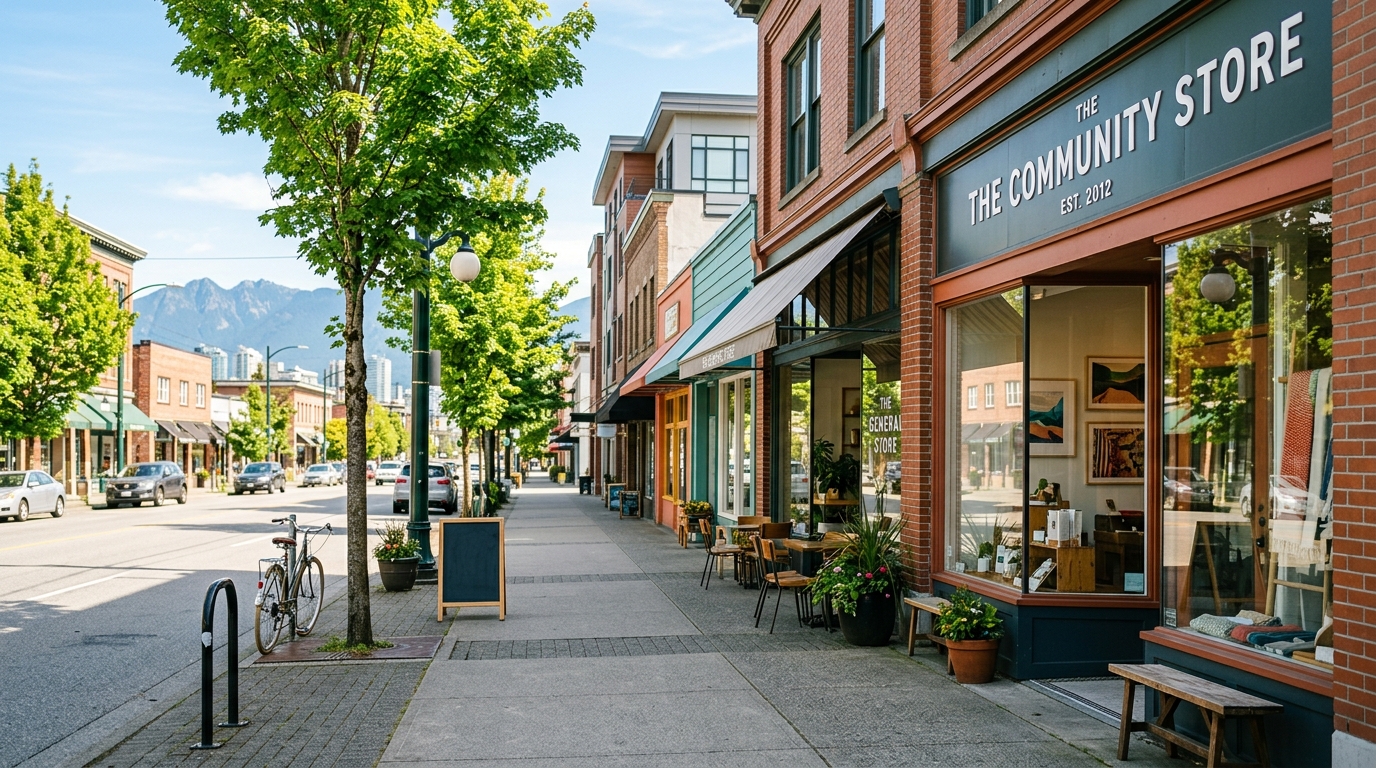
The numbers tell a story that would have seemed improbable five years ago. Downtown Vancouver's retail vacancy rate remains well above its pre-pandemic baseline, with stretches of Robson and Granville still carrying empty storefronts that have cycled through multiple tenants. Meanwhile, less than four kilometres away on Main Street, landlords are regularly fielding multiple offers for ground-floor units. This divergence between downtown and neighbourhood commercial strips has become a defining structural shift in Metro Vancouver's retail market heading into 2026.
According to CBRE's Q1 2026 Vancouver retail market data, neighbourhood commercial corridors including Mount Pleasant, Commercial Drive, and Main Street are recording vacancy rates below 5%—a threshold that represents effective full occupancy. Downtown Vancouver's retail vacancy, by contrast, remains meaningfully elevated, weighed down by large-format vacancies on major shopping streets and the lingering effects of reduced office-worker foot traffic.
Rent data reinforces the trend. Colliers International's neighbourhood retail tracking shows base rents on key strips in Mount Pleasant and along Main Street have moved upward year-over-year, a reversal of the softening seen during 2020 and 2021. The compression of available space has granted landlords in these corridors genuine negotiating leverage.
The driver of this divergence is structural. Neighbourhood strips benefit from dense, walkable residential catchments that generate consistent daily foot traffic independent of office occupancy. Mount Pleasant alone has absorbed thousands of new residential units over the past four years, as purpose-built rental and mixed-use development reshaped the area's demographics. The customers are already there, living within a ten-minute walk.
City of Vancouver business licence data for 2025 and 2026 highlights the operator mix filling this demand: independent food and beverage businesses, health and wellness operators—physiotherapy, yoga, massage, and specialty fitness—and local service providers anchored to neighbourhood clientele. These are not the national chains that once defined retail real estate value; they are operators for whom a 1,200-square-foot space on Kingsway or Fraser Street outperforms a 2,500-square-foot unit on Robson, because their customers live two blocks away and visit twice a week.
Build-out economics further support this shift. Neighbourhood units typically carry lower base rents than prime downtown retail, reducing the capital required to reach profitability. For a food operator or wellness business running on tight margins, the difference between a $38-per-square-foot net and a $58-per-square-foot net is often the difference between a viable business model and one that requires unrealistic revenue assumptions to succeed.
Institutional landlords have begun to read this data carefully. Several Metro Vancouver commercial real estate portfolios have quietly added neighbourhood strip assets over the past 18 months, according to BC Assessment commercial property assessment records, which show assessed values on key corridor properties tracking upward as transaction activity increases. The repositioning is subtle, but the direction of capital is visible in the data.
For the Mount Pleasant BIA, the vacancy picture creates a different challenge than the one facing the Downtown Vancouver BIA: managing the pace of change and preserving the neighbourhood character that made the corridor attractive. Rapid rent escalation in a tight market can displace the independent operators who built the strip's identity, replacing them with better-capitalised tenants who may not serve the same community function.
That tension represents the next chapter of this story. For now, the data presents a clear opportunity for retail tenants facing lease renewals, and for smaller landlords weighing whether to hold or sell into rising institutional interest. The neighbourhood strips are not an emerging opportunity—they have already emerged. The question for operators and investors in Q2 2026 is whether they act on that reality before the market fully prices it in.



