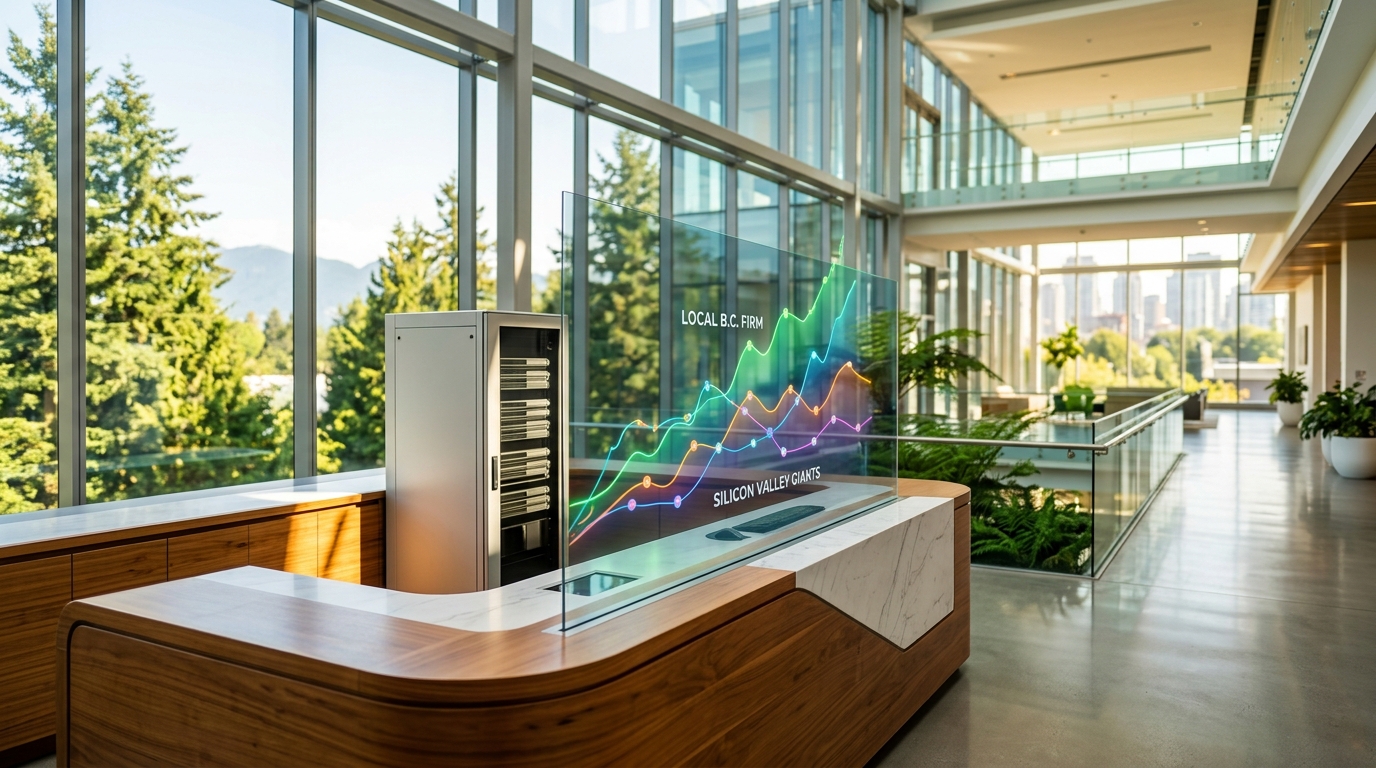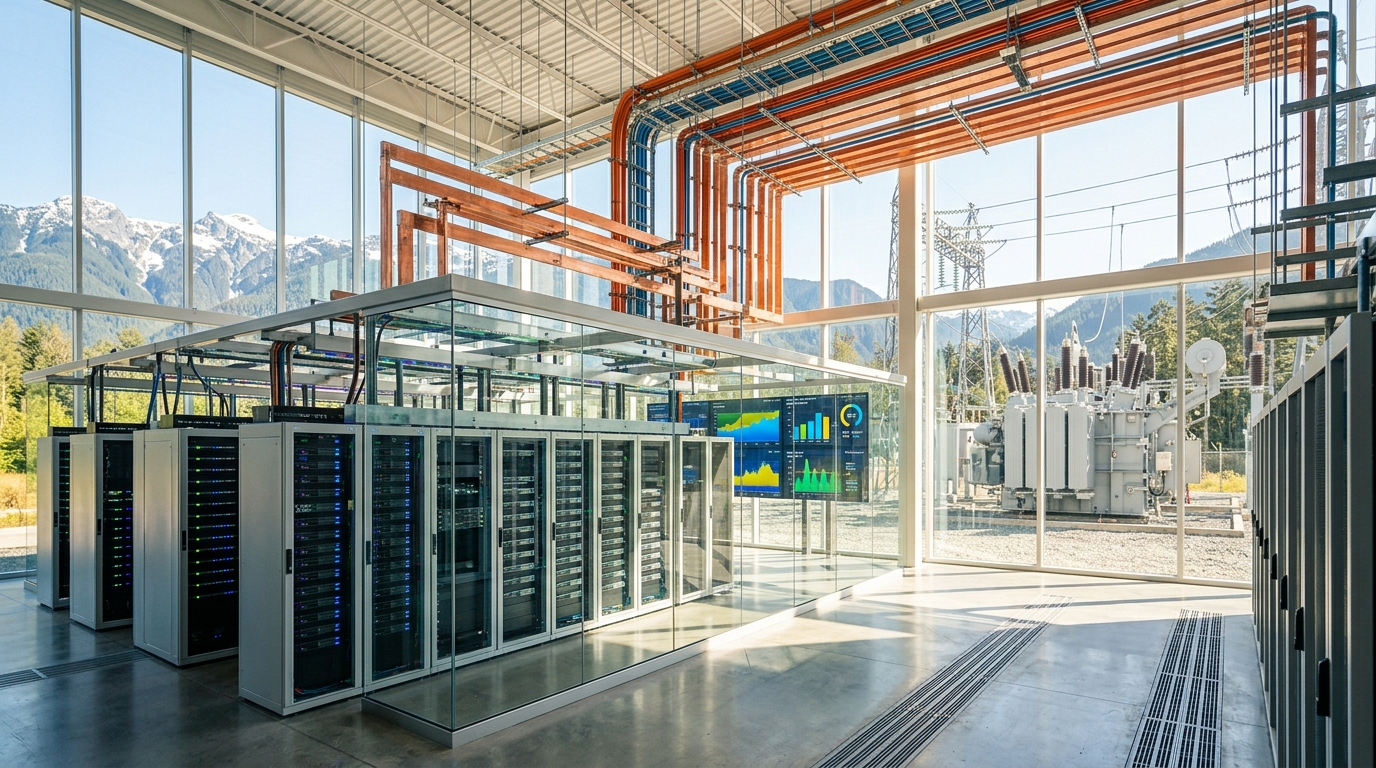
The binding constraint on a potential $1–3 billion investment decision isn't a regulatory hearing, a rezoning battle, or a labour shortage. It is a queue for transformer capacity at BC Hydro—one that has grown by an estimated 40% since 2023 and now stretches 18 to 36 months for large industrial customers. Three hyperscale cloud operators are currently in site-selection processes for Metro Vancouver data centre campuses. Which ones break ground will depend heavily on their position in that queue.
The pitch to hyperscalers is compelling. BC's industrial electricity rate is approximately 5 to 6 cents per kWh—among the lowest on the continent, derived almost entirely from hydroelectric generation. Metro Vancouver's average annual temperature of roughly 10°C reduces cooling costs by up to 30% compared with US Sun Belt hubs. For operations running tens of thousands of servers around the clock, this represents a structural cost advantage that warmer climates cannot replicate.
The global backdrop makes BC's position striking. Global data centre construction spending is projected to exceed US$500 billion by 2030, driven by AI workloads that require significantly more power than conventional cloud computing. Hyperscalers are scrambling to secure low-carbon, low-cost power agreements. BC—with its surplus hydro capacity, net-zero grid, and proximity to the US West Coast—checks every box on paper.
In practice, the grid is a different matter. BC Hydro's large-load interconnection queue has become the central variable in site-selection conversations. Fleet electrification, industrial expansion, and data centre prospecting are all competing for the same transformer capacity. The 18–36 month wait, previously reported on regarding commercial vehicle electrification, applies with equal force to a 50-megawatt data centre load.
Invest Vancouver and the Vancouver Economic Commission have made infrastructure readiness a centrepiece of their pitch, highlighting BC Hydro's capital investment commitments and the province's clean energy infrastructure planning as signals that capacity constraints are being addressed. The argument is that while a queue exists, it is a managed one, and alternative jurisdictions face similar delays with less sustainable grids.
This framing has merit. The US PJM interconnection queue, which serves Northern Virginia, has been effectively closed to new large-load applicants for stretches of the past two years. Utilities across the US Mid-Atlantic and Southeast are grappling with a global manufacturing bottleneck that has extended lead times for large power transformers to two years or more. BC's queue is a known problem in a global context, but the grid's carbon profile and rate structure remain key differentiators.
For the three operators currently in site selection, speed-to-queue is as critical as site fundamentals. A hyperscaler that identifies an ideal parcel in Burnaby or Surrey but delays its interconnection application while finalising a lease could find itself 12 months behind a competitor that moved faster on a less optimal site. Cushman & Wakefield's North American data centre market analysis has flagged interconnection timing as the primary development risk across major Canadian markets.
For other large-load customers already in BC Hydro's queue—including industrial operators and cold storage facilities—the arrival of hyperscale demand is a mixed signal. It validates BC's power advantage and may accelerate grid investment, but it introduces well-capitalised competitors for constrained capacity. A data centre operator signing a 20-year power purchase agreement carries different leverage than a mid-sized manufacturer seeking a 5-megawatt connection.
JLL's Vancouver data centre pipeline briefing identifies Metro Vancouver as an emerging Tier 2 market with Tier 1 fundamentals. This reflects the region's power and climate advantages, despite the current lack of large-scale colocation infrastructure found in Toronto or Seattle. Filling that gap would reshape Vancouver's position in the North American data centre hierarchy.
The grid queue is the mechanism by which BC's hydroelectric inheritance is rationed among competing claimants. How BC Hydro manages that queue over the next 24 months will do more to determine the shape of Metro Vancouver's technology economy than any incentive package. Boardroom deals get the headlines, but transformer allocations determine the outcomes.