A quiet shift is reshaping Vancouver's enterprise software sector: inference costs for frontier open-weight large language models have fallen by roughly 10x in 18 months. This data point—more than any product launch or funding announcement—has made the build-versus-license debate a practical necessity for local founders. The economics have shifted; the window to act has not.
Metro Vancouver is home to more than 200 active SaaS companies, according to BC Tech Association data. A significant cluster operates in sectors—construction tech, legal tech, and resource management—where proprietary, domain-specific data serves as a natural moat. The question is whether local founders are building on that foundation fast enough, or if they are renting AI capabilities from closed-model providers and surrendering the margins that moat was intended to protect.
The urgency stems from the rapid maturation of open-weight models. Meta's Llama series and Mistral's enterprise variants have reached a threshold where, for many vertical SaaS use cases, they are not materially inferior to GPT-4-class closed models. They can be fine-tuned on proprietary data, self-hosted for data sovereignty, and run at a fraction of the per-token cost. For a construction tech firm with years of project cost data, or a legal tech company with a library of BC-specific case outcomes, this combination is decisive.
The strategic logic is clear. A company that fine-tunes an open-weight model on its own data and integrates it into its workflow creates a defendable advantage. A company that routes every inference call through a closed API owns only a vendor relationship—one that becomes less advantageous as model competition intensifies. The former builds durability; the latter outsources its intelligence layer.
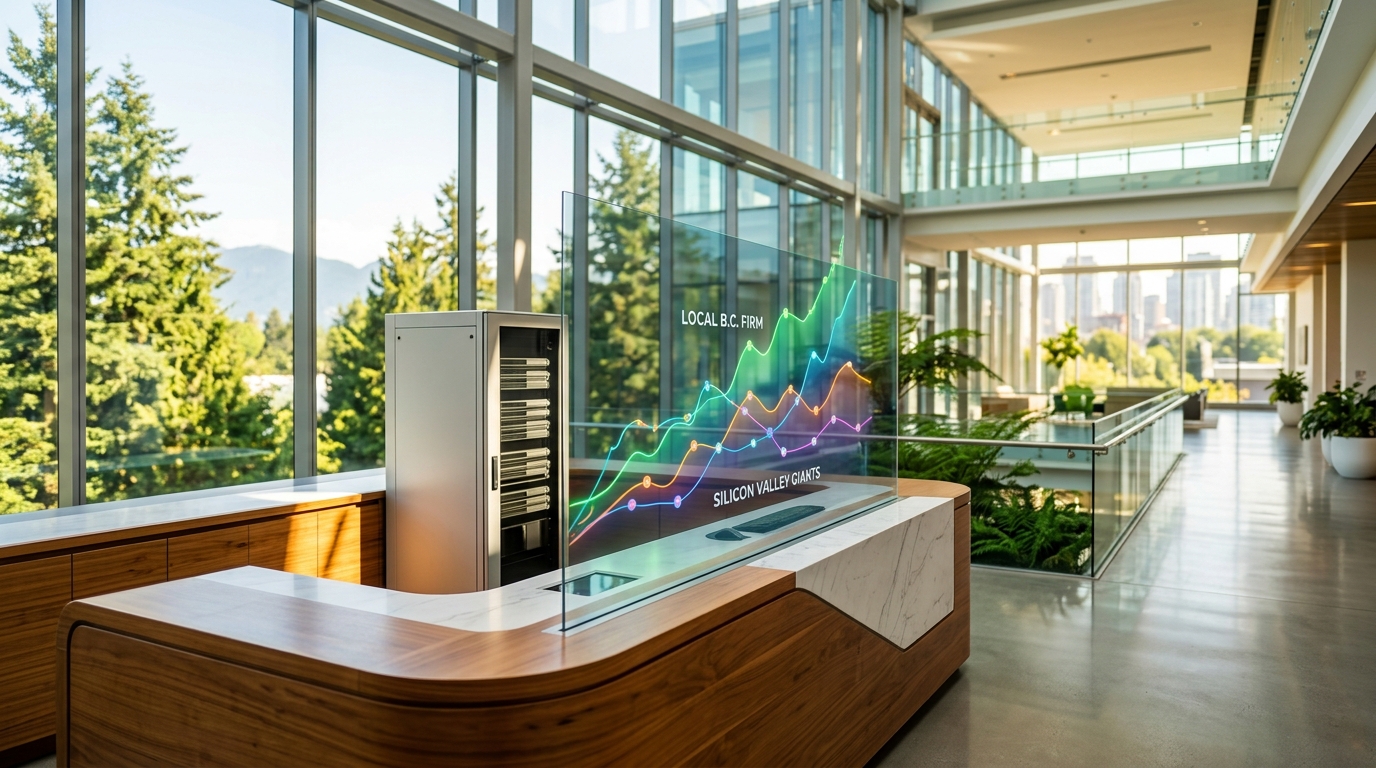
BC Tech Association survey data indicates a shift in how local software firms are allocating technology budgets, with a growing share moving toward self-hosted and fine-tuned deployments rather than pure API consumption.
Compute access, historically a barrier for mid-market firms, is easing. The Digital Research Alliance of Canada allocates GPU capacity to BC-based researchers and companies with academic partnerships. For a legal tech or cleantech firm with a UBC or SFU connection, this provides a resource advantage that larger US competitors may not share.
The risk of delay is concrete. Well-capitalised US competitors are already moving. A construction tech platform that deploys a fine-tuned model trained on North American project data can undercut a Vancouver incumbent on both price and capability within a single product cycle. The window to establish a data-trained AI layer is measured in months, not years.
Investors are taking note. Yaletown Partners and Vanedge Capital have signalled that AI defensibility—specifically whether capabilities are tied to proprietary data or a replaceable API—is a key diligence criterion. For founders, the build-versus-license decision is now a valuation question.
This does not render closed models irrelevant. For rapid prototyping or low-sensitivity use cases, API-based access remains rational. The error is treating it as a permanent architecture. The winners will be those who used closed-model APIs to validate product-market fit and are now systematically replacing those dependencies with fine-tuned, proprietary alternatives.
Vancouver's vertical SaaS founders possess a structural advantage: domain-specific data, trust-based customer relationships, and a local talent pool with the technical depth to execute. The inflection point has arrived. The question is no longer whether AI will reshape these markets, but whether local firms will own their AI layer when it does.