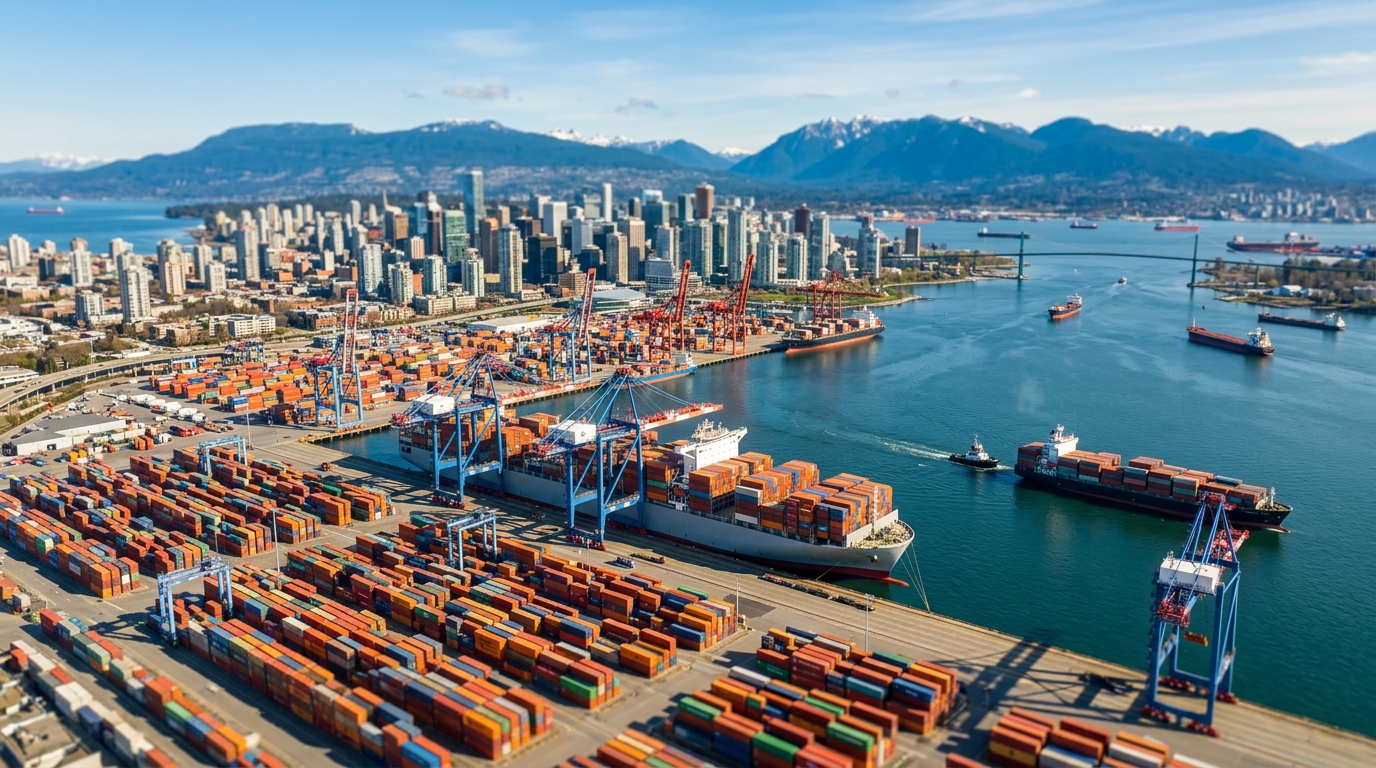
The numbers tell a story that experienced freight operators have been tracking for months: as U.S. tariffs on a broad basket of Chinese goods now exceed 145 per cent, the economics of routing Pacific cargo through American West Coast ports have shifted. Canada's largest port, which handled approximately 147 million tonnes of cargo in 2024, is emerging as a strategically positioned alternative gateway. Preliminary Q1 2026 data, expected from the Vancouver Fraser Port Authority this week, is expected to confirm this trend.
This is not a story about tariffs being inherently negative; it is a story about where volume is moving and which Metro Vancouver operators are positioned to capture it.
Where the growth is
The clearest signal in the preliminary data is in intermodal transit—goods moving through Vancouver destined for onward distribution in the U.S. When U.S. import costs spike, shippers recalculate. A container that once moved directly from Shenzhen to Los Angeles increasingly makes commercial sense routed through Vancouver, moved in-bond through Canada, and distributed southward by rail or truck. Container shipping analysts at Drewry have noted that Canadian gateway ports are among the primary beneficiaries of Pacific trade-flow disruption when U.S. tariff regimes create significant cost differentials.
Bulk commodity flows—coal, grain, and potash—are softening, reflecting broader demand uncertainty in Asian markets. However, value-added cargo and intermodal containers are moving in the opposite direction, providing a clear operational signal for logistics businesses.
The 90-day window
Metro Vancouver's port-adjacent industrial corridor—the warehousing and freight-handling operations in Richmond, Delta, and Surrey—faces a capacity question. New volume translates into revenue only if operators have the contracts, equipment, and labour in place to handle it.
The BC Maritime Employers Association has been tracking terminal utilization rates, and the picture at Deltaport and Vanterm is one of increasing pressure. For third-party logistics providers, customs brokers, and drayage operators, the practical question is: how to prepare for the next 90 days?
Three moves stand out. First, shippers and freight forwarders who have not reviewed their Canadian gateway capacity agreements since 2024 should do so immediately, as spot rates and contract terms are shifting. Second, operators with available cold-chain or bonded warehouse capacity should actively market to freight forwarders handling Chinese consumer electronics, apparel, and industrial components—the categories most affected by the tariff differential. Third, drayage operators serving the port corridor should engage with CN and CPKC regarding intermodal positioning, as the rail connection south is the fulcrum on which the transhipment opportunity turns.
Who is already winning
Early beneficiaries are concentrated in two segments. Customs brokerage firms with established relationships with Chinese freight forwarders have seen inquiry volumes rise sharply since the tariff escalation accelerated in late 2025. Intermodal logistics operators—those who can move a container from Deltaport to a U.S. distribution point without a port-of-entry delay—are in a structurally advantaged position.
Statistics Canada's international merchandise trade data will provide a definitive picture once Q1 figures are published, but the directional trend is consistent: Canadian import volumes through Pacific gateways are absorbing traffic that would previously have moved through Seattle or Long Beach.
The labour variable
No analysis of Port of Vancouver capacity is complete without acknowledging the labour context. ILWU Canada's Locals 500 and 514, which represent longshore workers at major terminals, operate under agreements that provide a degree of labour stability relative to some U.S. West Coast counterparts. This stability is a selling point for shippers evaluating routing options.
While terminal operators and shipping lines weigh total landed cost—including port fees, rail costs, and drayage rates—the current tariff differential is large enough to overwhelm many secondary cost considerations for affected cargo categories.
What this means for Vancouver
Global trade is being reshuffled, and Vancouver sits at the hinge point. For a drayage operator in Delta, a customs broker in Richmond, or a warehouse operator in Surrey, this is not a distant macroeconomic abstraction; it is a contract opportunity available to those who move first.
The Port of Vancouver has spent two decades building infrastructure and rail connectivity for moments like this. The question for Metro Vancouver's logistics community is not whether the volume shift is real, but whether local businesses are positioned to handle it.



