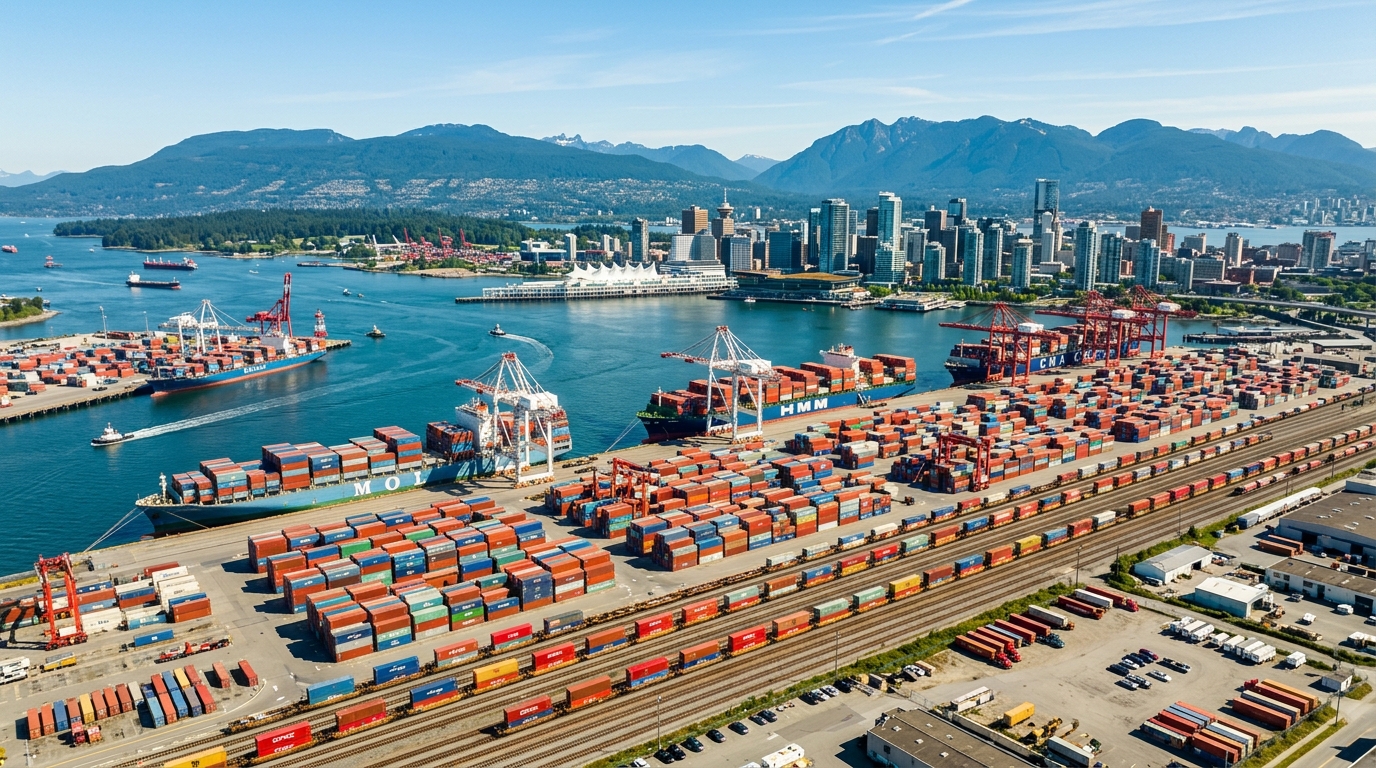
For the first time in years, phones at Metro Vancouver freight forwarding offices are ringing with inquiries that previously went to Seattle and Los Angeles. US tariff uncertainty—and the operational friction it has generated at American customs—is nudging transpacific shippers toward Canadian gateways. The Port of Vancouver, Canada’s largest port, is beginning to reflect this shift in its data.
Container throughput at the Port of Vancouver rose year-over-year in early 2026, with the Vancouver Fraser Port Authority reporting increased volumes through the Roberts Bank and Centerm terminals compared to the same period in 2025. While this growth is modest, the trend is clear: importers who previously relied on US West Coast ports are now evaluating Vancouver as a primary gateway rather than a contingency.
The cause is clear. Sweeping US tariff actions introduced in 2025 and extended into 2026 have created a compliance fog for importers moving goods from Asia. Shifting duties, customs backlogs, and the threat of retroactive assessments have increased the cost and risk of routing through American ports. Canada’s stable trade posture and its network of free trade agreements make Vancouver an increasingly attractive alternative for cargo destined for Canadian consumers or for cross-border delivery after Canadian customs clearance.
The stickiness question
The central debate among logistics professionals is whether this diversion is a temporary blip or a structural shift. Supply chain relationships are often sticky: once a shipper secures a Canadian customs broker, books consistent rail capacity on CN or CPKC, and establishes a warehousing footprint in the Fraser Valley, the switching costs to reverse course are significant. The Canadian International Freight Forwarders Association has noted growing member activity around new transpacific account development, a leading indicator that operators expect some of this volume to persist.
History offers a precedent. When US West Coast port labour disruptions stalled cargo in 2014 and 2015, Vancouver captured meaningful market share and retained a portion of it after American ports returned to normal operations. Shippers who discovered the Canadian gateway during that disruption stayed because the service proved reliable. The current window, driven by policy rather than labour action, may prove even more durable, as trade policy uncertainty typically has a longer tail than a strike.
Where the opportunity lives
The immediate beneficiaries are customs brokers and freight forwarders licensed to operate in Canada. Licence application activity in BC has tracked upward in 2026 as firms position for increased volume. For established brokers, the opportunity lies in building relationships with Asian shipping lines and import-side clients who are evaluating Canadian routing for the first time.
Industrial landlords are also watching closely. Metro Vancouver's industrial vacancy rate remains among the tightest in North America, a structural constraint that limits how quickly the logistics sector can scale. Warehouse and distribution space near the port and along the Highway 1 corridor is effectively full, meaning new volume either waits for new supply or pushes further into the Fraser Valley. Landlords with available space near port terminals are fielding stronger-than-usual leasing inquiries, and some are beginning to price that scarcity accordingly.
Third-party logistics providers (3PLs) with established port relationships and available capacity are best positioned to convert inquiry into contract. The constraint is not demand, but the physical infrastructure required to handle incremental volume. Operators who invest now in bonded warehouse certification, expanded cold-chain capability, and customs-integrated technology will be better placed to retain clients acquired during this diversion window.
What smart operators should do now
The Conference Board of Canada has flagged Canadian port competitiveness as a near-term policy priority, and the BC Ministry of Jobs, Economic Development and Innovation has signalled interest in supporting logistics sector capacity expansion. Operators who engage with port authority and provincial economic development programs now are more likely to access capital and permitting support before the window narrows.
For those who move freight, broker customs, or own industrial land near a BC port, the next 12 to 18 months may represent a significant new-client acquisition environment. The shippers calling today are evaluating whether Canada works. The objective for operators is to ensure the service meets those expectations and builds lasting professional relationships.



