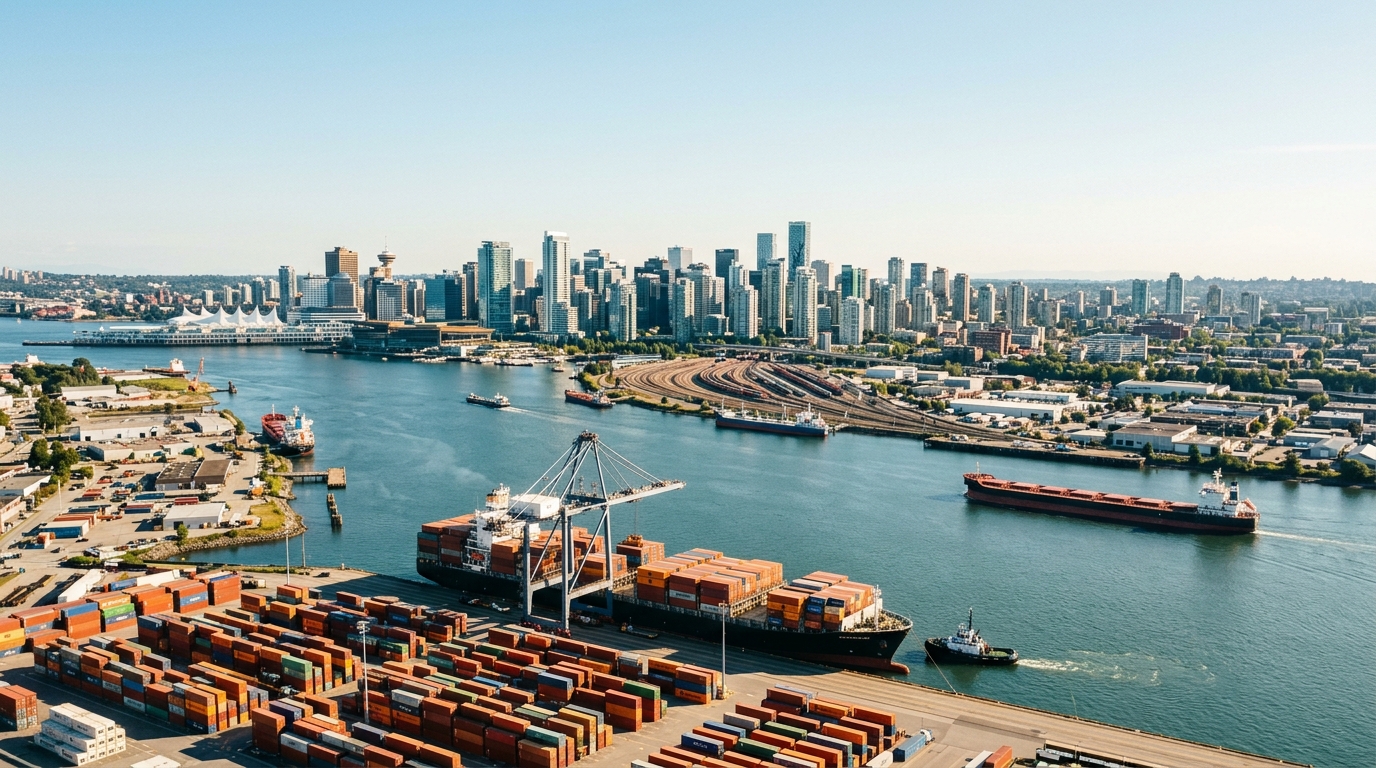
For years, BC’s export economy has operated as though the province had only one door to the Pacific. That assumption is being tested by a capacity push at the Port of Prince Rupert's Fairview Container Terminal. With Phase 2 construction underway, the project aims to increase annual throughput capacity to between 1.6 million and 1.8 million TEUs by 2028. Combined with sustained investment in the CN Rail northern corridor and growing frustration among BC shippers with Lower Mainland bottlenecks, the arithmetic of moving goods to Asian markets is shifting.
Prince Rupert holds a structural geographic advantage: it sits roughly 1,200 nautical miles closer to Asian ports than Metro Vancouver, translating into roughly two days' less sailing time. That edge has historically been offset by limited terminal capacity. The current expansion positions Prince Rupert as a high-volume alternative for BC exporters who have long accepted Vancouver congestion as a cost of doing business.
The congestion tax
For grain elevator operators and lumber traders, the most persistent logistics frustration is dwell time at Metro Vancouver terminals. Container dwell times at the Port of Vancouver—the interval a container sits at a terminal waiting for rail or truck pickup—have been a chronic pressure point, spiking during labour disruptions and peak harvest seasons. Prince Rupert has consistently posted shorter average dwell times, a function of less congestion, direct CN rail connections, and a terminal designed for efficiency.
For BC grain producers, the calculus is direct. Agricultural exporters—canola, wheat, and pulses—compete on thin margins where a two-day shipping advantage and lower demurrage costs are critical. The BC Grain Producers Association has identified corridor diversification as a strategic priority, and the Fairview expansion provides a necessary infrastructure anchor.
Forestry exporters face a similar dynamic. The BC Lumber Trade Council has emphasized that reliable, cost-competitive Pacific access is a structural requirement for the sector's viability. A higher-capacity Prince Rupert corridor addresses that requirement more effectively than incremental improvements at congested Lower Mainland terminals.
CN's corridor investment
CN Rail has committed significant capital to its northern BC corridor, including track upgrades and siding expansions designed to increase train frequency and reduce transit times between Prince George and Prince Rupert. This mainline serves as the spine of the northern strategy; without reliable, high-capacity rail, expanded terminal capacity would be stranded infrastructure.
The corridor connects Prince George—the hub of BC's interior—directly to Prince Rupert, running through Smithers and Terrace. This geography benefits mining and forestry exporters in the Nechako, Bulkley Valley, and Skeena regions who currently route product south before heading west. A higher-capacity northern route means shorter hauls to port for a significant portion of the province's resource export base.
The industrial land opportunity
Metro Vancouver's industrial land market is constrained. Vacancy rates have hovered near historic lows, and land costs have made new logistics development increasingly expensive. Logistics planners and industrial real estate investors are now evaluating northern BC sites as viable alternatives.
If Prince Rupert becomes a high-volume export hub, communities along the CN corridor—Terrace, Smithers, and Prince George—become logical locations for value-added processing and warehousing. BC's Ministry of Transportation has flagged northern infrastructure as a provincial priority, and the federal Asia-Pacific Gateway program has historically supported such corridor-enabling investment.
Industrial land in Terrace or Prince George trades at a fraction of Lower Mainland prices. For a food processor or lumber remanufacturer, proximity to a high-capacity northern port changes the site selection equation.
A path to diversification
This is not a story about Metro Vancouver losing its position as BC's primary trade gateway; the Port of Vancouver handles volumes that Prince Rupert will not match for many years. The shift is about pressure relief and provincial diversification. A credible northern corridor gives BC exporters genuine optionality, introduces competitive discipline into terminal and rail pricing, and distributes economic activity into regions that have long felt the province's prosperity was concentrated in the southwest.
For the grain farmer in the Peace Country, the sawmill operator in the Bulkley Valley, or the mining company moving concentrate out of the Skeena, 2028 is approaching. The infrastructure is being built, and the cost calculus is shifting. The question now is whether northern BC communities and provincial planners can capture the industrial development opportunity that accompanies this growth.



