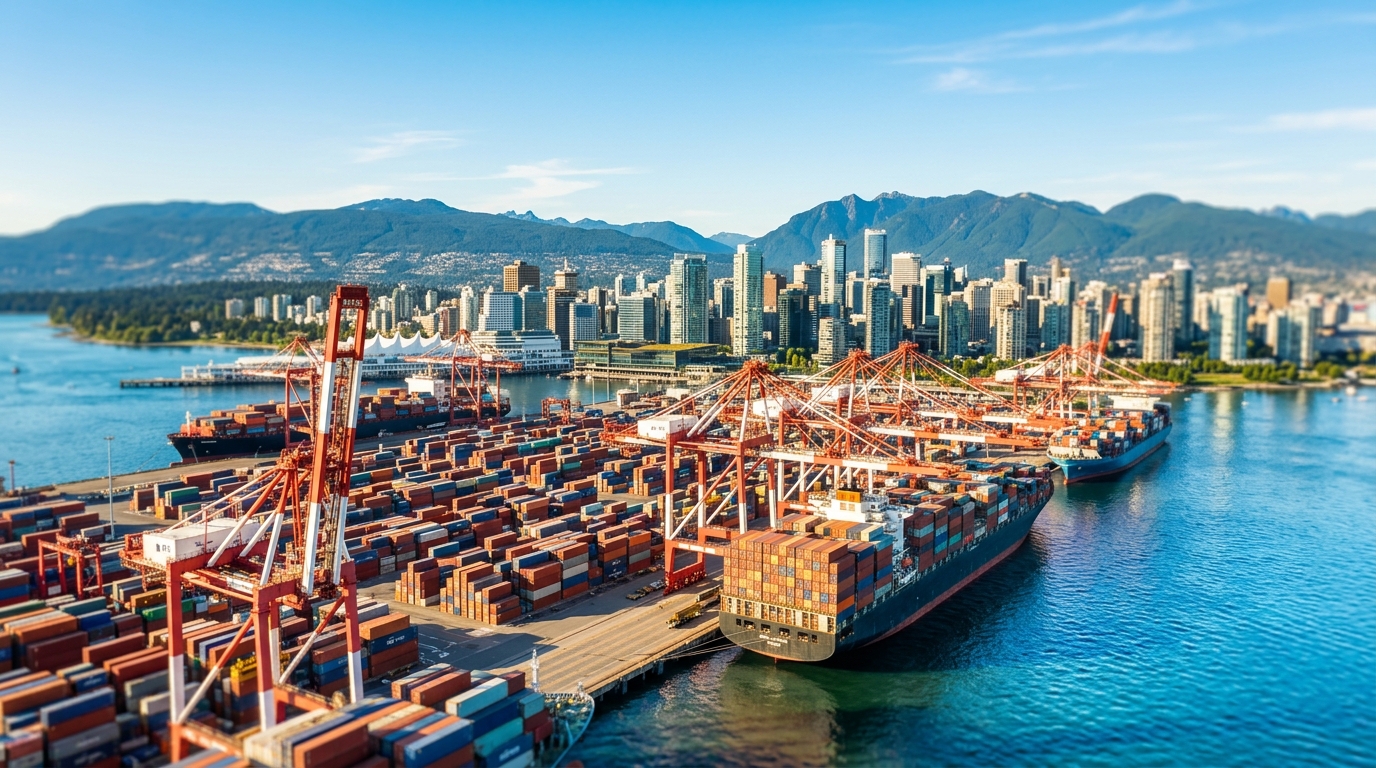
Container ships continue to arrive at Deltaport and Centerm. However, inside the offices of freight forwarders, logistics brokers, and Asian export manufacturers, routing spreadsheets have shifted. Tariff unpredictability between the United States and its trading partners—and the resulting uncertainty for Canadian transshipment corridors—is prompting a consequential rethink of how Pacific cargo moves to North American markets.
The stakes for Metro Vancouver are significant. The Port of Vancouver handles approximately $300-billion in annual trade across 170 world economies, serving as Canada's largest port by tonnage and a primary Pacific gateway. Even a modest, sustained diversion of container volumes—freight analysts typically flag a 5 to 10 per cent shift as structurally significant—carries cascading effects across Metro Vancouver's logistics sector, industrial real estate market, and the thousands of workers employed in marine, rail, and warehousing operations.
The speed at which routing decisions are now being made is the critical factor. Tariff structures that once changed on a multi-year cycle are now subject to executive action on weeks' notice. That compression of policy timelines has forced shippers—particularly in electronics, automotive components, and consumer goods in China, South Korea, and Japan—to model routing scenarios previously dismissed as mere contingency planning.
The Prince Rupert Variable
The most direct beneficiary of Vancouver diversion risk within Canada is the Port of Prince Rupert, 1,500 kilometres up the BC coast. Prince Rupert's Fairview Container Terminal has expanded to a capacity of 1.8 million twenty-foot equivalent units (TEUs) annually, positioning it as a credible alternative for shippers seeking Canadian landfall without routing through Metro Vancouver's more congested infrastructure.
Prince Rupert's competitive proposition is straightforward: it is the closest North American port to Asian shipping lanes, CN Rail's direct corridor to Chicago and the US Midwest provides competitive transit times, and its relative lack of congestion can translate into faster vessel turnaround. When Vancouver labour disruptions demonstrated the fragility of single-gateway dependence, shippers took note. The current tariff environment is accelerating that calculus.
What the Volume Data Shows
Vancouver Fraser Port Authority data on container volumes provides the clearest observable signal. Preliminary figures for the first half of 2026 indicate a shifting landscape; a sustained decline in TEU throughput, particularly in import containers from Northeast Asia, would confirm that routing modelling has translated into routing action.
The BC Maritime Employers Association tracks labour utilization and throughput data that serves as a leading indicator—a drop in gang hours and vessel calls often precedes the volume figures that show up in quarterly port statistics.
On the rail side, CN Rail's intermodal volumes through its Pacific corridor and CPKC's competing corridor offer a second data layer. A meaningful drop in intermodal lifts originating at Vancouver terminals—without a corresponding drop at Prince Rupert—would signal genuine diversion rather than overall trade softness.
The Tariff Mechanism
Canadian Chamber of Commerce analysis highlights that it is not just the tariffs themselves but the unpredictability of their application that drives routing behaviour. A shipper moving electronics from Shenzhen to a US Midwest retailer via Vancouver faces layered uncertainty: US Section 232 measures, potential retaliatory Canadian tariffs, and the possibility that these measures could change mid-transit. That uncertainty increases insurance pricing, letters of credit, and risk premiums.
Conference Board of Canada research has identified tariff unpredictability as the primary driver of supply chain restructuring. Companies can price a known tariff into their landed cost calculations, but they cannot easily price a tariff that may or may not exist in 90 days.
Who Loses, Who Wins
The distributional effects are significant. Terminal operators at Deltaport and Centerm face volume risk; Metro Vancouver's tight industrial real estate market faces demand softness if throughput contracts; and the roughly 16,000 workers employed across the region's marine and port-adjacent logistics sector face potential reduced hours.
Conversely, logistics operators with existing relationships at Prince Rupert are positioned to capture diverted Canadian-destined cargo. Third-party logistics providers (3PLs) offering flexible routing across multiple gateways are seeing increased RFP activity. Furthermore, Metro Vancouver's warehousing and distribution operators serving domestic Canadian consumption remain relatively insulated from diversion risk.
There is also a longer-term structural opportunity. If tariff friction reduces the attractiveness of the Vancouver-to-US-Midwest corridor, it creates pressure to develop Vancouver's role as a distribution hub for Canadian consumption rather than a transshipment gateway to the US. This represents a shift toward a lower-volume, higher-value-add business model.
What Operators Should Do Now
The routing decisions made in freight forwarder offices in Shanghai, Seoul, and Tokyo this week will manifest in Vancouver's volume statistics in the coming months. The immediate priority is intelligence; operators should maintain active conversations with forwarding partners to monitor routing signals. The second priority is contract flexibility—operators should stress-test long-term volume commitments against a 10 to 15 per cent volume reduction scenario.
Finally, for operators with the capital, positioning is key. The firms that emerged strongest from the 2023 labour disruption were those that had already built multi-gateway relationships. Vancouver's port ecosystem has navigated structural challenges before; the current environment rewards the same preparation.



