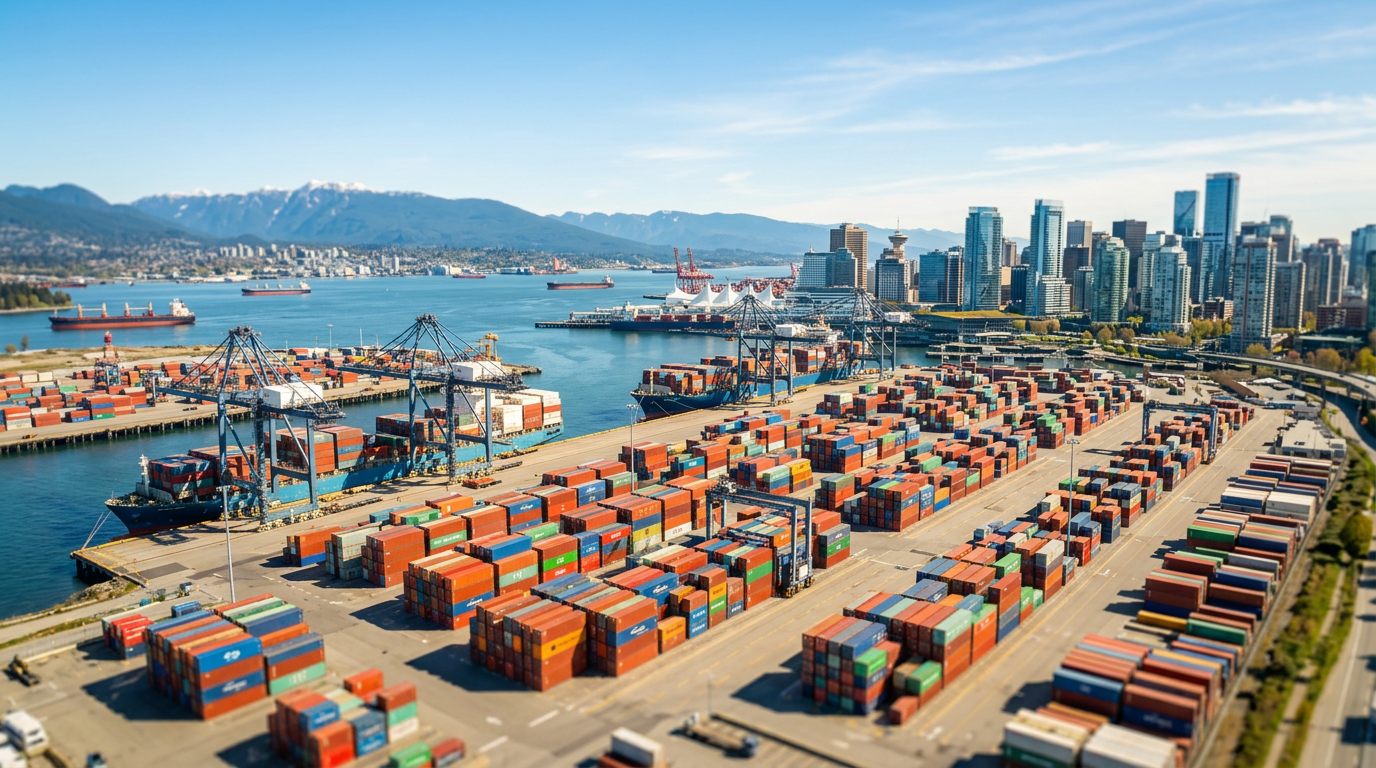
The document that tells the real story of British Columbia's tariff moment isn't a government press release or a chamber of commerce survey. It is the monthly traffic statistics published by the Vancouver Fraser Port Authority. The data shows that Metro Vancouver's export sector is not waiting to be rescued.
Preliminary Q1 2026 data indicates container throughput is holding—and growing in select categories—despite the tariff uncertainty that has rattled Canada-U.S. trade relationships since late 2025. The headline number matters less than the driver: a measurable shift in cargo destination mix, away from U.S. ports and toward Asia-Pacific and European lanes. BC exporters are accelerating market diversification strategies that forward-looking operators began building more than a year ago.
This is not a story about passive resilience. It is a story about operators who identified tariff risk early, moved deliberately, and are now seeing the results in their order books.
The Numbers Behind the Shift
Statistics Canada's Trade Data Online shows BC's export value to Asian markets rising year-over-year. The share of provincial exports destined for non-U.S. markets is expanding as U.S.-bound shipment growth slows. This directional shift has been building for several quarters, but the pace accelerated following the first round of U.S. tariff announcements in early 2025.
The Port of Vancouver, Canada's largest port by tonnage, sits at the centre of this reorientation. Its container terminals connect BC exporters directly to trans-Pacific shipping lanes, and the volume of containerized goods reflects the destination decisions exporters are making in their sales offices and freight contracts.
The Asia Pacific Foundation of Canada has long documented the structural case for this pivot: BC's geography, its deep Indo-Canadian and Chinese-Canadian business networks, and its existing logistics infrastructure provide a comparative advantage in Asia-Pacific trade. Tariff pressure has served to convert that latent advantage into urgent action.
What Smart Operators Did First
The exporters and freight forwarders faring best in 2026 treated tariff risk as a planning input rather than a news event. Rather than waiting for U.S. tariffs to materialize, they used the extended period of uncertainty throughout 2024 and early 2025 to establish relationships, qualify new buyers, and negotiate freight rates in Asian and European markets.
This sequencing is critical. Locking in a reliable buyer in South Korea, Japan, or Germany requires months of qualification, compliance documentation, and trust-building. Exporters who began that process in 2024 are now executing on established contracts. Those beginning today face a more crowded field as competitors who delayed now pursue the same diversification plays.
The BC Chamber of Commerce has tracked this dynamic through membership surveys, revealing a two-speed export sector: operators with existing Asia-Pacific relationships or the organizational capacity to build them quickly are adapting, while smaller exporters without those resources face a steeper climb.
The Canadian Manufacturers and Exporters BC chapter has similarly noted that the diversification opportunity is concentrated among mid-size and larger exporters with dedicated trade development capacity, remaining less accessible to smaller manufacturers who rely on long-standing U.S. distribution channels.
The Freight Forwarder View
Freight forwarders occupy a uniquely informative position. They see the destination decisions of hundreds of exporters simultaneously and are often the first to note when a client shifts lanes. The view from Vancouver's freight forwarding community in early 2026 is one of genuine activity: more requests for rate quotes on trans-Pacific lanes, more inquiries about European Union market access, and a noticeable uptick in clients seeking bonded warehouse and transshipment options to redirect cargo mid-route.
This detail is telling. The most sophisticated operators are not just diversifying destinations; they are building optionality into their logistics chains to respond to future tariff changes with greater speed.
The Window Is Narrowing
The Port of Vancouver's throughput data provides evidence that the diversification playbook works. However, the opportunity carries urgency: the exporters best positioned in 2026 are those who moved in 2024 and 2025. First-mover advantage in new markets is substantial, compounding over time as buyer loyalty, logistics efficiency, and local market knowledge deepen.
For Metro Vancouver exporters still heavily weighted toward U.S. markets, the Q1 2026 throughput data is not a reason for complacency. It is evidence that the operators already executing their diversification plans are pulling ahead.
The port is holding. The question for every BC exporter is whether their own order book will say the same thing twelve months from now.



