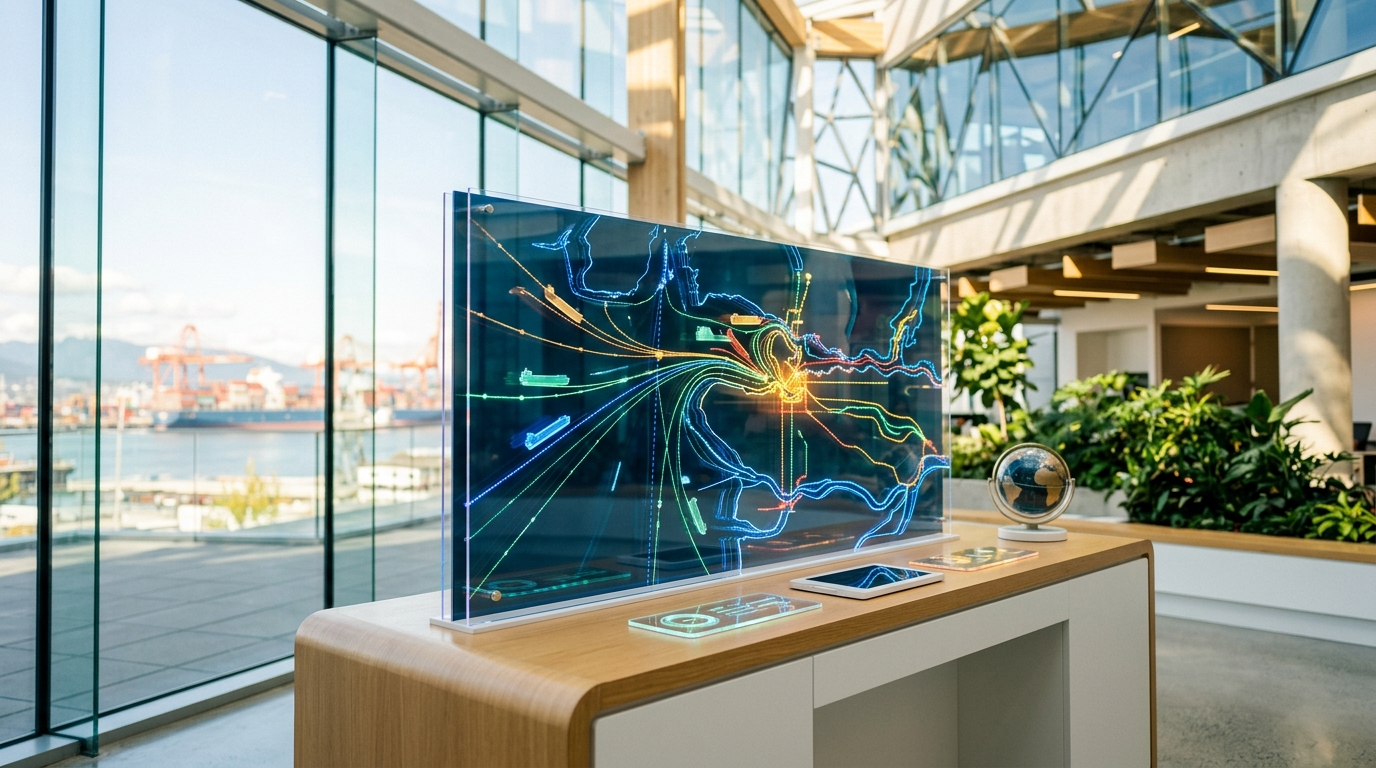
Canada’s busiest port handles roughly $550 billion in annual trade value. Until recently, a meaningful portion of that activity was coordinated via phone calls, spreadsheets, and educated guesses regarding vessel arrival times. The Vancouver Fraser Port Authority (VFPA) is moving to change that. The port is advancing a digital twin initiative—a real-time computational model of cargo flow, berth scheduling, and rail-port handoffs—that could fundamentally alter how goods move through Canada’s Pacific gateway.
The business case is clear. Container volumes at Vancouver terminals recovered to near-record levels in the first quarter of 2026, and Asia-Pacific trade lanes remain active following years of post-pandemic disruption. When operating at near-capacity, the ability to predict a four-hour berth delay rather than discovering it after the fact is worth millions of dollars, and it allows BC exporters to provide customers with reliable delivery windows.
The impact extends beyond the port gates: digital twin adoption in port operations is growing at approximately 28% annually worldwide, driven by ports in Rotterdam, Singapore, and Los Angeles that have already demonstrated measurable throughput gains. Vancouver has the volume to justify the investment. As it builds the platform to act on its data, it is creating a vendor ecosystem that BC tech and logistics firms should monitor closely.
The digital twin targets rail-port coordination as a primary friction point. CN Rail and CP Kansas City both run BC corridor operations that feed container traffic to and from Vancouver terminals, and the scheduling handoff between vessel arrival and rail departure has long been a source of costly delays. A live simulation layer that models those handoffs—accounting for vessel AIS data, terminal gate throughput, and rail slot availability simultaneously—provides operators with a common operating picture that all parties can use to act in advance.
For BC logistics firms, the competitive implications are concrete. Third-party logistics providers and freight forwarders who integrate with port digital twin data feeds will be able to offer customers tighter transit-time guarantees and more accurate landed-cost modelling. The BC Maritime Employers Association has consistently flagged labour productivity and scheduling efficiency as top-of-mind issues for terminal operators; a digital twin addresses both by reducing idle time and last-minute shift adjustments.
The vendor opportunity is significant for BC’s tech sector. Port digital twin platforms require integration across vessel tracking systems, terminal operating systems, customs data feeds, and rail APIs. The BC Tech Association’s supply chain working group has been tracking this space, and local firms are eager to build on top of port data infrastructure. The question remains whether the VFPA’s procurement process creates genuine on-ramps for BC-based vendors or defaults to the global integrators that typically land these contracts.
Transport Canada’s port modernization program provides federal funding context for capital projects of this scale. How that funding structure shapes the vendor selection process—and whether it includes any preference for Canadian technology providers—will determine how much of the economic benefit stays in BC.
The Metro Vancouver industrial and logistics market is already tight. CBRE’s most recent Metro Vancouver industrial data shows vacancy rates near historic lows, meaning logistics operators are competing for efficiency gains rather than square footage. A port that promises more predictable throughput is, effectively, a logistics capacity multiplier.
The VFPA’s digital twin push is a developing story. The platform is not yet fully operational, and the vendor ecosystem is still being defined. However, the direction is clear: the ports that win the next decade of Asia-Pacific trade will be those with the best data. Vancouver has a genuine shot at being one of them, provided the BC tech and logistics community moves quickly to help build it.