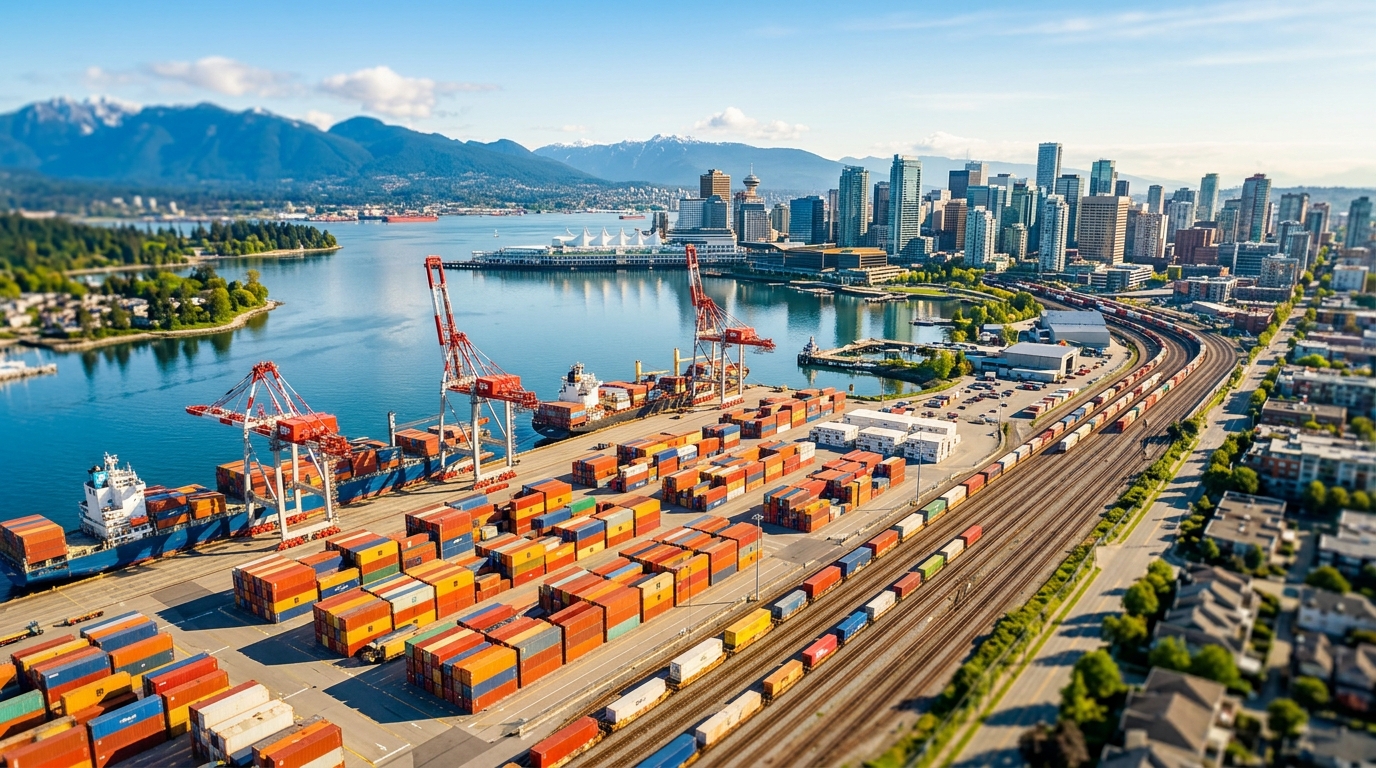
For those who spent 2022 and 2023 watching containers sit idle at Deltaport, the latest numbers from the Vancouver Fraser Port Authority carry weight. Preliminary Q2 2026 data from the port authority’s July performance update shows container dwell times at both Deltaport and Centerm terminals returning to the three-to-four-day benchmark considered normal by the industry—a significant signal that the worst of the post-pandemic supply chain disruption is, operationally, behind us.
At the peak of the congestion crisis in 2022–2023, dwell times at Canada's largest port by tonnage stretched to eight to ten days. For Metro Vancouver's import-dependent retail, food distribution, and light manufacturing sectors, that translated into stockouts and emergency air freight costs. The return to four-day dwell times restores a competitive advantage the BC economy had previously taken for granted.
The Port of Vancouver handles approximately 145 million tonnes of cargo annually, serving as the primary gateway for Western Canada's consumer goods, manufacturing inputs, and agricultural products.
What this means for Vancouver
Supply chain predictability is the foundation of business planning. When dwell times are volatile, operators compensate by holding excess safety stock, tying up working capital. Stable port throughput allows businesses to lean out inventory buffers and plan sourcing cycles with confidence.
For retailers placing Q4 orders—the holiday inventory cycle that typically locks in by August—the timing of this recovery is vital. A port operating at pre-pandemic efficiency means Q4 goods ordered now have a reasonable expectation of arriving on schedule, without the buffer weeks that became standard practice during the congestion years.
The Retail Council of Canada's BC chapter has identified port predictability as a top operational concern for its members, particularly mid-market retailers. A normalized port environment reduces one of the most significant variables those operators face heading into the year's most critical trading period.
The one constraint that remains
The recovery story is more complex for goods moving beyond the Lower Mainland. Rail capacity between the coast and the Prairies remains an unresolved bottleneck. Even with containers moving efficiently through terminal gates, goods destined for the interior face a network that has not fully recovered to 2019 throughput baselines. CN Rail and CPKC are running divergent expansion timelines through the Fraser Canyon, and neither carrier has committed to a date by which combined capacity will match pre-pandemic levels on the most constrained segments.
The practical implication: goods destined for distribution centres in Alberta and Saskatchewan face a different risk profile than goods staying in the Lower Mainland. The Canadian International Freight Forwarders Association has noted that dwell time improvements at the terminal do not equate to end-to-end supply chain reliability when rail slots are constrained. Freight forwarders are advising clients with Prairie distribution networks to build additional transit-time buffers into Q4 timelines.
The longer horizon: Roberts Bank Terminal 2
For operators looking further ahead, the Roberts Bank Terminal 2 expansion has its federal environmental certificate in place, with a first-berth target of 2030. While this project will add necessary capacity for long-run volume growth, the 2030 timeline does not address immediate rail constraints.
The bottom line
If you run a retail, food distribution, or manufacturing operation that sources through Vancouver, the port is functioning efficiently. You can likely reduce the safety-stock buffers built during the congestion years—provided your goods remain in the Lower Mainland or move by truck.
However, if your supply chain runs east by rail, maintain a conservative approach to Q4 timelines. The terminal is no longer the primary bottleneck; the rail corridor is. Consult with your freight forwarder before August order windows close to confirm rail slot availability for October and November.



