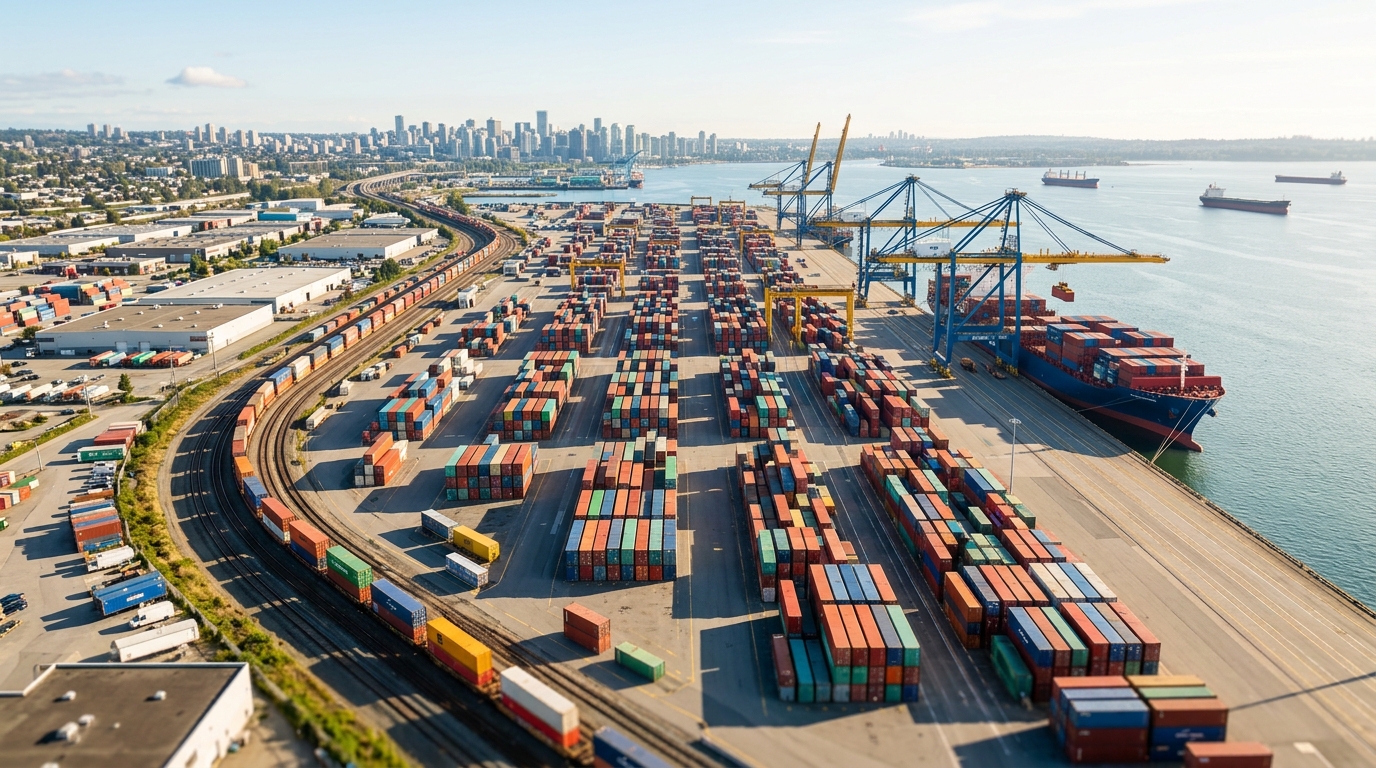
The ongoing trade tensions between the U.S. and China are producing tangible shifts at the waterfront: a measurable change in container routing. Metro Vancouver is well-positioned to capture a significant share of this redirected flow, provided local operators can secure these volumes before competitors in Seattle and Prince Rupert do.
According to Vancouver Fraser Port Authority (VFPA) reporting, the Port of Vancouver handled more than 147 million tonnes of cargo in its most recent full reporting year, cementing its status as Canada's largest port by tonnage. Container volumes at Roberts Bank's Deltaport and the Centerm terminal on Burrard Inlet have historically tracked closely with trans-Pacific trade flows, making the current tariff environment a potential windfall for agile operators.
The mechanics are straightforward. Escalating U.S. duties on Chinese goods are altering landed-cost calculations, prompting importers to reroute shipments away from American West Coast ports. Canadian gateways, where goods can clear Canada Border Services Agency customs, are seeing increased interest from freight forwarders and beneficial cargo owners. While goods of Chinese origin do not typically qualify for CUSMA preferential duties simply by transiting through Canada, importers are increasingly utilizing duty deferral programs and bonded warehousing to manage costs.
The Canadian International Freight Forwarders Association has noted in recent trade policy commentary that Canadian ports hold a structural advantage when U.S. tariff exposure makes direct American entry costly. For Metro Vancouver logistics operators, this translates into a specific set of business opportunities, assuming infrastructure and capacity can meet the demand.
Roberts Bank and the Structural Advantage
Vancouver's geographic and infrastructural position remains a key asset. Roberts Bank Terminal 2, the $3.5-billion expansion project under development by the VFPA, is designed to add a full container berth to BC's most productive marine terminal. Even before that capacity arrives, the existing Deltaport facility is among the most efficient on the Pacific coast, with direct rail connections to CN and CP's transcontinental networks.
That rail link is critical. Containers offloaded at Deltaport can reach Toronto in roughly four to five days via intermodal rail—a competitive transit time that makes Vancouver a viable entry point for goods destined for Central Canadian and northeastern U.S. markets.
Prince Rupert, operated by the Prince Rupert Port Authority, remains Vancouver's primary domestic competitor. While Prince Rupert sits roughly 30 hours closer to Asian ports by sailing time, Vancouver’s larger terminal capacity, deeper warehousing ecosystem, and superior road network into the Lower Mainland provide a distinct edge in volume absorption and distribution.
The Operators Positioning to Win
The routing dividend accrues to the logistics ecosystem surrounding the ports. The businesses best positioned include:
Customs brokers and freight forwarders: These are the first movers. As importers restructure supply chains, demand for Canadian customs expertise is surging. Brokers with established relationships with Asian shippers and the ability to offer end-to-end routing solutions—including bonded warehouse arrangements—are seeing increased inbound inquiries. The CIFFA's Lower Mainland membership includes dozens of firms with this capability.
Industrial warehousing operators: Space in the Delta and Surrey corridors—the arteries connecting Roberts Bank to the distribution network—is at a premium. Recent industrial market data for the South Fraser submarket shows vacancy rates well below five per cent, suggesting that sustained volume increases will likely drive upward pressure on lease rates for large-bay logistics facilities.
Cold-chain and specialized logistics operators: These firms stand to benefit if the routing shift includes temperature-sensitive cargo such as perishables or pharmaceuticals. Vancouver's cold-chain infrastructure is well-connected to the Deltaport complex.
Trucking and drayage companies: Operators managing short-haul routes between Roberts Bank, Centerm, and regional distribution centres will see direct volume increases. Companies that can scale drayage capacity quickly will command a rate premium.
The Competitive Clock
The BC Chamber of Commerce has urged governments to promote Canadian port capacity to Asian shippers. The pitch centres on Canadian tariff structures and competitive transit times. For logistics operators, the opportunity is immediate; the businesses that build relationships with Asian freight forwarders, expand bonded warehouse capacity, and secure long-term drayage contracts will be best positioned as this routing shift stabilizes.



