For years, quantum computing was viewed as a technology perpetually a decade away. That timeline is compressing, and Metro Vancouver is closer to the centre of this shift than many realize.
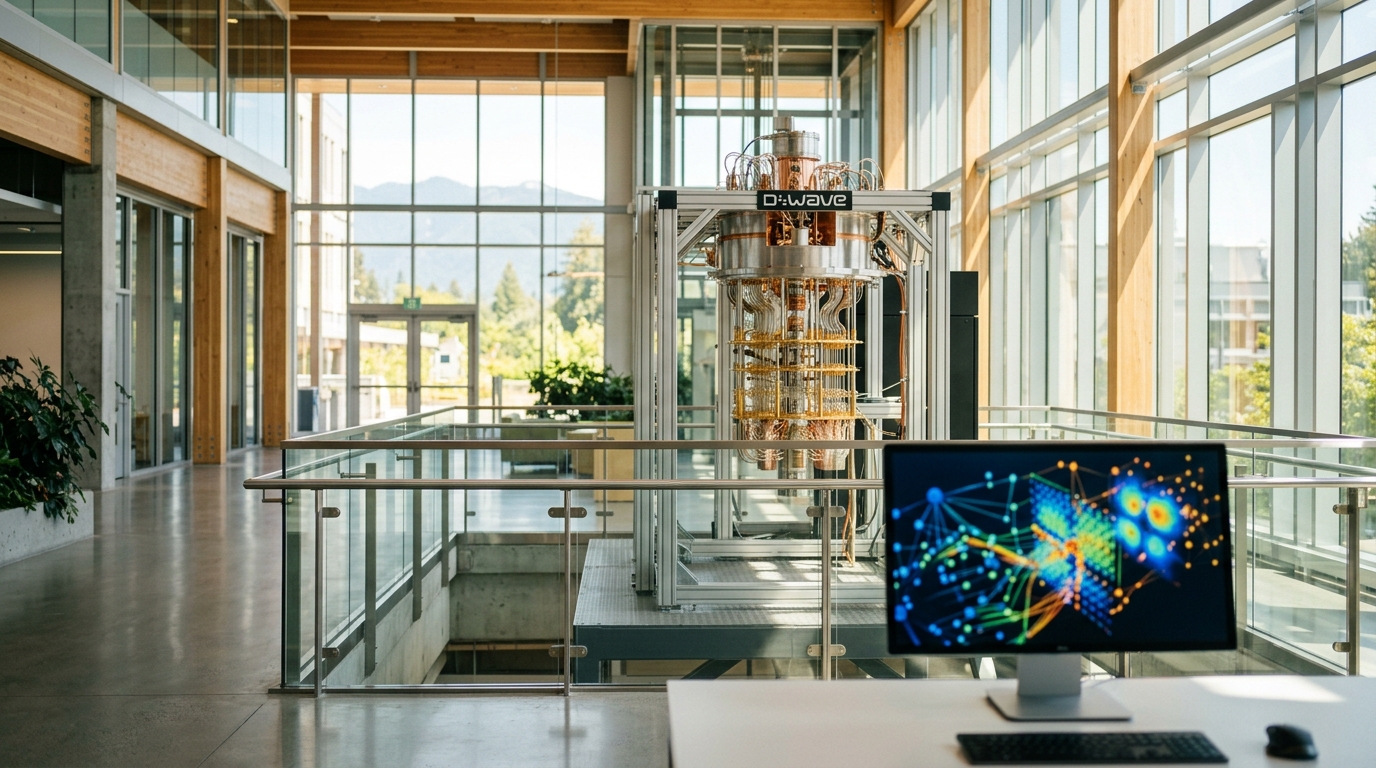
D-Wave Quantum, the Burnaby-based company trading on the NYSE as QBTS, has spent two decades developing quantum annealing systems. This commercial-grade approach to optimization differs from the gate-based quantum computing pursued by firms like IBM and Google. While the industry debates which architecture will prevail, D-Wave has accumulated a roster of paying customers. Public filings show the company serving clients across logistics, financial services, and life sciences—sectors that align with Metro Vancouver’s existing industrial strengths.
Simultaneously, UBC’s Stewart Blusson Quantum Matter Institute is securing a significant share of federal dollars through Canada’s National Quantum Strategy, a $360-million federal initiative designed to accelerate research, talent development, and commercialization. The convergence of a commercially oriented hardware firm and a world-class research institution within the same region creates the structural alignment necessary to foster a robust ecosystem.
Quantum computing is not a single technology with one readiness date. It is a family of approaches, some of which are deployable today for specific problem classes. Optimization tasks—such as scheduling, routing, portfolio balancing, and molecular simulation—are areas where near-term quantum systems demonstrably outperform classical computers. This is the commercial thesis D-Wave has been executing for years.
D-Wave’s disclosures describe a pipeline spanning sectors where British Columbia has concentrated activity. Logistics optimization is a natural fit for a region defined by the Port of Vancouver and dense last-mile delivery networks. Pharmaceutical applications, particularly molecular simulation for drug discovery, align with BC’s growing life sciences cluster. Financial services firms exploring risk modelling represent another near-term use case. The challenge for corporate innovation leads is determining whether their organizations will be among the first to deploy these tools or among the last to adapt.
The federal investment landscape reinforces this urgency. NSERC’s Quantum Alliance program directs research funding toward university-industry partnerships, and UBC’s quantum research community is well-positioned to capture a significant share of this support. With SFU’s physics department also contributing research, Metro Vancouver possesses a dual-campus depth that few Canadian cities can match.
Commercial readiness varies by sector. A logistics company running vehicle routing problems across hundreds of nodes can now access quantum-classical hybrid solvers to achieve measurable performance improvements. Conversely, a pharmaceutical firm simulating protein folding at the scale required for novel drug discovery is waiting on hardware that does not yet exist at the necessary qubit counts and error rates. Investors and procurement leads who conflate these timelines risk moving too early or missing the window entirely.
The Creative Destruction Lab’s quantum stream offers a useful lens on the commercial frontier. CDL’s cohorts have historically skewed toward the software and applications layer—where near-term value capture is most plausible—rather than the hardware layer, where capital requirements are immense and timelines remain uncertain.
For BC’s tech ecosystem, the strategic opportunity lies less in building quantum hardware—a race dominated by well-capitalized global players—and more in developing the applications, integration tools, and domain expertise required for enterprise deployment. A Vancouver firm developing deep expertise in quantum optimization for port logistics is building a defensible position in a niche that is geographically and economically relevant to this region.
The BC Tech Association is mapping the province’s deep-tech stack with increasing granularity. Quantum-adjacent companies, including those working on quantum-safe cryptography—which carries near-term commercial urgency given the threat quantum computers pose to current encryption—are appearing with greater frequency.
Skepticism remains warranted, as the commercial trajectory of quantum computing has been overpromised in the past. D-Wave’s revenue growth reflects an early-stage market, and the $360-million federal envelope is modest compared to the billions deployed by the United States, China, and the European Union. Canada is a credible player, not a dominant one. BC’s advantage is concentration: a hardware company, a research institution, federal funding, and industry verticals that align with near-term use cases, all within a single metro area.
This is not a guarantee of success, but it is the type of structural setup that, five years from now, will likely be viewed as the foundation of a genuine deep-tech cluster. The investors and operators paying attention now will determine which story gets written.